
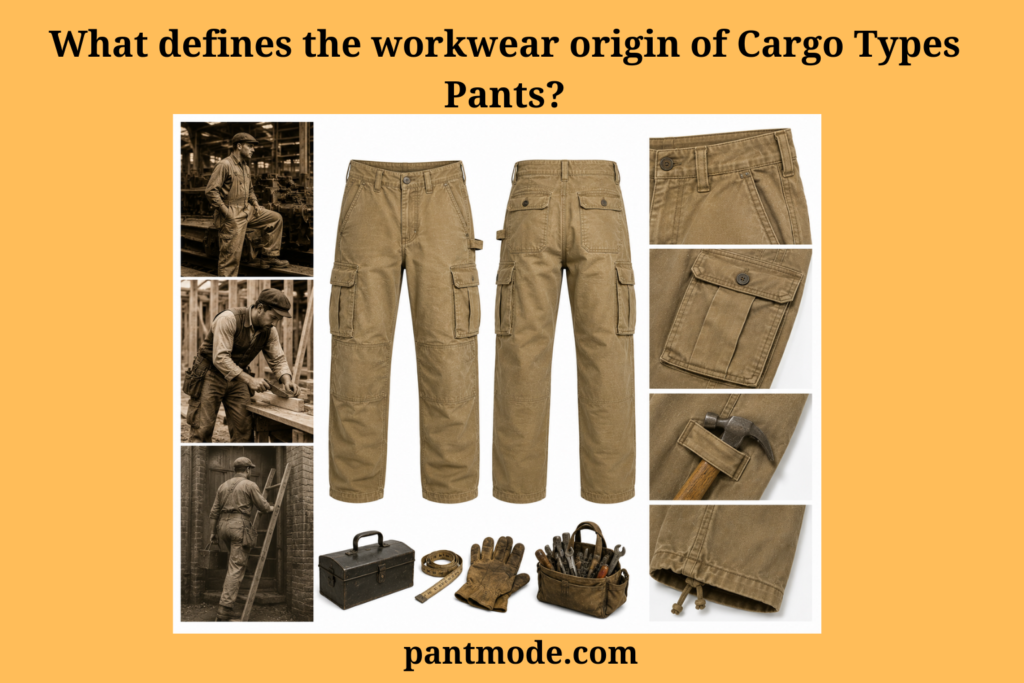
What defines the workwear origin of Cargo Types Pants?
The workwear origin of Cargo Types Pants is defined by the way military utility storage and industrial jobsite durability shaped modern workwear cargo pants.
Workwear cargo pants are not fashion cargos with extra pockets. Their origin is best understood through two connected forces: military storage ancestry and industrial workwear development. This guide covers origin logic, structural features, jobsite workflows, trade-specific fabric and pocket selection, durability failures, safety boundaries, and a final verification checklist. For pocket construction context, compare cargo utility.
Quick Answer: What Defines the Workwear Origin of Cargo Types Pants?
The workwear origin of cargo types pants is defined by the shift from simple utility storage to jobsite-ready construction. Military leg-mounted storage influenced the cargo-pocket idea, while industrial workwear added durable fabrics, reinforced stress points, tool pockets, double-knee panels, gusseted mobility, stable waistbands, and trade-specific layouts for occupational use.
Definition: Workwear Cargo Pants
Workwear cargo pants are occupational utility trousers designed for jobsite use. They combine cargo storage with reinforced seams, bar-tacks, tool pockets, double-knee panels, gusseted movement, stable waistbands, secure closures, and materials selected for the demands of a specific trade or work environment.
Figure: workwear cargo pants should be evaluated as an occupational system, not only as pants with extra pockets.
How Did Military Utility and Industrial Work Shape the Workwear Origin of Cargo Types Pants?
Military utility and industrial work shaped the workwear origin of Cargo Types Pants by combining leg-mounted storage logic with jobsite durability, reinforcement, mobility, and trade-specific tool organization.
Military fieldwear introduced the idea of leg-mounted utility storage. Soldiers needed accessible storage for field items without relying only on jacket or waist pockets. That storage logic later helped workwear cargo pants carry tools, fasteners, gloves, phones, measuring devices, and jobsite accessories.
Industrial workwear supplied the durability layer. Workers needed pants that could handle abrasion, kneeling, tool carry, climbing, bending, and repeated washing. Reinforced knees, bar-tacks, double stitching, tool pockets, and heavier fabrics became workwear priorities.
Jobsite specialization created trade-specific pocket systems. Carpenters, electricians, HVAC workers, mechanics, warehouse workers, and landscapers carry different tools and move differently. Pocket layout, fabric blend, knee reinforcement, and fit should change by trade.
For silhouette choices beyond jobsite utility, compare cargo fit. For non-workwear contrast, see cargo style.
Boundary note: workwear cargo pants should not be reduced to one single origin. They blend military storage ancestry with industrial jobsite construction.
| Origin Force | Utility Need | Design Result | Modern Workwear Meaning | Boundary |
|---|---|---|---|---|
| Military fieldwear | Accessible storage without relying only on jacket or waist pockets | Leg pockets became associated with storage and mobility | Cargo pockets support tools, fasteners, gloves, phones, and measuring devices | British Battle Dress is an ancestor, not a modern workwear cargo pant |
| Industrial workwear | Abrasion, kneeling, tool carry, climbing, bending, washing | Reinforced knees, bar-tacks, double stitching, tool pockets, heavy fabrics | True workwear cargos are judged by construction performance | Industrial workwear matters as much as military utility |
| Jobsite specialization | Different tools and movement patterns by trade | Pocket layouts, fabric blends, knee reinforcement, and fit choices vary | The right pair depends on job, hazard, climate, tool load, and movement | One cargo pant cannot serve every trade equally |
What Structural Features Define Durable Workwear Cargo Pants?
Durable workwear cargo pants are defined by reinforced pockets, bar-tack stitching, double-knee panels, gusseted mobility, reinforced seams, tool pockets, stable waistbands, secure closures, and trade-ready fabric.
Bellows cargo pockets support expandable storage. Pleated sides and reinforced corners allow the pocket to carry fasteners or compact tools. Weak corners create pocket blowouts.
Bar-tack stitching protects stress points. Dense rectangular stitches should appear at pocket corners, belt loops, and tool-loop points. Missing bar-tacks increase tearing risk.
Double-knee panels protect kneeling zones. Extra fabric layers slow knee abrasion and may support knee-pad openings. They do not replace proper knee protection where required.
Gusseted crotches support squatting and climbing. A diamond insert reduces seam strain. Poor rise or stiff fabric can still restrict movement.
Reinforced seams and wide belt loops stabilize the garment. Double or triple stitching, reinforced oversized loops, and secure closures help work pants survive repeated tool carry and daily movement.
Boundary note: visible cargo pockets do not prove workwear quality. Construction evidence matters.
Workwear Cargo Anatomy Matrix
| Feature | Occupational Benefit | Visual Indicator | Failure Risk |
|---|---|---|---|
| Bellows cargo pockets | Expandable tool and hardware storage | Pleated pocket sides, reinforced corners | Pocket blowouts |
| Bar-tack stitching | Reinforces stress points | Dense rectangular stitches | Torn pocket corners or belt loops |
| Double-knee panels | Protects knees during kneeling work | Extra knee fabric layer | Fast knee abrasion |
| Gusseted crotch | Supports squatting and climbing | Diamond crotch insert | Crotch blowouts |
| Reinforced seams | Improves long-term durability | Double or triple stitching | Seam splitting |
| Tool pockets | Organizes daily tools | Divided utility pockets | Decorative-only storage |
| Utility loop | Carries hammer or tool handle | Loop on side seam or thigh | Weak loop tearing |
| Wide belt loops | Supports work belt | Reinforced oversized loops | Belt-loop failure |
| Secure closures | Keeps pockets closed during movement | Snaps, buttons, industrial hook-and-loop | Snagging or lost items |
| Reinforced back pockets | Holds heavy carried items | Double-layer pocket bag | Wallet/tool wear-through |
How Do Workwear Cargo Pants Improve Jobsite Efficiency?
Workwear cargo pants improve jobsite efficiency by placing tools, fasteners, devices, and protective accessories where workers can access them during movement without overloading the waistband or hands.
Divided thigh pockets support small hand tools. Workers can separate markers, knives, bits, and compact tools so they are easier to find.
Reinforced cargo pockets support gloves, fasteners, phones, and accessories. Secure closures reduce the risk of items falling during movement, but overloaded pockets can distort fit and stress seams.
Hammer loops, ruler pockets, and utility bands support measuring and marking work. Sharp tools still need safe storage and closure to reduce cut, snag, or drop risks.
Double knees and gusseted mobility support repeated work positions. Kneeling, climbing, squatting, and crouching create stress at knees and crotch seams. Reinforcement and mobility construction reduce early failure.
Stable waistbands and wide belt loops support a work belt. Belt loops must be reinforced because loaded belts pull hard during movement.
Boundary note: pants should support workflows but not replace proper tool belts, pouches, knee protection, or required PPE.
Jobsite Function Application Table
| Jobsite Need | Use Feature | Result | Boundary |
|---|---|---|---|
| Switching between small hand tools | Divided thigh pockets or tool pockets | Faster access with less searching | Heavy tools may still need a belt or pouch |
| Carrying fasteners, gloves, or accessories | Reinforced cargo pockets with secure closure | Items stay organized during movement | Overloaded pockets stress seams |
| Measuring and marking work | Ruler pocket, pencil slot, knife pocket | Common tools stay separated | Sharp tools need safe storage |
| Kneeling on hard surfaces | Double knees or knee-pad openings | Better abrasion resistance | Does not replace required knee protection |
| Climbing, squatting, crouching | Gusseted crotch and mobility fit | Less seam strain | Fit must match body and rise |
| Moving through ladders, shelves, or vehicles | Secure closures and low-snag pockets | Lower catch and drop risk | Avoid loose straps around equipment |
| Wearing a work belt | Stable waistband and wide belt loops | Better support under movement | Belt loops must be reinforced |
| Repeated washing and daily wear | Durable fabric and reinforced seams | Longer service life | Care method affects shrinkage and wear |
Figure: trade selection should start with abrasion, tool load, kneeling, movement, and hazard exposure.
Which Workwear Cargo Pants Should You Choose for Different Trades?
The right workwear cargo pants depend on the trade’s abrasion level, tool load, movement pattern, climate, hazard exposure, and required safety standards.
Carpentry needs durable fabric and organized tool access. Heavy cotton duck, canvas, or durable stretch blends can work with double knees, ruler pockets, hammer loops, and reinforced cargo pockets. Knee protection and tool safety matter more than pocket count.
Electrical work needs flexibility and safety-aware material selection. Durable low-snag pockets can support testers, small tools, and markers, but arc-related clothing and PPE rules must follow the actual hazard assessment.
HVAC, plumbing, and mechanics need abrasion resistance plus movement. Gusseted crotches, divided thigh pockets, secure closures, reinforced knees, and low-snag layouts help workers climb, crouch, kneel, and move around equipment.
Landscaping, warehouse, and delivery work need climate and movement awareness. Breathable abrasion-resistant fabric, low-bulk pockets, secure phone or scanner storage, and a comfortable rise reduce snagging and sitting discomfort.
Welding or hot work needs PPE boundaries first. Generic cotton duck is not automatically safe. Follow employer rules, hazard assessment, jobsite standards, and flame-resistant garments where required. OSHA notes cotton or wool may be acceptable only under appropriate exposure conditions and may still ignite under certain heat or arc conditions.
For fabric basics beyond workwear, compare cut and fabric. For broader alternatives, see non-denim.
Safety boundary: cargo pants do not replace PPE, FR garments, arc-rated clothing, welding protection, or employer-required safety systems.
Trade-to-Fabric Decision Matrix
| Trade / Use Case | Fabric / Construction Priority | Pocket Priority | Safety Boundary |
|---|---|---|---|
| Carpentry | Heavy cotton duck, canvas, or durable stretch blend with double knees | Tool pockets, ruler pocket, hammer loop, reinforced cargo pockets | Knee protection and tool safety matter more than pocket count |
| Electrical | Durable flexible fabric with low-snag design | Secure pockets for testers, small tools, markers | Follow electrical PPE and arc-related clothing requirements |
| HVAC | Abrasion-resistant fabric with stretch and gusseted mobility | Divided thigh pockets, secure closures, phone/radio pocket | Avoid loose snag-prone straps near equipment |
| Plumbing | Double knees, water-tolerant or quick-drying blends, gusseted crotch | Secure utility pockets and reinforced back pockets | Knee protection and drying behavior matter |
| Landscaping | Ripstop, canvas, or abrasion-resistant fabric with breathable fit | Cargo pockets for gloves, small tools, accessories | Consider heat, moisture, abrasion exposure |
| Welding / hot work | Appropriate FR garments and PPE where required | Low-snag pockets with secure closures | Generic cotton duck is not automatically safe |
| Warehouse | Flexible fabric, reinforced seams, stable waistband | Low-bulk pockets, secure phone/scanner pocket | Avoid snagging on shelving or machinery |
| Delivery / driving | Stretch fabric, comfortable rise, secure closures | Phone, wallet, route device, small cargo pockets | Avoid bulky back pockets that affect sitting |
| Mechanics | Abrasion-resistant fabric, reinforced knees, gusseted mobility | Tool pockets, secure closures, reinforced thigh pockets | Avoid hardware or loops that scratch surfaces |
| General construction | Heavy-duty fabric, double knees, bar-tacks, reinforced seams | Balanced cargo storage and tool loops | Match PPE to actual site hazards |
What Durability and Safety Failures Should You Avoid in Workwear Cargo Pants?
The main failures to avoid in workwear cargo pants are weak pocket stitching, decorative tool pockets, fast knee abrasion, crotch blowouts, unsafe fabric assumptions, poor mobility, weak belt loops, and snag-prone closures.
Pocket blowouts come from weak corners. Pull gently at pocket corners and inspect stitch density. Bar-tacks or reinforcement should protect high-tension pocket zones.
Decorative tool pockets fail when they are shallow or thin. A tool pocket should actually hold the tool without tilting out or tearing the bag.
Knee abrasion and crotch blowouts reveal poor construction. Double knees, knee-pad compatibility, gussets, reinforced rise seams, and mobility fit reduce early failure.
Unsafe hot-work assumptions create safety risk. Heavy cotton is not automatically PPE. Check hazard exposure, garment rating, employer rules, and jobsite standards before welding, flame, spark, or arc exposure.
Snagging closures and weak belt loops reduce productivity and safety. Loose straps, exposed hardware, weak flaps, and narrow loops can catch, tear, or drop items around equipment.
Boundary note: workwear failure is a safety and productivity issue, not only a style problem.
Durability Failure Diagnostic Table
| Failure | Root Cause | Field Test | Fix |
|---|---|---|---|
| Pocket blowouts | No bar-tacks or weak pocket corners | Pull gently at pocket corners and inspect stitching density | Choose reinforced pockets with bar-tacks |
| Decorative tool pockets | Thin pocket bags or shallow divisions | Check whether tools fit securely without tilting out | Choose divided, reinforced utility pockets |
| Fast knee abrasion | No double-knee layer or weak fabric | Bend and inspect knee fabric thickness | Choose double knees or knee-pad compatible design |
| Crotch blowouts | No gusset, poor rise, weak seams | Squat and check seam strain | Choose gusseted crotch and reinforced seams |
| Unsafe hot-work fabric assumption | Treating heavy cotton as PPE | Check hazard exposure and garment rating | Use FR/PPE according to jobsite standards |
| Poor mobility | Stiff fabric with no gusset or stretch | Climb, squat, and kneel during fit test | Choose mobility construction |
| Belt-loop failure | Narrow or weak belt loops | Inspect stitching and belt-loop width | Choose wide reinforced loops |
| Snagging closures | Loose straps, exposed hardware, weak flaps | Move around ladders or equipment | Choose secure low-snag closures |
How Can You Verify Authentic Workwear Cargo Pants Before Buying?
You can verify authentic workwear cargo pants by inspecting fabric purpose, pocket construction, stress-point reinforcement, knee protection, mobility design, waistband strength, closure security, safety suitability, and trade fit.
Fabric purpose: ask whether the fabric is chosen for abrasion, movement, climate, or safety. The pass standard is fabric that matches the job, not only the look.
Pocket construction: ask whether cargo pockets are reinforced and usable. The pass standard is pockets that hold tools or accessories without sagging.
Stress points: ask whether pocket corners, belt loops, and seams are bar-tacked or reinforced. The pass standard is dense stitching in high-tension areas.
Knee protection: ask whether knees are reinforced or knee-pad compatible. The pass standard is protection that matches kneeling frequency and jobsite requirements.
Mobility design: ask whether the pants include a gusset, stretch, or movement-friendly fit. The pass standard is squatting and climbing without seam strain.
Safety suitability: ask whether the pant matches PPE, FR, or hazard requirements where needed. The pass standard is safety verification before use.
For casual-workwear overlap, compare casual pants. For taxonomy placement, see all pant types.
Boundary note: “workwear-inspired” is not the same as jobsite-ready.
Authentic Workwear Verification Checklist
| Verification Point | What to Check | Pass Standard |
|---|---|---|
| Fabric purpose | Is the fabric chosen for abrasion, movement, climate, or safety? | Fabric matches the job, not just the look |
| Pocket construction | Are cargo pockets reinforced and usable? | Pockets hold tools or accessories without sagging |
| Stress points | Are pocket corners, belt loops, and seams bar-tacked or reinforced? | High-tension areas show dense stitching |
| Knee protection | Are knees reinforced or knee-pad compatible? | Kneeling zones are protected for the trade |
| Mobility design | Is there a gusset, stretch, or movement-friendly fit? | Squatting and climbing do not strain seams |
| Waist support | Are belt loops wide and reinforced? | Waistband supports a work belt without sagging |
| Closure security | Do pockets close securely without snagging? | Closures protect items and reduce catch risk |
| Safety suitability | Does the pant match PPE, FR, or hazard requirements? | Safety needs are verified before use |
| Trade fit | Does the layout match the actual job? | Pockets, fabric, and fit support daily workflow |
| Long-term durability | Can the pants handle washing, abrasion, and repeated wear? | Construction supports service life |
Key Takeaway
The best workwear cargo pants are not defined by pocket count alone. They should match the job’s abrasion level, tool load, kneeling demands, movement pattern, climate, and safety requirements. For welding, flame, spark, arc, or hot-work hazards, generic cotton duck is not enough by itself; use proper PPE, flame-resistant garments where required, and employer or jobsite safety standards.
Frequently Asked Questions
The workwear origin of Cargo Types Pants is defined by the shift from simple utility storage to jobsite-ready construction, combining military utility storage with industrial workwear durability.
Fashion cargo pants are not jobsite-ready unless their fabric, seams, pockets, knees, waistband, closures, and mobility features can handle occupational stress.
No. Workwear cargo pants can support jobsite workflows, but they do not replace required PPE, flame-resistant garments, knee protection, or employer-required safety systems.
Workwear-ready cargo pants use reinforced pockets, bar-tack stitching, double knees, gusseted mobility, reinforced seams, tool pockets, stable waistbands, secure closures, and trade-ready fabric.
Check fabric purpose, pocket construction, stress-point reinforcement, knee protection, mobility design, waistband strength, closure security, safety suitability, trade fit, and long-term durability.
Conclusion
The workwear origin of Cargo Types Pants is best understood through the connection between military utility storage, industrial reinforcement, trade-specific pockets, mobility construction, and safety-aware fabric selection.
Workwear cargo pants combine utility storage with occupational durability.
Durable fabric, bar-tacks, double knees, gussets, secure pockets, wide belt loops, and reinforced seams matter more than fashion pocket count.
Trade and hazard level should determine fabric, pocket layout, PPE compatibility, and fit.
Choose workwear cargo pants by testing fabric purpose, pocket reinforcement, knee protection, movement, waistband support, safety suitability, and trade fit before buying.