
What Traditional Features Define Sirwal Pant Types?
Sirwal Pant Types are traditionally defined by construction, length, crotch volume, ankle shape, waistband style, fabric, decoration, gendered use, and regional context.
Sirwal belongs to a wider family of related loose traditional trousers across Arab, Persian, Central Asian, Ottoman-influenced, North African, and South Asian clothing traditions.
This article classifies Sirwal by repeated garment signals, not by one fixed appearance. It helps readers identify Sirwal Pant Types by construction, length, ankle shape, waistband, fabric, decoration, gendered use, and region. For the wider historical frame, compare Sirwal origin.
Quick Answer
Sirwal Pant Types are traditional loose trouser categories defined by construction, length, crotch volume, ankle shape, waistband style, fabric, decoration, gendered use, and regional context. They belong to a wider family of related trousers across Arab, Persian, Central Asian, Ottoman-influenced, North African, and South Asian dress traditions.
Definition
Sirwal Pant Types are categories of traditional loose trousers usually recognized by a roomy upper leg, practical waistband, and controlled lower leg. They may be tapered, gathered, cuffed, decorated, short, long, plain, embroidered, underlayered, or regionally named depending on cultural context.
Key Takeaway
The safest way to classify Sirwal Pant Types is to check construction first, then length, ankle shape, waistband, fabric, decoration, region, gendered use, and terminology. Sirwal, shalwar, salwar, sarouel, seroual, and şalvar may overlap, but they should not be used as identical labels.
External sources: This guide uses Zay source for traditional UAE Sirwal construction and terminology, and Met source for Ottoman şalvar comparison.
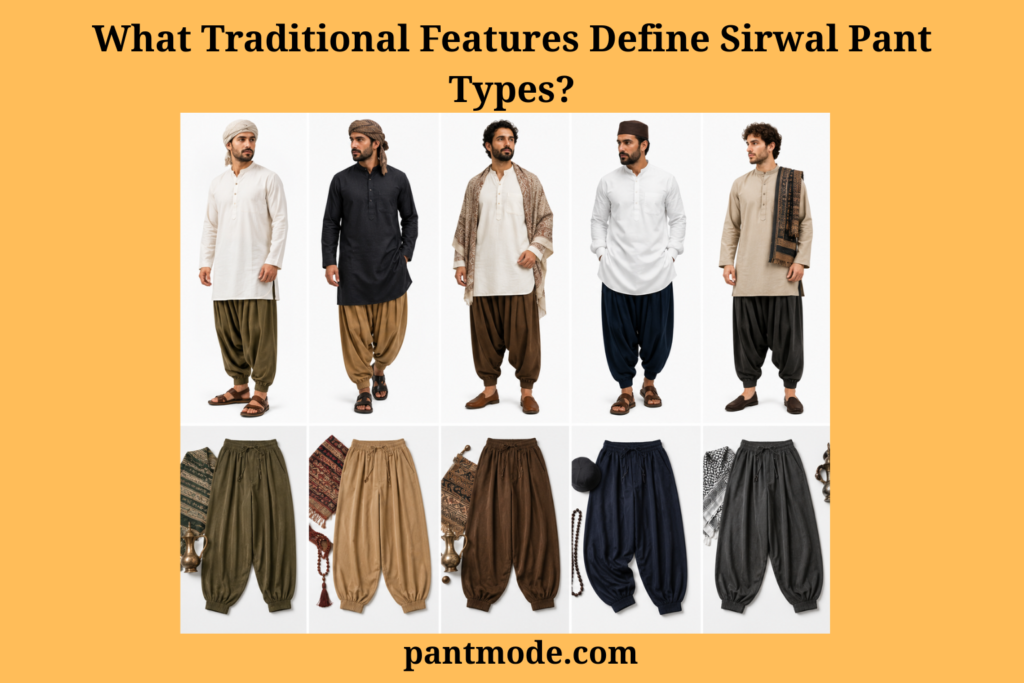
Figure: Sirwal Pant Types are classified by repeated garment signals, not by one fixed silhouette.
What Are Sirwal Pant Types in Traditional Clothing?
Sirwal Pant Types are traditional loose trouser categories identified by construction, length, ankle treatment, waistband style, fabric, decoration, region, and use.
Sirwal Pant Types are categories of loose traditional trousers. Classification depends on repeated garment signals rather than one universal pattern.
Sirwal belongs to a wider traditional trouser family. Related forms appear in Middle Eastern, Persian, Central Asian, Ottoman-influenced, North African, and South Asian dress contexts.
The article boundary is traditional taxonomy. Generic modern joggers, costume harem pants, and unrelated Western trousers should not be used as Sirwal examples.
Related terms may overlap without being identical. Sirwal, shalwar, salwar, sarouel, seroual, and şalvar need cultural and construction context. For traditional role, see cultural history.
Sirwal Pant Types Definition Box
| Item | Traditional Definition |
|---|---|
| Main garment family | Loose traditional trousers with regional variations |
| Core structure | Roomy upper leg, practical waist, and controlled lower leg |
| Classification factors | Construction, length, ankle shape, region, gender use, fabric, decoration |
| Waist systems | Drawstring, gathered waistband, folded waist, pleats, or later closures |
| Ankle systems | Tapered, gathered, cuffed, embroidered, narrow, or open depending on region |
| Article boundary | Traditional trouser taxonomy, not modern joggers or generic harem pants |
| Correct interpretation | A family of related garments, not one fixed style |
Why Do Sirwal Pant Types Depend on Construction Rather Than One Fixed Style?
Sirwal Pant Types depend on construction rather than one fixed style because regional forms vary by cut, volume, waistband, crotch structure, ankle finish, fabric, and cultural context.
The main classification rule is construction first. Check cut, upper volume, waistband, crotch structure, ankle finish, fabric, and cultural context before choosing the name.
Different regions use related names and related shapes. One name can describe several traditional trouser forms, including long drawstring Sirwal, short underlayer Sirwal, and embroidered ankle Sirwal.
Traditional definitions rely on repeated design signals. A modern elastic drop-crotch pant may resemble Sirwal visually, but it is better called harem pants, drop-crotch pants, or Sirwal-inspired pants if it lacks traditional context.
Sirwal Pant Types Taxonomy Table
| Classification Lens | Sirwal Type Category | What to Check | Why It Matters |
|---|---|---|---|
| Construction | Loose, gusseted, tapered, gathered | Seat volume, crotch structure, ankle control | Confirms traditional trouser logic |
| Length | Short, calf-length, ankle-length | Hem position and garment function | Separates underlayer, visible, and full-length forms |
| Ankle shape | Tapered, gathered, cuffed, decorated, open | Lower-leg finishing | Helps identify regional form |
| Waistband | Drawstring, gathered, pleated, modern closure | Fastening system | Shows traditional or modern adaptation |
| Region | Gulf, Levant, Ottoman, South Asian, North African | Cultural context and naming | Prevents terminology confusion |
| Gender / use | Men’s, women’s, underlayer, outer trouser, ceremonial | Styling and visibility | Explains decoration and layering |
| Fabric | Cotton, linen, heavier cloth, decorated fabric | Material and use case | Separates everyday, formal, and regional examples |
| Decoration | Plain, embroidered, trimmed, metal-thread, lace/crochet | Lower-leg and cuff details | Signals craft, gendered use, or regional identity |
What Core Construction Features Define Sirwal Pant Types?
The core construction features that define Sirwal Pant Types are loose upper volume, roomy crotch construction, adjustable waist fastening, controlled ankle shape, and region-specific fabric or decoration.
Loose upper leg or roomy seat supports movement, sitting comfort, and modest coverage. This volume separates traditional Sirwal logic from flatter Western trouser blocks.
Drawstring or gathered waistband allows adjustable fit and practical fastening. Tapered, gathered, cuffed, or narrowed ankles control loose fabric volume.
Gusseted or dropped crotch construction creates the roomy traditional shape. Fabric and decoration reflect region, gender use, occasion, and craftsmanship.
Figure: construction clues include upper volume, gusset space, waist fastening, and ankle finish.
Sirwal Pant Types Construction Anatomy Table
| Construction Feature | Function | Recognition Clue | Classification Value |
|---|---|---|---|
| Loose upper leg | Movement and modest coverage | Room around thigh and seat | Core Sirwal signal |
| Roomy crotch | Sitting, kneeling, and mobility | Low crotch or gusset panel | Separates Sirwal from flat trousers |
| Crotch gusset | Extra movement | Diamond or inserted panel | Traditional construction clue |
| Drawstring waist | Adjustable fit | Tie cord or waist channel | Common traditional closure |
| Gathered waist | Controls upper fabric volume | Fabric gathered into waistband | Shows loose-trouser structure |
| Tapered ankle | Controls lower fabric | Narrowing below calf | Classic Sirwal finish |
| Cuffed ankle | Structure or decoration | Cuff or band at lower leg | Regional or decorative clue |
| Embroidered lower leg | Craft and identity | Decorative calf or ankle panel | Often important in women’s forms |
Which Length Categories Shape Sirwal Pant Types?
Length categories shape Sirwal Pant Types by showing whether the garment functions as an underlayer, visible trouser, calf-length style, or full-length ankle-controlled form.
Long Sirwal reaches the ankle or lower leg. It may function as outerwear, underlayer, or daily wear depending on region.
Short Sirwal may function as an undergarment, modesty layer, or region-specific lower garment. Mid-calf Sirwal can appear where decorated cuffs, lower-leg panels, or visible ankle areas matter.
Ankle-length Sirwal often gives the clearest recognizable silhouette. Length should always be interpreted with cultural context, garment function, and ankle treatment.
Sirwal Pant Types Length and Ankle-Shape Matrix
| Length Category | Common Ankle Shape | Traditional Use | Recognition Clue | Watch-Out |
|---|---|---|---|---|
| Short Sirwal | Open, gathered, or narrow | Undergarment or modesty layer in some contexts | Ends above lower leg | Do not assume all short forms are outerwear |
| Mid-calf Sirwal | Cuffed, decorated, or narrow | Visible lower-leg styling | Decoration may appear near calf | Needs regional context |
| Ankle-length Sirwal | Tapered, gathered, or cuffed | Daily wear, underlayer, or outer trouser | Controlled ankle volume | Do not confuse with standard trousers |
| Long loose Sirwal | Narrowed or gathered ankle | Traditional loose trouser form | Roomy seat with controlled lower leg | Avoid calling all loose pants Sirwal |
| Related open-hem forms | Less tapered or open | May belong to related trouser traditions | Wider hem | Name carefully by region |
How Do Ankle Shapes Define Sirwal Pant Types?
Ankle shapes define Sirwal Pant Types by showing how each trouser controls lower-leg volume, displays decoration, or separates a traditional Sirwal form from a related loose trouser.
Tapered ankles create a clean lower leg with controlled fabric volume. Gathered ankles create a puffed or balloon-like lower silhouette.
Cuffed ankles create a stronger finish at the lower leg. Decorated ankles or lower-leg panels can show embroidery, trim, lace, crochet, or ornamental cuff detail.
Open or less-tapered hems may appear in related trouser traditions. These forms should be named carefully by region and context.
Figure: ankle treatment helps separate Sirwal type categories visually and functionally.
Sirwal Pant Types Ankle-Shape Decision Matrix
| Ankle Shape | Visual Effect | Traditional Function | Most Accurate Description |
|---|---|---|---|
| Tapered ankle | Clean and controlled | Prevents fabric from dragging | Classic Sirwal-style lower leg |
| Gathered ankle | Puffed or rounded | Holds loose volume at the foot | Gathered Sirwal or related loose trouser |
| Cuffed ankle | Structured finish | Adds durability or decoration | Cuffed Sirwal type |
| Embroidered ankle | Decorative focus | Shows craft and regional identity | Decorated Sirwal, often region-specific |
| Narrow lower leg | Slim lower profile | Works under robes or dresses | Narrow-leg Sirwal form |
| Open hem | Less controlled lower leg | May belong to related trousers | Use regional term carefully |
Which Regional Forms Explain Sirwal Pant Types?
Regional forms explain Sirwal Pant Types because related loose-trouser traditions changed by culture, naming system, garment pairing, fabric, and lower-leg treatment.
Gulf and Arab Sirwal forms often emphasize modest coverage, ankle finishing, drawstring waist, and use under robes or dresses. Levantine sherwal forms may show a very roomy seat, wide upper volume, and narrowed ankle.
Ottoman şalvar-related forms are fuller, gathered, and connected to Turkish, Balkan, or Ottoman-influenced dress. South Asian shalwar and salwar forms share related loose trouser logic but remain culturally distinct.
North African sarouel and seroual forms overlap in loose-trouser shape and naming variants. For regional context, see regions.
Regional Sirwal Pant Types Comparison Table
| Region / Tradition | Related Type Name | Key Shape Signal | Cultural Context | Naming Caution |
|---|---|---|---|---|
| Gulf / Arab | Sirwal | Drawstring, tapered ankle, modest coverage | Under robes, dresses, or traditional garments | Do not call all loose pants Arab Sirwal |
| Levant | Sherwal / Sirwal-related | Very roomy seat, narrow lower leg | Rural and regional dress | Shape can be more visibly baggy |
| Ottoman / Turkish | Şalvar | Wide gathered silhouette | Ottoman, Turkish, Balkan influence | Use şalvar when context is specific |
| South Asian | Salwar / shalwar | Loose trousers with tunic pairing | Salwar-kameez, kurta systems | Not always best called Sirwal |
| North African | Sarouel / seroual | Loose or low-crotch trouser | Maghreb or French-linked naming | Regional context decides term |
| Modern fashion | Harem pants | Exaggerated drop crotch | Fashion reinterpretation | Not automatically traditional Sirwal |
How Do Men’s and Women’s Uses Affect Sirwal Pant Types?
Men’s and women’s uses affect Sirwal Pant Types by changing whether the garment appears as an outer trouser, underlayer, modesty garment, decorated lower-leg form, or ceremonial textile.
Men’s Sirwal types may function as outer trousers, undergarments, modesty layers, or traditional daily garments depending on region. Function may matter more than decoration in plain daily forms.
Women’s Sirwal types may be worn under dresses, robes, or tunics. Visible decorated cuffs can include embroidery, trim, lace, crochet, or metal-thread work.
Layered Sirwal forms may be partly hidden under outer garments. Gender use should be described carefully because Sirwal appears in both men’s and women’s clothing traditions. See women’s Sirwal.
Men’s vs Women’s Sirwal Pant Types Table
| Wearer / Use Context | Common Design Difference | Visibility | Classification Note |
|---|---|---|---|
| Men’s daily Sirwal | Practical loose trouser shape | Visible or underlayer | Region decides exact term |
| Men’s modesty layer | Simple fabric and drawstring | Often hidden | Function may matter more than decoration |
| Women’s under-dress Sirwal | Narrow lower leg, cuff, or decoration | Lower leg may show | Decoration can be important |
| Women’s decorated Sirwal | Embroidery, trim, lace, or metal-thread | Often visible near ankle | Strong craft signal |
| Ceremonial or formal use | Richer fabric or ornament | Visible detail | Use region-specific description |
| Modern adaptation | Elastic or simplified construction | Fully visible | May be Sirwal-inspired, not traditional |
What Fabric and Decoration Patterns Define Sirwal Pant Types?
Fabric and decoration patterns define Sirwal Pant Types by showing whether the garment is everyday, lightweight, structured, decorative, ceremonial, plain, or regionally ornamented.
Cotton and linen support everyday comfort, breathability, washing, and underlayer use. Heavier fabrics create more structure for rural, winter, or formal examples.
Embroidery and trim add visible ornament near cuffs or lower-leg panels. Metal-thread decoration adds formal shine and craft value.
Plain Sirwal is defined mainly by cut, waistband, ankle, and use. Ornate Sirwal is defined by both construction and decoration.
Sirwal Pant Types Fabric and Decoration Table
| Fabric / Decoration | Practical Role | Type Signal | Best Description |
|---|---|---|---|
| Plain cotton | Everyday wear and washing | Practical Sirwal | Everyday traditional Sirwal |
| Linen / light fabric | Breathability and comfort | Warm-climate Sirwal | Lightweight Sirwal type |
| Heavier cloth | Structure and durability | Rural or winter form | Heavy traditional Sirwal |
| Lined fabric | More body and formality | Formal or structured use | Lined Sirwal type |
| Embroidered cuffs | Visible ornament | Regional or women’s form | Decorated Sirwal |
| Lace / crochet / trim | Craft detail | Decorative lower-leg type | Ornamented Sirwal |
| Metal-thread work | Formal or status signal | Ceremonial type | Embellished Sirwal |
| Plain drawstring waist | Adjustable function | Traditional practical closure | Drawstring Sirwal |
How Does Waistband Construction Shape Sirwal Pant Types?
Waistband construction shapes Sirwal Pant Types by showing whether the trouser uses traditional adjustable fastening, gathered volume control, pleated structure, or later modernized closure systems.
A drawstring waistband allows adjustable fit without modern tailoring. A gathered waistband controls large fabric volume around the body.
A pleated waistband folds excess fabric into a more structured waist. A folded waistband creates a simple traditional waist finish.
Hook, button, or zipper closures usually show modernization or influence from European-style clothing. Elastic can also indicate later adaptation.
Sirwal Pant Types Waistband Construction Table
| Waistband Type | Function | Identification Clue | Classification Meaning |
|---|---|---|---|
| Drawstring | Adjustable traditional fit | Cord or tie | Strong traditional Sirwal signal |
| Gathered waist | Controls loose fabric | Bunched fabric at waist | Common loose-trouser construction |
| Pleated waist | Structures fabric volume | Folded pleats | More tailored regional or modernized form |
| Folded waist | Simple traditional fastening | Fold-over waistband | Practical traditional closure |
| Elastic waist | Easy modern fit | Stretch waistband | May indicate modern adaptation |
| Hook / button / zipper | Tailored fastening | Modern closure | Possible modernization or Western influence |
How Do Sirwal Pant Types Differ From Shalwar, Salwar, Sarouel, Şalvar, and Harem Pants?
Sirwal Pant Types differ from shalwar, salwar, sarouel, şalvar, and harem pants because each term carries a different cultural, linguistic, regional, or fashion context.
Sirwal commonly refers to loose traditional trousers in Arabic, Middle Eastern, Gulf, and Islamic dress contexts. Shalwar and salwar share linguistic and design connections but often carry Persian, Central Asian, and South Asian associations.
Sarouel and seroual often appear in North African, French-linked, or fashion naming contexts. Ottoman şalvar refers more specifically to Turkish, Ottoman, Balkan, or Anatolian clothing contexts.
Harem pants are broad modern Western fashion labels. They are not always culturally or historically precise. For modern reinterpretations, see modern variations.
Figure: correct naming prevents confusion between Sirwal, shalwar, salwar, sarouel, şalvar, and harem pants.
Sirwal Pant Types vs Related Trousers Matrix
| Term | Shared Feature | Key Difference | Use This Term When |
|---|---|---|---|
| Sirwal | Loose trouser, often ankle-controlled | Arabic / Middle Eastern / Gulf context | Discussing Arab, Gulf, or Islamic traditional trousers |
| Shalwar | Loose trouser family | Persian / Central Asian linguistic association | Discussing Persian or related trouser roots |
| Salwar | Loose trouser worn with upper garment systems | South Asian clothing context | Discussing salwar-kameez or South Asian clothing |
| Şalvar | Wide gathered trouser | Turkish / Ottoman / Balkan association | Discussing Ottoman or Turkish traditional trousers |
| Sarouel / seroual | Loose or low-crotch trouser | North African or French-linked naming | Discussing Maghreb or fashion naming variants |
| Harem pants | Loose or drop-crotch style | Broad modern fashion label | Discussing modern fashion or costume reinterpretations |
| Modern drop-crotch pants | Low-crotch fashion silhouette | Lacks cultural specificity | Discussing contemporary fashion trousers |
What Mistakes Weaken Sirwal Pant Types Classification?
The mistakes that weaken Sirwal Pant Types classification come from naming every loose trouser Sirwal, ignoring regional context, and confusing traditional garments with modern fashion labels.
Calling every loose drop-crotch pant Sirwal erases regional and cultural specificity. Check region and traditional use before naming the garment.
Treating Sirwal as only Arab oversimplifies the wider context. Persian, Central Asian, Islamic, Ottoman, South Asian, and North African connections should not be ignored.
Treating Sirwal and harem pants as identical confuses traditional naming with modern Western fashion labels. Ignoring women’s Sirwal forms also misses decorated, layered, and regionally significant examples.
Sirwal Pant Types Terminology Mistake/Fix Checklist
| Mistake | Risk | Better Fix |
|---|---|---|
| Calling all drop-crotch pants Sirwal | Cultural overgeneralization | Check region and traditional use |
| Saying Sirwal is only Arab | Historical oversimplification | Mention wider Persian, Central Asian, Islamic, Ottoman, and regional context |
| Equating Sirwal with harem pants | Terminology confusion | Distinguish traditional term from fashion label |
| Ignoring shalwar/salwar links | Missing linguistic and regional context | Compare related terms |
| Ignoring women’s Sirwal | Incomplete taxonomy | Include decorated and layered forms where relevant |
| Claiming one fixed cut | Weak definition | Classify by construction, length, ankle, waist, region, and use |
| Using modern joggers as examples | Entity drift | Label them modern adaptations or unrelated garments |
| Ignoring ankle shape | Poor identification | Check taper, gather, cuff, or decoration |
How Can Readers Identify Sirwal Pant Types From Garment Details?
Readers can identify Sirwal Pant Types from garment details by checking the silhouette, waist, crotch construction, ankle finish, fabric, decoration, region, use case, and related name.
Step one is the upper structure. Check for a loose upper section, roomy seat, or generous crotch volume.
Step two is the construction system. Check for a crotch gusset or dropped construction, then inspect drawstring, gathered, folded, pleated, elastic, button, or zipper waist.
Step three is the lower leg. Check for tapered, gathered, cuffed, embroidered, narrow, or plain lower-leg finish.
Step four is cultural and use context. Check embroidery, trim, cuff decoration, fabric type, region, and whether the garment is outerwear, underlayer, ceremonial, practical, or fashion reinterpretation.
Sirwal Pant Types Step-by-Step Identification Checklist
| Step | What to Check | Classification Result |
|---|---|---|
| 1 | Loose upper section or roomy seat | Confirms loose-trouser family |
| 2 | Crotch gusset or dropped construction | Supports traditional Sirwal logic |
| 3 | Drawstring, gathered, or folded waist | Suggests traditional fastening |
| 4 | Tapered, gathered, or cuffed ankle | Confirms ankle-control pattern |
| 5 | Embroidery, trim, or cuff decoration | May indicate regional or women’s form |
| 6 | Fabric type | Helps separate everyday, formal, or ceremonial use |
| 7 | Regional context | Determines best term |
| 8 | Use case | Separates outerwear, underlayer, or fashion reinterpretation |
| 9 | Related name | Checks Sirwal, shalwar, salwar, şalvar, or sarouel |
| 10 | Modern styling details | Identifies adaptation or harem-pants label |
What Final Checklist Summarizes Sirwal Pant Types?
The final checklist that summarizes Sirwal Pant Types should confirm loose upper structure, ankle control, traditional waist logic, regional context, accurate terminology, and harem-pants distinction.
Loose upper structure confirms traditional loose trouser logic. Controlled ankles help confirm Sirwal or related ankle-controlled trouser categories.
Drawstring, gathering, pleating, or traditional fastening supports traditional classification. Regional context helps choose the correct term.
Accurate terminology prevents careless naming. Modern fashion drop-crotch pants should not automatically be called Sirwal.
Final Sirwal Pant Types Identification Checklist
| Final Check | Pass / Fail |
|---|---|
| Does the garment have a loose upper leg or roomy crotch structure? | |
| Does the ankle narrow, gather, cuff, or carry decoration? | |
| Does the waist use drawstring, gathering, pleating, or traditional fastening logic? | |
| Does the fabric match everyday, formal, regional, or gender-specific use? | |
| Does the garment have regional clues in cut, decoration, naming, or styling? | |
| Does the name match the cultural context? | |
| Does the explanation avoid confusing traditional Sirwal with generic modern harem pants? | |
| Does the classification include length, ankle shape, waist, region, gender/use, fabric, and decoration? | |
| Does the article avoid claiming one single fixed Sirwal design? | |
| Does the article avoid treating Sirwal as only Arab or only modern fashion? | |
| Does the final type classification help readers choose the most accurate garment term? |
Frequently Asked Questions
Sirwal Pant Types are traditional loose trouser categories identified by construction, length, crotch volume, ankle shape, waistband style, fabric, decoration, gendered use, regional context, and terminology.
Sirwal Pant Types are classified by repeated garment signals such as roomy upper structure, crotch volume, drawstring or gathered waist, tapered or cuffed ankle, fabric, decoration, region, and traditional use.
No. Harem pants are a broad modern fashion label, while Sirwal refers to culturally rooted traditional trouser categories with regional construction and terminology.
Yes. Sirwal appears in men’s and women’s clothing traditions, but gendered use differs by region, layering system, decoration, occasion, and visibility.
Sirwal should be compared with shalwar, salwar, sarouel, seroual, Ottoman şalvar, harem pants, and modern drop-crotch trousers because the terms overlap but are not identical.
Conclusion
Sirwal Pant Types are best summarized as a traditional trouser taxonomy based on construction, length, ankle shape, waistband, fabric, decoration, gendered use, and regional context.
Sirwal should be treated as a family of related loose traditional trousers, not one fixed garment. Construction is the strongest classification starting point.
The main classification signals are roomy upper structure, crotch volume, ankle control, waistband style, fabric, decoration, region, and use.
Related terms such as shalwar, salwar, sarouel, seroual, and şalvar should be used carefully.
The most accurate Sirwal classification comes from reading the garment’s construction, region, use, and terminology together.