
What Cultural Roots and Traditional Design Define the Origin of Sirwal Pants?
The origin of Sirwal pants is best explained as the cultural and design history of loose, ankle-controlled traditional trousers shaped by Persian, Central Asian, Middle Eastern, Islamic, Ottoman-influenced, South Asian, Gulf, Levantine, and North African clothing traditions.
Sirwal pants are loose traditional trousers with a roomy upper structure and controlled lower-leg shaping. This article focuses on cultural roots, terminology, regional diffusion, construction, and design recognition.
Sirwal pants should not be treated as modern joggers, costume trousers, generic harem pants, or one fixed Arab-only design. For the basic garment meaning, compare traditional features.
Quick Answer
The origin of Sirwal pants is best understood as a cultural and design history of loose, ankle-controlled trousers linked to Persian and Central Asian trouser traditions and later adapted across Arab, Gulf, Ottoman-influenced, South Asian, and North African clothing systems. Sirwal pants are not one fixed design or a modern harem-pants label.
Definition
Sirwal pants are loose traditional trousers with a roomy upper section and a controlled lower leg, usually narrowed, tapered, gathered, or cuffed near the ankle. Traditional versions often use drawstrings, folded waistbands, crotch gussets, regional fabrics, and lower-leg decoration.
Key Takeaway
The safest way to explain Sirwal pants is as a regional trouser family shaped by cultural diffusion. Their origin is tied to related terms such as shalwar, salwar, şalvar, and sarouel, while their design is recognized through loose upper volume, ankle control, modest coverage, movement ease, and regional detail.
External sources: This guide uses Zay source for UAE Sirwal construction and terminology context, and Met source for Ottoman şalvar comparison.
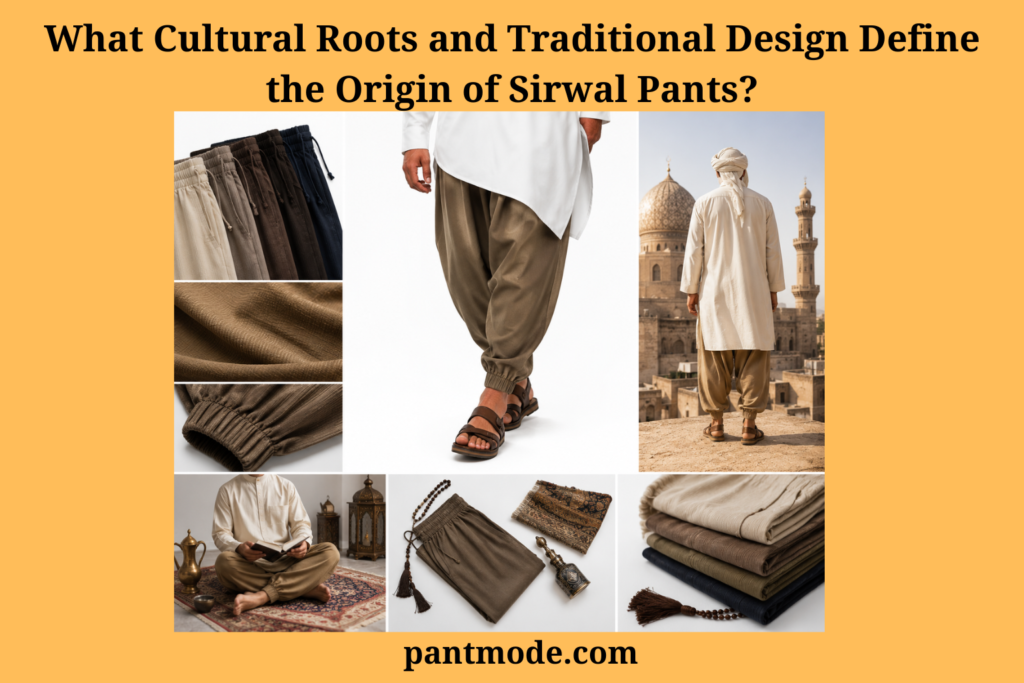
Figure: the origin of Sirwal pants is best framed through cultural diffusion and related regional trouser traditions.
What does the origin of Sirwal pants reveal about their cultural identity?
The origin of Sirwal pants reveals a cultural identity rooted in loose traditional trouser forms shaped by regional movement, modest coverage, practical construction, and cultural diffusion.
Sirwal pants are loose traditional trousers. They are usually roomy through the seat or upper leg and often narrowed, gathered, or controlled near the ankle.
The cultural frame is regional, not single-source. The origin of Sirwal pants connects to broader trouser traditions across Persian, Central Asian, Middle Eastern, Islamic, Ottoman-influenced, South Asian, Gulf, Levantine, and North African clothing cultures.
The main design signals are construction-based. Look for roomy upper legs, practical waist fastening, crotch gusset or dropped-seat construction, tapered lower legs, modest coverage, and regional decoration. For cultural meaning, compare cultural history.
Short Definition Box for Sirwal Pants
| Term | Short Definition |
|---|---|
| Sirwal pants | Loose traditional trousers with a roomy upper section and controlled ankle shape |
| Main design logic | Movement, modest coverage, seated comfort, and fabric control |
| Common closure | Drawstring, folded waistband, or region-specific fastening |
| Lower-leg detail | Tapered ankle, gathered cuff, narrow leg, embroidery, trim, or decorated cuff |
| Best explanation | A regional trouser family shaped by Persian, Central Asian, Arab, Ottoman-influenced, South Asian, and North African dress traditions |
| Not the same as | Generic modern joggers, costume harem pants, or one fixed Arab-only design |
Why is the origin of Sirwal pants linked to Persian and Central Asian trouser traditions?
The origin of Sirwal pants is linked to Persian and Central Asian trouser traditions because the terminology and design logic connect Sirwal with shalwār, shalwar, salwar, and other related loose trouser forms.
The word Sirwal is often connected to Persian shalwār and related trouser terms. This connection reflects a wider family of related trouser words rather than one isolated modern fashion label.
Sirwal-style trousers are commonly associated with Persian and Central Asian clothing roots. Careful wording matters because the garment should not be described as the invention of one person or one exact birthplace.
The shape made practical sense across mobile and seated dress cultures. The roomy seat, loose upper leg, and ankle control support walking, sitting, riding, kneeling, and modest coverage.
Regional cultures changed the details. Fabric, ankle shape, closure, decoration, and width all vary across local dress systems.
Origin and Terminology Table
| Term | Common Association | Shared Meaning | Important Distinction |
|---|---|---|---|
| Sirwal | Arabic and Middle Eastern dress contexts | Loose trousers with ankle control | Often used in Arab, Gulf, Levantine, and Islamic dress contexts |
| Shalwār / Shalwar | Persian and South/Central Asian roots | Loose trousers | Often linked linguistically to Sirwal |
| Salwar | South Asian clothing traditions | Loose trousers worn with kameez or tunic forms | Cultural pairing and cut may differ from Arab Sirwal |
| Şalvar | Turkish / Ottoman-influenced traditions | Wide or gathered trousers | Associated with Ottoman and Balkan-influenced dress contexts |
| Sarouel / Seroual | French and North African-linked variants | Loose or low-crotch trousers | Often used in North African or Western fashion language |
| Harem pants | Western fashion label | Loose, dropped-crotch trousers | Broad fashion term, not always culturally precise |
| Standard trousers | Western tailoring tradition | Two-legged lower garment | Usually flatter through seat/crotch and less ankle-gathered |
How did the origin of Sirwal pants spread across Middle Eastern and Islamic dress cultures?
The origin of Sirwal pants spread across Middle Eastern and Islamic dress cultures through linguistic exchange, regional adoption, practical clothing needs, and local adaptation.
Persian and Central Asian contexts are commonly associated with older trouser traditions and linguistic roots. Arab and Middle Eastern contexts then adopted Sirwal-style trousers into many traditional clothing systems.
Gulf contexts developed local details. Drawstring waists, narrow lower legs, and decorated cuffs can help identify specific regional forms.
Ottoman-influenced regions overlap with şalvar and wide gathered silhouettes. South Asian salwar and shalwar forms developed their own cuts and garment pairings.
North African and Mediterranean contexts may use related names such as sarouel or seroual. For regional comparison, see regions.
Regional Spread Timeline
| Stage | Region / Context | Spread Pattern | Design Adaptation |
|---|---|---|---|
| Root association | Persian and Central Asian trouser traditions | Linguistic and design roots commonly linked to shalwār / shalwar forms | Loose trouser logic, movement, ankle control |
| Wider adoption | Arab and Middle Eastern dress cultures | Sirwal enters broader regional clothing systems | Modest coverage, drawstring waist, tapered ankle |
| Islamic dress contexts | Muslim-majority regions | Part of layered traditional clothing | Practical underlayer or visible trouser form |
| Ottoman influence | Anatolia, Balkans, Mediterranean-linked regions | Overlaps with şalvar and wide gathered trousers | Roomy silhouette and gathered waist |
| South Asian adaptation | Indian subcontinent and neighboring regions | Related salwar / shalwar forms develop | Paired with tunics, kameez, or regional tops |
| Gulf refinement | UAE and Gulf dress traditions | Local details become specific | Narrow lower leg, drawstring, decorated cuffs |
| North African adaptation | Maghreb and Mediterranean-linked variants | Sarouel / seroual terms appear | Local fabrics, shapes, and styling customs |
What traditional design features define the origin of Sirwal pants?
The traditional design features that define the origin of Sirwal pants are loose upper-leg volume, a roomy seat or gusset, ankle control, adjustable waist fastening, and region-specific lower-leg detail.
The loose upper leg allows movement, sitting comfort, and airflow. It also supports modest coverage in layered traditional clothing systems.
The roomy seat or crotch gusset creates extra space for movement. This structure supports walking, kneeling, sitting, riding, and working without tight restriction.
The tapered ankle controls fabric volume. Narrowed or gathered lower legs prevent the trouser from dragging or flaring uncontrollably.
The drawstring or folded waistband supports adjustable fit. Decorated cuffs or lower-leg details add visible ornament where the trouser may show beneath garments.
Figure: traditional Sirwal design combines upper-leg volume, gusset space, ankle control, and practical fastening.
Traditional Sirwal Design Anatomy Table
| Design Feature | Function | Recognition Clue | Traditional Meaning |
|---|---|---|---|
| Loose upper leg | Movement and modest coverage | Fabric volume around thigh and seat | Practical comfort |
| Roomy crotch / gusset | Seated comfort and mobility | Dropped or diamond-shaped crotch area | Traditional trouser engineering |
| Tapered ankle | Controls fabric | Narrow lower leg or gathered cuff | Volume balanced by control |
| Drawstring waist | Adjustable fit | Cord, tie, fold, or gathered waistband | Practical closure |
| Narrow leg section | Keeps trouser close at lower leg | Taper below knee or calf | Useful under robes or tunics |
| Embroidered cuff | Decorative identity | Lower-leg trim, threadwork, or embellishment | Regional craftsmanship |
| Plain cotton or linen | Everyday utility | Washable, breathable fabric | Practical daily wear |
| Decorated cloth | Formal or regional use | Stiffer fabric, lining, trim, metal thread | Social or ceremonial signal |
How does the origin of Sirwal pants explain their loose crotch and tapered ankle design?
The origin of Sirwal pants explains their loose crotch and tapered ankle design as a practical solution for movement, modest coverage, seated comfort, and fabric control.
The roomy seat and crotch area support kneeling, sitting, riding, walking, and movement. This shape prevents tight restriction in postures common to traditional daily life and layered clothing systems.
The loose upper leg adds comfort, airflow, and ease. The tapered lower leg controls loose fabric so it does not drag or interfere with walking.
The adjustable waist allows flexible sizing and easy fastening. Decorated lower-leg areas place craft value where the trouser may remain visible.
Shape and Function Table
| Shape Element | Practical Reason | Cultural Result |
|---|---|---|
| Loose crotch | Allows seated and kneeling postures | Comfort within traditional dress |
| Roomy seat | Supports mobility | Distinguishes Sirwal from Western tailoring |
| Loose thigh | Improves movement and modest coverage | Works in layered clothing systems |
| Tapered ankle | Controls fabric volume | Keeps garment practical |
| Drawstring waist | Adjustable fit | Supports everyday use |
| Decorated cuff | Visible ornament | Signals regional craft identity |
Which regional variations shaped the origin of Sirwal pants across Arab, Ottoman, and South Asian contexts?
The regional variations that shaped the origin of Sirwal pants show that Sirwal is a flexible trouser family rather than one identical garment.
Arab and Gulf variations often emphasize modest coverage, drawstring fastening, ankle control, and lower-leg decoration. Levantine and rural variations may appear heavier, roomier, and more visibly baggy.
Ottoman-influenced variations overlap with şalvar-style trousers and wide gathered silhouettes. South Asian salwar and shalwar variations share loose trouser logic but differ in garment pairing and cultural styling.
North African and Mediterranean variations may use related names, shapes, and textile traditions. The correct term depends on region, period, construction, and context.
Regional Variation Comparison Matrix
| Region / Tradition | Common Variation | Recognition Clue | Important Note |
|---|---|---|---|
| Gulf / UAE | Tapered ankle, drawstring, decorated lower leg | Narrow legs, cuff embellishment | Often tied to traditional women’s dress forms |
| Arab regional dress | Loose trousers for modest coverage | Roomy upper section, controlled ankle | Not one identical design everywhere |
| Levantine rural contexts | Heavier and roomier forms | Baggy upper volume | May reflect work and rural dress needs |
| Ottoman-influenced regions | Şalvar-like gathered trousers | Wide seat, gathered waist | Overlaps with Turkish and Balkan traditions |
| South Asian dress | Salwar / shalwar | Paired with kameez or tunic | Related but culturally distinct |
| North African contexts | Sarouel / seroual variants | Loose silhouette, local naming | Naming may reflect French or regional usage |
| Modern fashion | Harem pants label | Exaggerated drop crotch | Not always historically precise |
What materials and decorations connect the origin of Sirwal pants to traditional craftsmanship?
The materials and decorations connected to the origin of Sirwal pants show how everyday utility, climate adaptation, regional craft, and social meaning shaped the garment.
Cotton or plain washable fabric supports everyday wear, layering, and practical movement. Linen or lightweight cloth supports warm climates and breathable traditional dress.
Heavier cloth, broadcloth, or lined fabric may appear in rural, formal, colder, or region-specific examples. The material can signal climate, status, season, or occasion.
Embroidered cuffs add visible design near the ankle. Trim, lace, crochet, or metal-thread work can embellish lower-leg openings or seams.
Reused decorative panels show the value of handwork and inherited textile craft. Decoration is not only visual; it can preserve regional identity.
Fabric and Decoration Table
| Material / Decoration | Common Use | Cultural Signal | Recognition Clue |
|---|---|---|---|
| Cotton | Everyday trousers | Practical daily wear | Plain, washable fabric |
| Linen / light cloth | Warm climates | Breathability and comfort | Lightweight handfeel |
| Broadcloth / heavier fabric | Formal or regional examples | Social or seasonal importance | Heavier drape |
| Lined fabric | Special use or added structure | Formality or durability | More structured lower leg |
| Embroidered cuff | Visible lower-leg design | Regional craft identity | Decoration at ankle or calf |
| Metal-thread embellishment | Decorative or formal value | Status and craftsmanship | Shiny threadwork |
| Lace / crochet / trim | Ornamented lower leg | Local decorative tradition | Edging or seam detail |
| Plain drawstring waist | Everyday function | Practical adjustability | Cord or folded waistband |
How does the origin of Sirwal pants differ from modern harem pants and fashion trousers?
The origin of Sirwal pants differs from modern harem pants because Sirwal is a culturally rooted traditional trouser form, while harem pants are often a broad Western fashion label.
Not every dropped-crotch trouser is Sirwal. Traditional Sirwal is defined by cultural use, regional construction, terminology, and practical dress context, not only by bagginess.
Many modern fashion versions exaggerate the dropped crotch. They may use novelty fabrics or remove regional closure and cuff details.
Use “Sirwal-inspired” when a garment borrows the shape but lacks traditional cultural construction. For present-day reinterpretations, compare modern variations.
Sirwal vs. Harem Pants Comparison Table
| Feature | Traditional Sirwal Pants | Modern Harem Pants |
|---|---|---|
| Cultural context | Regional traditional trouser family | Broad fashion category |
| Terminology | Sirwal, shalwar-related terms, regional names | Western fashion label |
| Shape | Loose upper section with ankle control | Often exaggerated drop crotch |
| Waist | Drawstring, folded waist, regional fastening | Elastic waistband common |
| Ankle | Tapered, gathered, narrow, or cuffed | Often elasticized or loose |
| Decoration | Regional cuffs, trims, embroidery | Fashion prints or novelty styling |
| Use | Traditional dress, modest coverage, practical movement | Casual fashion, costume, trend styling |
| Best wording | Sirwal or regional term | Harem pants if modern/fashion-focused |
Which misconceptions about the origin of Sirwal pants should readers avoid?
The main misconceptions about the origin of Sirwal pants come from treating a broad regional trouser family as one Arab-only, one-gender, one-pattern, or modern harem-pants garment.
Sirwal pants are not purely Arab in origin. Many references link the trouser tradition to Persian or Central Asian roots before wider Arab and Middle Eastern adoption.
Sirwal pants and harem pants are not exact synonyms. Harem pants are a broad modern or Western fashion label, while Sirwal is culturally and regionally specific.
All Sirwal pants do not have the same cut. Regional versions vary in width, ankle shape, fabric, length, waistband, and decoration.
Sirwal pants are not only men’s clothing. Regional forms exist for men and women, with differences in styling, ornament, and use. For this point, compare women’s Sirwal.
Misconception/Fix Checklist
| Misconception | Correction | Safer Article Wording |
|---|---|---|
| Sirwal is purely Arab | Persian / Central Asian roots are commonly cited | Sirwal became important in Arab dress after wider regional diffusion |
| Sirwal equals harem pants | Harem pants are broader fashion label | Sirwal is a culturally specific trouser tradition |
| All Sirwal look the same | Regional cuts vary | Sirwal is a family of related loose trousers |
| Sirwal is only male clothing | Men’s and women’s forms exist | Gendered use varies by region |
| One person invented Sirwal | No single inventor should be claimed | The garment developed through cultural diffusion |
| All loose trousers are Sirwal | Design and context matter | Use the correct regional term when possible |
| Modern versions are always traditional | Many are fashion reinterpretations | Use “Sirwal-inspired” when appropriate |
How can the origin of Sirwal pants help identify authentic traditional design?
The origin of Sirwal pants helps identify authentic traditional design by showing which construction clues belong to regional loose trouser systems.
Loose upper leg or roomy seat is a key clue. Look for fabric volume around the thigh, seat, and crotch.
Tapered or gathered ankle shape controls upper-leg volume. Look for narrow lower legs, ankle cuffs, gathered openings, or decorated lower sections.
Traditional waist closure may include drawstrings, folded waistbands, or region-specific fastenings. Gusset or dropped-seat construction supports sitting, kneeling, and movement.
Cultural context should guide terminology. Lower-leg decoration may show embroidery, trim, cuff decoration, lace, crochet, or metal-thread embellishment.
Figure: authentic identification reads construction, ankle shape, waist, decoration, and terminology together.
Authentic Design Identification Checklist
| Identification Check | Pass / Fail |
|---|---|
| Does the trouser have a loose upper leg or roomy seat? | |
| Does the ankle narrow, gather, taper, or carry a cuff? | |
| Does the waist use a drawstring, fold, or traditional fastening? | |
| Is there a gusset, dropped crotch, or roomy crotch construction? | |
| Does the garment show modest coverage and movement ease? | |
| Are there regional fabric or decoration clues? | |
| Does the lower leg show embroidery, trim, or craft detail where relevant? | |
| Is the term Sirwal, shalwar, salwar, şalvar, or sarouel used accurately? | |
| Is the explanation tied to cultural context, not just bagginess? | |
| Is the garment traditional, regionally specific, or only Sirwal-inspired? |
Which related garments should be compared with the origin of Sirwal pants?
The related garments that should be compared with the origin of Sirwal pants include shalwar, salwar, Turkish şalvar, sarouel / seroual, harem pants, and standard Western trousers.
Shalwar and salwar share loose trouser logic and related linguistic roots. Salwar is often associated with South Asian garment pairings such as salwar-kameez.
Turkish şalvar shares a wide or gathered trouser form. It belongs to Ottoman, Turkish, Balkan, and Anatolian contexts.
Sarouel or seroual naming is often connected to North African or French-linked usage. Harem pants share loose or dropped-crotch silhouettes but remain a broad Western fashion label.
Standard Western trousers usually use a flatter seat and more tailored crotch block. This comparison clarifies why Sirwal should not be reduced to generic trousers.
Figure: Sirwal should be compared with related terms, while still respecting regional differences.
Related Garments Comparison Matrix
| Garment | Shared Feature with Sirwal | Key Difference | Best Term to Use When |
|---|---|---|---|
| Sirwal | Loose upper leg, ankle control, traditional context | Regionally specific term | Discussing Arab, Gulf, Middle Eastern, or related traditional trousers |
| Shalwar | Related loose trouser tradition | Persian / South Asian framing | Discussing Persian or South Asian-related trouser forms |
| Salwar | Loose trouser worn with tunic systems | Strong South Asian garment pairing | Discussing salwar-kameez or South Asian clothing |
| Turkish şalvar | Wide, gathered trouser silhouette | Ottoman / Turkish / Balkan association | Discussing Ottoman-influenced trousers |
| Sarouel / seroual | Loose, often low-crotch trouser | North African / French-linked naming | Discussing Maghreb or fashion naming variants |
| Harem pants | Loose or dropped-crotch style | Broad Western fashion label | Discussing modern fashion reinterpretations |
| Standard trousers | Two-legged garment | Flat tailored block, less ankle control | Comparing traditional and Western trouser construction |
What final checklist summarizes the origin of Sirwal pants and traditional design?
The final checklist that summarizes the origin of Sirwal pants should confirm loose upper structure, ankle control, linguistic connection, practical function, regional clues, historical caution, and correct garment comparison.
Loose upper structure shows traditional loose trouser logic. Controlled ankle volume balances fabric volume.
Linguistic connection places the garment in a wider trouser family. Sirwal, shalwar, salwar, şalvar, sarouel, and regional variants overlap but are not always interchangeable.
Practical function includes comfort, movement, modest coverage, and seated posture. Regional clues may appear through fabric, decoration, cuff treatment, waistband, or styling context.
Historical caution avoids one fixed origin claim. Correct comparison prevents confusion with every loose trouser or modern harem pant.
Final Sirwal Origin and Design Checklist
| Final Check | Pass / Fail |
|---|---|
| Does the garment show a loose upper structure with controlled ankle volume? | |
| Is the terminology connected to Sirwal, shalwar, salwar, şalvar, sarouel, or a regional variant? | |
| Does the design reflect practical comfort, modest coverage, and movement? | |
| Are there regional clues in fabric, decoration, cuff treatment, or waistband construction? | |
| Does the article avoid claiming one single fixed origin? | |
| Does the article avoid saying Sirwal is purely Arab in origin? | |
| Does the article distinguish Sirwal from generic harem pants? | |
| Does the article explain that regional versions vary in cut and decoration? | |
| Does the article recognize both men’s and women’s regional forms where relevant? | |
| Does the garment belong to a traditional trouser family rather than only a modern trend? | |
| Does the article compare shalwar, salwar, şalvar, sarouel, and harem pants? | |
| Does the final explanation remain historical, cultural, explanatory, and design-focused? |
Frequently Asked Questions
The origin of Sirwal pants is best explained as a cultural and design history of loose, ankle-controlled trousers linked to Persian and Central Asian trouser traditions and later adapted across Arab, Gulf, Ottoman-influenced, South Asian, and North African clothing systems.
No. Sirwal pants became important in Arab and Middle Eastern dress contexts, but their origin is commonly linked to Persian and Central Asian trouser traditions through related terms such as shalwār, shalwar, and salwar.
No. Harem pants are a broad modern fashion label, while Sirwal refers to culturally rooted traditional trouser forms with regional terminology, construction, and dress context.
Traditional Sirwal pants are commonly recognized by loose upper-leg volume, a roomy seat or crotch gusset, drawstring or folded waistband, tapered or gathered ankle control, and regional decoration or cuff details.
Sirwal pants should be compared with shalwar, salwar, Turkish şalvar, sarouel or seroual, harem pants, and standard Western trousers because these terms share some loose-trouser logic but differ by region, context, and construction.
Conclusion
The origin of Sirwal pants is best understood as a layered cultural history of loose traditional trousers shaped by linguistic connection, regional diffusion, practical construction, and local craftsmanship.
Sirwal pants are part of a wider trouser family connected to shalwar, salwar, şalvar, and sarouel forms. The garment should be explained through cultural diffusion rather than one inventor or one fixed birthplace.
The design logic combines roomy upper structure, ankle control, adjustable waist, modest coverage, and regional decoration. Traditional Sirwal is not identical to every modern harem pant or loose fashion trouser.
A Sirwal pant is identified most accurately when its origin, terminology, construction, and regional context are read together.