
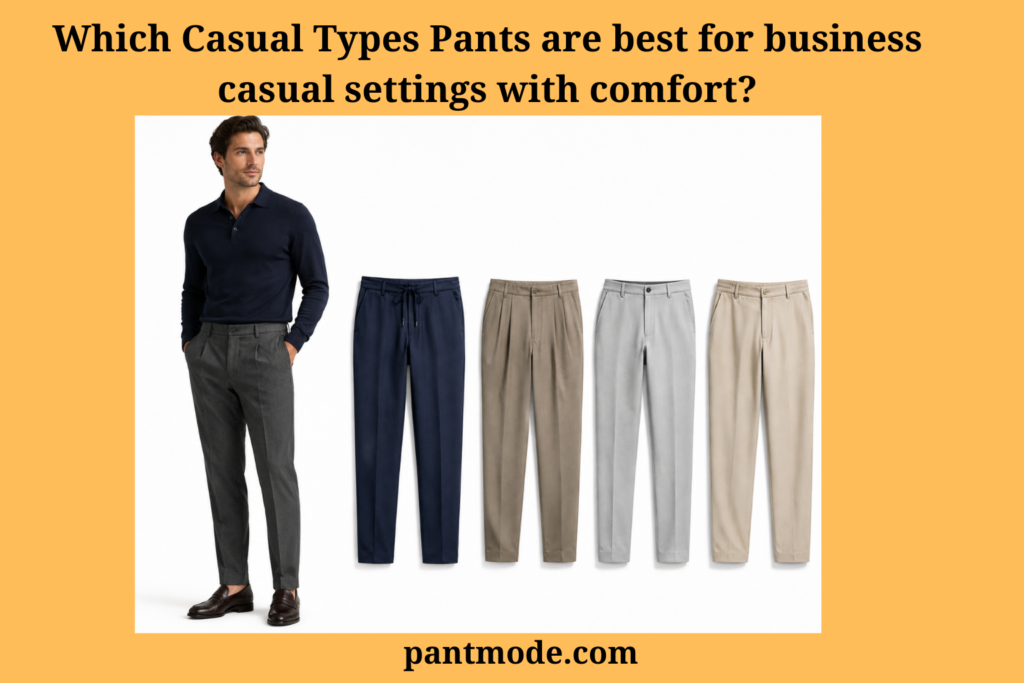
Which Casual Types Pants are best for business casual settings with comfort?
The best Casual Types Pants for business casual settings with comfort combine mobility, clean structure, matte fabric, controlled stretch, polished detailing, and office-ready styling.
Modern office pants must support sitting, commuting, walking, and long workdays without looking like sweatpants, gym pants, or loungewear. This guide explains the defining features, comfortable office pant styles, professional styling formulas, dress-code failures, and fitting-room tests for office-ready casual pants that still feel wearable.
Quick Answer: Which Casual Types Pants are best for business casual settings with comfort?
The best Casual Types Pants for business casual settings with comfort include performance chinos, ponte trousers, stretch wool-blend trousers, hidden drawstring trousers, refined five-pocket performance pants, and tailored travel trousers. They work best when fabric is matte, structured, recovery-friendly, clean through the hem, and styled with office-appropriate tops and shoes.
Definition: Comfortable Business Casual Pants
Comfortable business casual pants are office-appropriate pants that feel flexible during sitting, walking, commuting, and long workdays while still looking polished enough for modern workplaces. They avoid sweatpant details, visible drawstrings, shiny gym fabrics, jogger cuffs, clingy stretch, and messy hems.
Figure: comfortable business casual pants pass the office test when fabric, recovery, details, hem, and shoes work together.
What Features Define Comfortable Business Casual Pants in Today’s Workplace?
Comfortable business casual pants are defined by mobility, shape recovery, office-ready trouser details, matte fabric, clean drape, and hidden comfort features.
Choose fabric with mobility, not uncontrolled stretch. Comfortable business casual pants need to move when sitting, walking, and commuting, but they should still recover their shape. chino fabrics with 2–4% elastane, ponte knit trousers, or performance blends can provide comfort without looking sloppy, but stretch must recover after wear.
Maintain traditional trouser details. Belt loops, zip flies, flat fronts, pressed creases, welt pockets, and clean hems make comfortable pants look dress-code compliant. Performance chinos with a zip fly and belt loops look more office-ready than joggers with exposed drawstrings, but office formality still matters.
Prioritize matte fabrics over shiny technical finishes. High-shine synthetics can look athletic or gym-like under office lighting. Brushed cotton, matte twill, ponte knit, or wool-blend performance fabric looks more professional than glossy nylon, but technical fabrics need a matte finish.
Look for enough care labels to create clean drape. Thin stretch fabrics can cling to the thighs, knees, or seat. Medium-weight ponte trousers drape more cleanly than thin pull-on stretch pants, but heavy fabric should not restrict movement.
Use hidden comfort details instead of visible athletic details. Internal drawstrings, back elastic, stretch waistbands, and flexible seams improve comfort without weakening the business casual appearance. A flat-front trouser with hidden back elastic feels comfortable while still looking polished from the front, but visible athletic details can fail dress codes.
For broader comfort logic, compare this page with polished comfort. For material basics, use fabric and cut.
Boundary note: business casual varies by workplace. A pant that passes in a creative office may fail in a stricter professional setting.
Office-Ready Comfort Rule Blocks
| Rule | Reason | Example | Boundary |
|---|---|---|---|
| Choose fabric with mobility, not uncontrolled stretch | Comfortable business casual pants need to move when sitting, walking, and commuting, but they should still recover their shape | Cotton twill with 2–4% elastane, ponte knit trousers, or performance blends can provide comfort without looking sloppy | Stretch must recover after wear |
| Maintain traditional trouser details | Belt loops, zip flies, flat fronts, pressed creases, welt pockets, and clean hems make comfortable pants look dress-code compliant | Performance chinos with a zip fly and belt loops look more office-ready than joggers with exposed drawstrings | Office formality still matters |
| Prioritize matte fabrics over shiny technical finishes | High-shine synthetics can look athletic or gym-like under office lighting | Brushed cotton, matte twill, ponte knit, or wool-blend performance fabric looks more professional than glossy nylon | Technical fabrics need a matte finish |
| Look for enough fabric weight to create clean drape | Thin stretch fabrics can cling to the thighs, knees, or seat | Medium-weight ponte trousers drape more cleanly than thin pull-on stretch pants | Heavy fabric should not restrict movement |
| Use hidden comfort details instead of visible athletic details | Internal drawstrings, back elastic, stretch waistbands, and flexible seams improve comfort without weakening the business casual appearance | A flat-front trouser with hidden back elastic feels comfortable while still looking polished from the front | Visible athletic details can fail dress codes |
Which Comfortable Office Pants Work Best for Different Workplace Dress Codes?
The best comfortable office pants depend on workplace formality, comfort needs, fabric finish, and how closely the pant resembles traditional trousers.
chino structure use stretch twill, belt loops, zip fly construction, and clean hems to balance comfort with business casual structure. They work well in traditional business casual offices, but shiny finishes or overly tight slim fits reduce polish. For deeper context, see chino structure.
Ponte trousers use soft knit structure and smooth drape to support long sitting and creative-office comfort. They can look polished with flat fronts and clean shoes, but thin ponte can cling like leggings and fail the office test.
Stretch wool-blend trousers use natural drape, crease lines, and tailored waistbands to create more formal polish. They work in stricter offices, but delicate fabrics may require more careful maintenance.
Hidden drawstring trousers support long sitting and travel when the drawstring stays internal. They work for hybrid work and business travel, but visible drawstrings make the pants look too casual.
Refined five-pocket performance pants use stretch and durability with cleaner twill finishes. They work in casual or tech offices, but faded denim-like finishes reduce professional polish.
Tailored travel trousers support commuting and conferences through wrinkle resistance and clean taper. They work best when the fabric is matte, because swishy fabrics can sound and look too technical.
Boundary note: stricter offices need more traditional trouser details. Casual offices allow more flexibility, but visible jogger details still create risk.
Office Formality vs. Comfort Scale
| Pant Style | Comfort Level | Formality Level | Best Office Type | Avoid |
|---|---|---|---|---|
| Stretch wool-blend trousers | Medium-high | High | Formal business casual | Overly tight fit |
| Performance chinos | High | Medium-high | Traditional business casual | Shiny fabric |
| Ponte trousers | Very high | Medium-high | Creative / smart casual | Thin clingy fabric |
| Hidden drawstring trousers | Very high | Medium | Hybrid work / travel | Visible drawstrings |
| Refined five-pocket pants | High | Medium | Casual office / tech office | Faded denim-like finishes |
| Tailored travel trousers | High | Medium-high | Commuting / business travel | Swishy technical fabric |
Comfortable Office Pant Style Matrix
| Pant Style | Key Comfort Feature | Polished Detail | Ideal Environment | Best Shoe Pairing |
|---|---|---|---|---|
| Performance chinos | Stretch twill | Belt loops, zip fly, clean hem | Business casual office | Loafers, leather sneakers |
| Ponte trousers | Soft knit structure | Smooth drape, flat front | Creative office | Flats, loafers, dress sneakers |
| Stretch wool trousers | Natural drape | Crease, tailored waistband | More formal office | Loafers, oxfords, ankle boots |
| Hidden drawstring trousers | Adjustable waist | Concealed waistband detail | Hybrid / travel | Minimal sneakers, loafers |
| Five-pocket performance pants | Stretch and durability | Refined twill finish | Casual office | Leather sneakers, chukkas |
| Travel trousers | Wrinkle resistance | Matte finish, clean taper | Commuting / conferences | Dress sneakers, slip-ons |
Figure: business casual stretch pants look professional when soft comfort is balanced with structured tops, belts, polished shoes, and clean hems.
How Should You Style Business Casual Stretch Pants to Maintain a Professional Appearance?
You style business casual stretch pants professionally by balancing comfort fabrics with structured tops, polished shoes, belts, clean hems, and office-appropriate layers.
If you wear performance chinos, use an Oxford shirt and belt. Loafers or leather sneakers create classic business casual balance, while athletic sneakers weaken the office effect.
If you wear ponte trousers, use a fitted knit and blazer. Flats, loafers, or dress sneakers keep the outfit soft but polished, while oversized hoodies make the trousers read as loungewear.
If you wear hidden drawstring trousers, cover the comfort detail. An untucked tailored sweater and jacket can hide the waistband, while visible drawstrings make the pant too casual.
If you wear five-pocket performance pants, add a button-down and leather belt. Chukkas or leather sneakers make the pant casual but office-ready, while graphic tees reduce the professional effect.
If you wear stretch wool trousers, pair them with fine knitwear or a tucked shirt. Loafers, oxfords, or boots preserve formal polish, while sporty tops create mismatch.
If you wear travel trousers, use a clean tee with an overshirt or blazer. Slip-ons or dress sneakers support travel-ready professionalism, but swishy gym layers make the outfit too technical.
Boundary note: the softer the pant, the more structured the styling should be. Avoid running shoes, graphic tees, and oversized hoodies for business casual settings.
Professional Styling Formula Table
| Pant Type | Top Formula | Shoe Formula | Professional Effect | Avoid |
|---|---|---|---|---|
| Performance chinos | Oxford shirt + belt | Loafers or leather sneakers | Classic business casual | Athletic sneakers |
| Ponte trousers | Fitted knit + blazer | Flats, loafers, dress sneakers | Soft but polished | Oversized hoodie |
| Hidden drawstring trousers | Untucked tailored sweater + jacket | Minimal sneakers or loafers | Comfort details stay hidden | Visible drawstrings |
| Five-pocket performance pants | Button-down + leather belt | Chukkas or leather sneakers | Casual but office-ready | Graphic tees |
| Stretch wool trousers | Fine knit or tucked shirt | Loafers, oxfords, boots | More formal polish | Sporty tops |
| Travel trousers | Clean tee + overshirt or blazer | Slip-ons or dress sneakers | Travel-ready professionalism | Swishy gym layers |
Why Do Comfortable Business Casual Pants Fail the Dress Code, and How Do You Fix Them?
Comfortable business casual pants fail the dress code when visible athletic details, poor recovery, shiny fabric, jogger cuffs, tight waistbands, pooled hems, or casual styling overpower the office-ready structure.
Visible exterior drawstrings make pants look like sweatpants. Use a hidden drawstring or flat front to create a cleaner office look.
Bagging knees make fabric sag by afternoon. Choose better recovery fabric so the pant maintains a tailored line.
jogger style make the ankle look athletic. Use a standard hem if the office expects a more trouser-like silhouette. For jogger boundary context, see joggers.
Shiny or swishy fabric makes pants look technical or gym-like. Choose a matte finish to make the fabric look more professional.
Tight waistbands dig when sitting. Use a better rise, flexible waist, or back elastic that does not show from the front.
Pooled hems make fabric bunch at office shoes. Hem pants to a slight or no break for a sharper silhouette.
Overly casual styling lets hoodies, running shoes, or graphic tees dominate. Add structured pieces so the outfit returns to business casual balance.
Boundary note: some comfort pants should remain travel or casual-only pieces. Not every failure point is a size problem.
Dress-Code Failure Troubleshooting Table
| Failure Point | Warning Signal | Fix | Dress-Code Result |
|---|---|---|---|
| Visible drawstring | Looks like sweatpants | Use hidden drawstring or flat front | Cleaner office look |
| Bagging knees | Fabric sags by afternoon | Choose recovery fabric | Maintains tailored line |
| Jogger cuffs | Ankle looks athletic | Use standard hem | More trouser-like |
| Shiny fabric | Looks technical or gym-like | Choose matte finish | More professional |
| Tight waistband | Digs when sitting | Use flexible waist / better rise | Comfortable all day |
| Pooled hem | Fabric bunches at shoe | Hem to slight/no break | Sharper silhouette |
| Too casual styling | Hoodie/running shoes dominate | Add structured pieces | Business casual balance |
What Fitting-Room Checklist Helps You Choose Comfortable Business Casual Pants?
A fashion context for comfortable business casual pants should test fabric structure, sitting comfort, mobility, recovery, opacity, noise, shoe compatibility, and outfit range.
Fabric tag test: check stretch, fiber, and fabric weight. The pass standard is fabric that feels comfortable but structured.
Sit test: check waist and seat comfort. The pass standard is no digging, pinching, or pulling during a seated position.
Squat and step test: check mobility through real movement. The pass standard is no seam strain or tight pull across the thighs.
Recovery test: check the knees and seat after movement. The pass standard is no bagging after sitting or bending.
Light test: check opacity and shine. The pass standard is matte and opaque fabric under strong light.
Noise test: check whether the fabric swishes. The pass standard is fabric that does not sound gym-like.
Shoe test: check the hem break with office shoes. The pass standard is a clean line over loafers, dress sneakers, oxfords, boots, or flats.
Styling test: check outfit range. The pass standard is a pant that works with three or more office looks.
Boundary note: online buying requires checking fabric composition, garment measurements, reviews, care instructions, and return policy. Price or brand name should not be the main quality signal.
Final 8-Point Fitting Room Test
| Test | What to Check | Pass Standard |
|---|---|---|
| Fabric tag test | Stretch, fiber, fabric weight | Comfortable but structured |
| Sit test | Waist and seat comfort | No digging or pulling |
| Squat test | Mobility | No seam strain |
| Recovery test | Knees and seat | No bagging |
| Light test | Opacity and shine | Matte and opaque |
| Noise test | Swish sound | Not gym-like |
| Shoe test | Hem break | Clean over office shoes |
| Styling test | Outfit range | Works with 3+ office looks |
Key Takeaway
Comfortable business casual pants pass the office test when they use matte, structured, recovery-friendly fabric, preserve traditional trouser details, hide comfort features, sit cleanly over office shoes, and pair with polished tops and footwear. If the pant looks shiny, bags at the knees, shows drawstrings, cuffs at the ankle, or pools over shoes, it becomes too casual for many workplaces.
Frequently Asked Questions
The best Casual Types Pants for business casual settings with comfort include performance chinos, ponte trousers, stretch wool-blend trousers, hidden drawstring trousers, refined five-pocket performance pants, and tailored travel trousers.
Comfortable business casual pants are defined by mobility, shape recovery, office-ready trouser details, matte fabric, clean drape, and hidden comfort features.
Stretch pants can be business casual when the fabric is matte, structured, opaque, recovery-friendly, and supported by office-ready details such as belt loops, zip flies, flat fronts, welt pockets, and clean hems.
Comfortable work pants look too casual when visible athletic details, poor recovery, shiny fabric, jogger cuffs, tight waistbands, pooled hems, or casual styling overpower the office-ready structure.
Test business casual pants by checking fabric structure, sitting comfort, mobility, recovery, opacity, noise, shoe compatibility, and outfit range.
Conclusion
The best comfortable pant types are the pairs that feel easy through real workday movement while still looking structured, matte, clean, and office-ready.
Comfort comes from mobility, flexible waistbands, fabric weight, and stretch recovery.
Business-casual polish comes from matte fabric, trouser details, clean hems, office shoes, and structured styling.
The best choice depends on office dress code, daily routine, climate, and movement needs.
Test the fabric, sit comfort, stretch recovery, shine, noise, shoe compatibility, and outfit range before buying.