
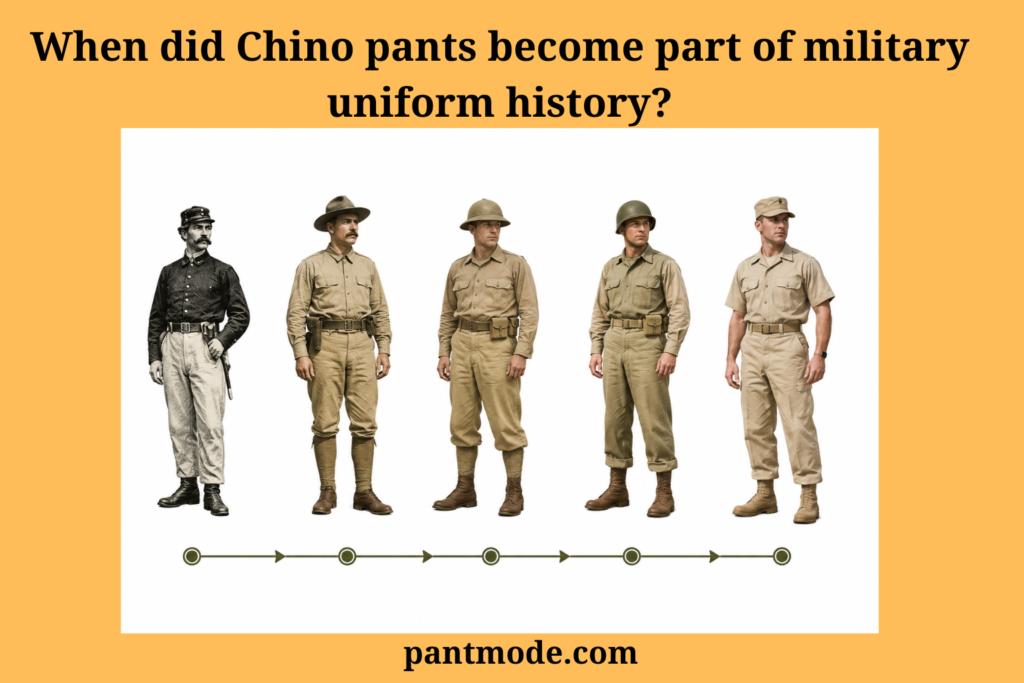
When Did Chino Pants Enter Military Uniform History?
Chino pants entered military uniform history through the evolution of khaki-colored cotton twill trousers designed for practical field service, warm-climate wear, and durable everyday uniform use.
Chino history combines khaki color development, cotton twill trouser design, military supply, and post-service civilian adoption. Khaki is primarily a color history, while chino refers to a trouser and cotton twill tradition connected to khaki color and chino structure.
Quick Answer: When Did Chino Pants Enter Military Uniform History?
Chino pants entered military uniform history through khaki-colored cotton twill trousers used for practical field and warm-climate service. Khaki color history developed through military need for dust-toned uniforms, while chinos later became associated with lightweight cotton twill military trousers and post-service civilian menswear.
Definition: Military Chino Pants
Military chino pants are cotton twill uniform trousers associated with service use, warm-climate practicality, and khaki or earth-tone military heritage. They differ from khaki color itself because chino refers to a trouser style or fabric tradition, while khaki primarily refers to a dust-colored shade.
Figure: chino military history connects khaki color, cotton twill, uniform service, and later civilian adoption.
How Did British India Create the Color Foundation for the Military Origins of Chino Pants?
British India created the color foundation for the military origins of chino pants by establishing khaki as a practical dust-colored uniform shade for dry and exposed environments.
The 1840s British India context matters because military uniforms began adapting toward dust-colored tones for camouflage in dry environments.
Mid-19th-century colonial warfare increased the need for less visible and more practical uniforms. Earth-toned utility clothing became an early step toward later chino trouser identity.
Late 19th-century military adaptation brought fabric and color traditions closer together as cotton utility trousers became more relevant in warm service contexts.
Military colors also shaped later chino colors, but khaki color history influenced chino identity without alone defining chino trousers.
Boundary note: Khaki color history helped shape chino identity, but khaki is a color term while chino is a trouser and fabric tradition.
Military Chino Origins Timeline
| Era | Event | Historical Link |
|---|---|---|
| 1840s British India | Military uniforms adapted toward dust-colored tones | Khaki color became a practical military shade |
| Mid-19th century colonial warfare | Soldiers needed less visible and more practical uniforms | Earth-toned utility clothing shaped later chino identity |
| Late 19th-century military adaptation | Cotton utility trousers became more relevant in warm service contexts | Fabric and color traditions began to overlap |
| Early 20th-century civilian adoption | Military-influenced cotton trousers entered broader wardrobes | Chinos developed into classic menswear beyond uniform use |
Why Did Tropical Warfare Make Cotton Twill Military Trousers Necessary?
Tropical warfare made cotton twill military trousers necessary because heavy wool uniforms were uncomfortable in heat, while cotton twill offered breathability, movement, and practical durability.
Heavy wool uniforms were uncomfortable and impractical in hot climates. Lightweight cotton twill offered better breathability and movement for warm-climate field service.
Soldiers still needed trousers that survived repeated wear. Twill weave provided strength while staying less bulky than heavy wool.
Khaki-colored cotton twill combined color utility and fabric durability, which helped military chinos gain both visual and textile usefulness.
The fabric logic connects directly to cotton twill, but fabric usefulness still depends on weight, weave, climate, and uniform construction.
Boundary note: Cotton twill improved warm-climate utility, but it did not solve every military uniform problem.
Tropical Uniform Adaptation Table
| Military Problem | Fabric Solution | Uniform Result |
|---|---|---|
| Heavy wool uniforms were uncomfortable in hot climates | Lightweight cotton twill improved breathability and movement | Cotton twill trousers became more suitable for tropical and field conditions |
| Soldiers needed trousers that survived repeated wear | Twill weave provided strength without heavy wool bulk | Cotton twill became practical for military use |
| Uniforms needed useful color and practical cloth | Khaki-colored cotton twill combined color utility and durability | Military chinos gained both visual and textile usefulness |
| Field service required movement | Cotton twill allowed easier mobility than stiff heavy cloth | Trousers became more wearable for daily service use |
How Did the Spanish-American War Shape the U.S. Military Adoption of Chinos?
The Spanish-American War helped shape the U.S. military adoption of chinos by increasing the need for practical lightweight cotton twill trousers suited to warm-climate service.
U.S. troops needed practical lightweight trousers for warm-climate service. Cotton twill military trousers became useful for field and service wear because they balanced movement, durability, and comfort.
Military logistics required scalable uniform production. Cotton twill trousers became standardized across service contexts, which helped spread chino identity through military and post-service clothing language.
The term “chino” became associated with cotton twill trouser traditions through military usage and supply history, but naming history should be treated carefully because supply terms and civilian language evolved over time.
Boundary note: Do not reduce chino naming history to one single supply event without source verification.
U.S. Adoption and Naming Timeline
| Cause | Effect | Naming Outcome |
|---|---|---|
| U.S. troops needed practical lightweight trousers for warm-climate service | Cotton twill military trousers became useful for field and service wear | “Chino” became associated with cotton twill trouser traditions through military usage and supply history |
| Military logistics required scalable uniform production | Cotton twill trousers became standardized across service contexts | Chinos entered broader American clothing language through military and post-service adoption |
| Soldiers returned to civilian life after service | Practical uniform-style trousers influenced civilian wardrobes | Chinos moved from military utility into classic American menswear |
| Surplus and workwear markets expanded access | Military-style cotton twill trousers became familiar outside uniform settings | Chino identity broadened beyond formal military issue |
Which WWII Military Chino Models Represent the Key Evolution of the Uniform Trouser?
WWII military chino models represent the key evolution of the uniform trouser by showing how cotton twill service pants became standardized, durable, and adaptable for both military and civilian wear.
Early service chino trousers used plain-front design, straight legs, and cotton twill construction for practical service and workwear use.
WWII-era khaki cotton twill trousers emphasized durable seams, sturdy fabric, and standardized fit because military uniforms needed broad utility and consistency.
Post-war surplus chinos created a transition point from uniform staple to classic menswear item. Civilian chinos adapted military features rather than copying every uniform detail.
Traditional khaki trouser construction shares some utility logic with military chinos, especially when khaki features align with cotton twill structure.
The wider construction relationship between chinos and khakis is explained through chinos and khakis.
Boundary note: Model names, specifications, and construction details require source verification because military garments varied by contract and era.
WWII Military Chino Model Comparison Matrix
| Model / Era | Key Feature | Military Function |
|---|---|---|
| Early service chino trousers | Plain front, straight leg, cotton twill construction | Practical service and workwear use |
| WWII-era khaki cotton twill trousers | Durable seams, sturdy fabric, standardized fit | Broad military utility and uniform consistency |
| Post-war surplus chinos | Clean cotton twill design adapted into civilian wardrobes | Transition from uniform staple to classic menswear item |
| Modern heritage chinos | Military-inspired details adapted for civilian wear | Preserves visual and construction references without being official issue |
Figure: vintage military chino authentication depends on labels, hardware, seams, fabric, and service-style fit together.
What Myths About Khaki and Chino Military History Need Correcting?
The biggest myths about khaki and chino military history come from confusing khaki color, chino cotton twill fabric, and military trouser construction as the same thing.
Khaki and chino do not mean exactly the same thing. Khaki refers primarily to a dust-colored shade, while chino refers to a cotton twill trouser style.
Any tan trouser is not automatically a chino. A chino requires cotton twill trouser structure, not just tan color.
Chinos did not begin only as civilian fashion pants. They became strongly associated with military and post-military clothing history before becoming classic civilian menswear.
The accurate distinction is easier when khaki color is separated from chino fabric and trouser construction.
Boundary note: Early military chinos were often khaki-colored, which is why the terms overlap in everyday speech, but overlap is not identity.
Khaki Color vs. Chino Fabric Terminology Table
| Myth | Reality | Technical Distinction |
|---|---|---|
| Khaki and chino mean exactly the same thing | Khaki refers primarily to a dust-colored shade, while chino refers to a cotton twill trouser style | Early military chinos were often khaki-colored, causing overlap |
| Any tan trouser is a chino | A chino requires cotton twill trouser structure, not just tan color | A tan dress pant may be khaki-colored but not automatically a chino |
| Chinos began only as civilian fashion pants | Chinos became strongly associated with military and post-military clothing history | Their modern fashion role developed after uniform utility |
| Khaki is the fabric and chino is the color | The terms are reversed in most accurate usage | Khaki is color-oriented; chino is garment/fabric-structure oriented |
How Can You Authenticate Vintage Military Chino Trousers?
You can authenticate vintage military chino trousers by checking labels, buttons, hardware, seam construction, cotton twill fabric, and practical service-style fit together.
Labels and tags provide stronger evidence when they show military specification labels, contract markings, dates, or stock information.
Buttons and hardware work as era-consistency clues. Period-appropriate buttons, metal hardware, or era-consistent closures can help distinguish originals from reproductions.
Seam construction helps verify military-use durability. Durable seams, flat-felled construction, or reinforced stress points support service-wear logic.
Cotton twill fabric and weight provide construction clues. A straight or practical service-style cut adds silhouette evidence, but fit alone cannot prove authenticity.
Boundary note: No single detail proves authenticity; labels, hardware, seams, fabric, and silhouette must be evaluated together.
Vintage Military Chino Authentication Checklist
☐ Check labels and tags: Military specification labels, contract markings, dates, or stock information provide stronger evidence of military issue or surplus origin.
☐ Check buttons and hardware: Period-appropriate buttons, metal hardware, or era-consistent closures help distinguish originals from reproductions.
☐ Check seam construction: Durable seams, flat-felled construction, or reinforced stress points support military-use durability.
☐ Check fabric and weave: Cotton twill structure with suitable weight and texture confirms connection to military chino construction.
☐ Check fit and silhouette: Straight or practical service-style cuts align better with historical uniform function.
☐ Check the full evidence system: Authenticity is stronger when label, hardware, seam, fabric, and silhouette evidence agree.
Key Takeaway
Chino pants developed through military uniform needs before becoming civilian menswear. Khaki explains the dust-colored military shade, while chino explains the cotton twill trouser tradition. Authentic vintage military chinos should be checked through labels, buttons, seams, fabric, and practical service-style fit.
Frequently Asked Questions
Chino pants entered military uniform history through khaki-colored cotton twill trousers used for practical field and warm-climate service.
No. Khaki primarily refers to a dust-colored military shade, while chino refers to a cotton twill trouser style or fabric tradition.
Soldiers wore cotton twill trousers because cotton twill offered breathability, movement, durability, and practical wearability in warm-climate service.
WWII military chinos were generally cotton twill service trousers with sturdy fabric, durable seams, standardized fit, and practical military construction.
Authenticate vintage military chino trousers by checking labels, contract markings, buttons, hardware, seam construction, cotton twill fabric, and straight service-style silhouette together.
Conclusion
Chino pants entered military uniform history through the combined development of khaki color utility, cotton twill trouser construction, warm-climate service needs, and later civilian adoption.
British India helped establish the khaki color foundation, while tropical and field service needs made cotton twill useful for durable military trousers.
U.S. military adoption, supply needs, and post-service civilian use helped spread chino trousers into classic menswear. Khaki remains a color term, while chino remains a trouser and fabric-structure tradition.
Authenticate military chinos by checking labels, hardware, seams, cotton twill fabric, and service-style silhouette together.