
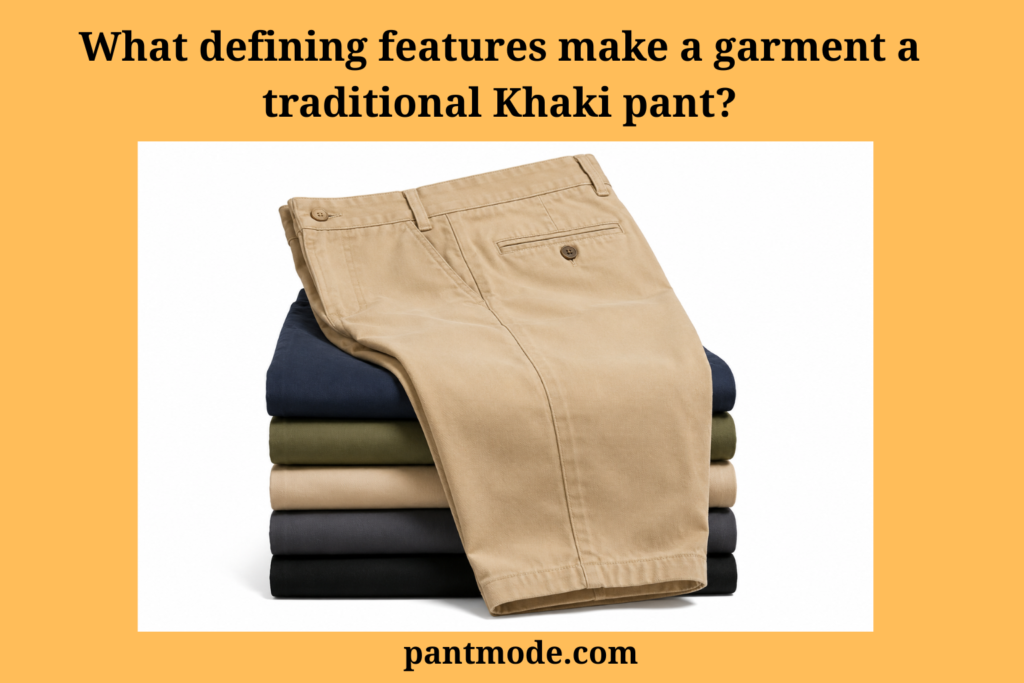
What Structural Characteristics Define Traditional Khaki Pants?
Traditional khaki pants are structurally defined by military-influenced utility, cotton twill fabric, durable pocket construction, reinforced stitching, practical closures, and a straight or slightly relaxed trouser silhouette.
Traditional khakis are not defined by tan color alone. This guide explains military origin, fabric anatomy, construction details, chinos comparison, fit evaluation, maintenance, and authenticity verification while separating garment structure from khaki color.
Quick Answer: What Structural Characteristics Define Traditional Khaki Pants?
Traditional khaki pants are usually defined by military-influenced utility, medium-to-heavy cotton twill, visible twill texture, durable pocket construction, reinforced stitching, practical closures, and a straight or slightly relaxed silhouette. Authentic khakis prioritize durability, structure, and everyday function over fashion-first detailing.
Definition: Traditional Khaki Pants
Traditional khaki pants are rugged cotton-twill trousers shaped by military and utility heritage. They are commonly associated with earth-tone color, durable fabric, practical pockets, reinforced construction, and a straighter silhouette that separates them from lighter, smoother, more tailored chinos.
Figure: traditional khaki pants combine utility heritage, cotton twill, reinforced construction, and functional fit.
How Does Military History Define the Structure of Traditional Khaki Pants?
Military history defines the structure of traditional khaki pants by prioritizing durability, dust-toned practicality, utility pockets, strong seams, and garments that could withstand repeated wear.
Military uniforms required practical garments for dusty environments. Earth-tone coloring helped the garment blend with field conditions, but the practical structure mattered as much as the color.
Durable fabric and utility-focused construction became key khaki associations because soldiers needed clothing that could tolerate repeated field wear. Strong seams, durable pocket construction, and rugged fabric choices became part of khaki identity.
Civilian khakis later carried that utility language into everyday wardrobes. PantMode explains this origin context through military heritage.
Boundary note: Modern khakis preserve design influence, not exact military uniform replication. A modern khaki garment can adapt the heritage without copying one historical uniform pattern.
Military-to-Modern Khaki Timeline
| Historical Stage | Structural Effect | Modern Application |
|---|---|---|
| Military utility need | Durable cloth, practical pockets, and earth-tone appearance became useful | Traditional khakis still emphasize durability and function |
| Repeated field wear | Strong seams and rugged fabric choices became important | Authentic khakis prioritize long-term wear |
| Civilian adoption | Utility trousers moved into everyday wardrobes | Khakis became casual, workwear, and smart-casual staples |
| Modern adaptation | Fits, fabrics, and finishes became more varied | Authenticity now requires inspecting construction, not only color |
How Do Fabric Weights and Cotton Twill Weaves Define Traditional Khaki Pants?
Fabric weight and cotton twill weave define traditional khaki pants by giving the trouser its rugged hand feel, visible diagonal texture, durable structure, and workwear-influenced identity.
Medium-to-heavy cotton twill construction is a key khaki fabric signal because it improves durability and resistance to wear. The fabric usually feels more substantial than lightweight fashion trousers.
Visible diagonal twill texture supports the rugged visual identity of traditional khakis. The weave gives the cloth a practical surface language that feels closer to utility trousers than smooth dress chinos.
Heavier fabric weights increase structure and long-term durability. Rugged cotton composition also preserves the workwear heritage associated with khaki trousers.
PantMode explains the fabric foundation more specifically in cotton twill.
Boundary note: Some modern khakis include stretch or lighter weights, so fabric must be judged with construction details too. Synthetic blends do not automatically make khakis inauthentic if the garment still supports khaki structure and utility.
Khaki Fabric Weight and Twill Guide
| Feature | Function | Authenticity Signal |
|---|---|---|
| Medium-to-heavy cotton twill | Improves durability and resistance to wear | Visible diagonal twill texture and substantial hand feel |
| Heavier fabric weight | Increases structure and long-term durability | Fabric feels denser than lightweight fashion trousers |
| Rugged cotton composition | Maintains khaki workwear heritage | Limited reliance on synthetic stretch fibers |
| Firm surface feel | Helps the trouser keep shape during daily wear | Stronger structure than soft fashion chinos |
How Do Pocket Structures, Stitching Patterns, and Closures Identify Authentic Khaki Trousers?
Pocket structures, stitching patterns, and closures identify authentic khaki trousers by revealing whether the garment was built for utility, durability, and repeated daily wear.
Slash pockets with durable pocket bags serve practical utility. They provide easy access while supporting daily use better than weak pocketing that can tear or sag quickly.
Welted, reinforced, or buttoned rear pockets signal storage security and cleaner construction. Rear pocket reinforcement matters because the seat area experiences repeated sitting, pulling, and movement.
Durable and consistent stitching supports long-term reliability. Reinforced stress points around pockets, closures, and seams help the garment tolerate repeated wear.
A heavy-duty zipper or button fly works as a dependable closure system. Tailoring details can support khaki identity, but they should not be treated as the only classification test; PantMode explains this in khaki tailoring.
Boundary note: One detail alone does not prove authenticity. Pockets, fabric, stitching, closure, and silhouette must agree before a trouser reads as traditional khaki.
Anatomy of a Traditional Khaki Table
| Construction Element | Authentic Standard | Purpose |
|---|---|---|
| Front pockets | Slash pockets with durable pocket bags | Easy access and practical utility |
| Rear pockets | Welted, reinforced, or buttoned rear pockets | Secure storage and cleaner appearance |
| Stitching | Durable, consistent stitching with reinforced stress points | Long-term structural reliability |
| Closure system | Heavy-duty zipper or button fly | Dependable daily use |
| Waistband | Stable waistband with clean finishing | Better fit control and comfort |
How Do Traditional Khaki Pants Differ From Modern Chinos?
Traditional khaki pants differ from modern chinos because khakis usually emphasize heavier fabric, rugged utility, visible durability, and roomier silhouettes, while chinos usually emphasize smoother fabric, cleaner tailoring, and smart-casual refinement.
Fabric weight creates the first difference. Traditional khakis usually feel heavier and more rugged, while modern chinos often feel lighter and smoother.
Stitching visibility creates the second difference. Khakis usually show more utility-focused construction, while chinos usually favor refined and visually discreet finishing.
Silhouette creates the third difference. Traditional khakis often appear straighter and roomier, while modern chinos often appear more tailored and streamlined. PantMode explains the comparison point in chino structure.
Both categories can overlap in retail language, which is why broader fabric and construction comparison matters. PantMode covers that overlap in chinos and khakis.
Boundary note: Modern retail usage may blur the terms. Khakis and chinos can share some features, but fabric weight, construction visibility, silhouette, and intended use help verify the difference.
Khakis vs. Chinos Structural Matrix
| Structural Characteristic | Traditional Khakis | Modern Chinos |
|---|---|---|
| Fabric weight | Heavier and more rugged | Lighter and smoother |
| Stitching visibility | More utility-focused and durable | More refined and visually discreet |
| Overall silhouette | Straighter and roomier | More tailored and streamlined |
| Intended use | Utility, durability, heritage | Smart-casual versatility |
| Visual identity | Practical and workwear-influenced | Cleaner and more polished |
Figure: authentic khaki verification works best when fabric, pocketing, stitching, closure, and fit agree.
How Should You Evaluate the Fit and Silhouette of Traditional Khaki Trousers?
You should evaluate the fit and silhouette of traditional khaki trousers by checking rise, leg shape, mobility, and visual balance against the pant’s utility-based heritage.
Mid-rise or higher-rise designs better support traditional proportions. Extremely low-rise construction can push khakis away from their practical trouser identity.
Straight or slightly relaxed leg shapes preserve khaki utility. Ultra-skinny taper can reduce movement and make the pant feel more fashion-driven than traditional.
Mobility matters because khakis come from practical garment traditions. A functional fit should allow walking, sitting, bending, and daily movement without pulling or collapsing.
Visual balance should stay clean and functional. The trouser can look polished, but it should not lose the practical utility language that makes traditional khakis distinct.
Boundary note: Modern slim khakis can work if they preserve mobility and construction integrity. No single fit is correct for every wearer.
Traditional Khaki Fit Evaluation Guide
| Evaluation Point | Poor Choice | Recommended Choice |
|---|---|---|
| Rise | Extremely low-rise construction | Mid-rise or higher-rise designs that support traditional proportions |
| Leg shape | Ultra-skinny taper | Straight or slightly relaxed silhouette |
| Mobility | Tight construction that restricts movement | Functional fit that reflects military utility |
| Visual balance | Excessively fashion-driven proportions | Clean, practical silhouette |
| Seat and thigh room | Collapsed or overly tight fit | Controlled room for movement and comfort |
How Can You Maintain Traditional Khaki Pants for Long-Term Durability?
You can maintain traditional khaki pants for long-term durability by washing them gently, reducing heat exposure, preserving cotton twill structure, and storing them in a way that controls creasing.
Washing inside out using cool water reduces fabric abrasion. This helps preserve twill structure and slows surface wear.
Air drying can reduce shrinkage and heat stress. Lower heat exposure helps cotton twill maintain shape and longevity.
Ironing while slightly damp can produce cleaner results with less stress on fibers. The fabric responds better when moisture helps relax creases before pressing.
Proper folding or hanging preserves shape and presentation. Storage matters because unnecessary creasing can weaken the polished appearance of traditional khakis.
Boundary note: Care labels override general advice because finishes and blends vary. Do not use one universal care rule for every khaki garment.
Khaki Maintenance Reference Guide
| Action | Benefit | Result |
|---|---|---|
| Wash inside out using cool water | Reduces fabric abrasion | Preserves twill structure longer |
| Air dry whenever possible | Minimizes shrinkage and heat stress | Improves fabric longevity |
| Iron while slightly damp | Produces cleaner results with less stress on fibers | Maintains a polished appearance |
| Store folded or hung properly | Reduces unnecessary creasing | Preserves presentation and shape |
| Follow the care label | Accounts for finishes, blends, and manufacturer instructions | Prevents avoidable damage |
How Can You Verify the Authenticity of Traditional Khaki Pants Before Buying?
You can verify the authenticity of traditional khaki pants before buying by checking cotton twill composition, fabric weight, pocket construction, stitching quality, closure strength, and traditional silhouette.
Start with fabric composition because durable cotton twill construction supports authentic khaki heritage. Then check fabric weight to see whether the cloth feels closer to traditional structure than very light fashion fabric.
Inspect pocket construction because strong slash pockets and reinforced rear pockets support utility and durability. Pocket strength should be evaluated with stitching and fabric quality.
Check closure strength because a durable zipper or button fly supports dependable daily use. The closure should work with the waistband, seams, and reinforcement points.
Evaluate the full garment system because product names and color labels should not replace structural inspection.
Boundary note: Authentic khakis are not verified by one feature alone. Fabric, pockets, stitching, closure, and silhouette should all support the same traditional khaki identity.
Authenticity Verification Checklist
☐ Check fabric composition: Durable cotton twill construction supports authentic khaki heritage.
☐ Check fabric weight: Medium-to-heavy structure is more consistent with traditional khakis than very light fashion fabric.
☐ Check pocket construction: Strong slash pockets and reinforced rear pockets support utility and durability.
☐ Check stitching quality: Consistent reinforced construction indicates better long-term reliability.
☐ Check closure strength: A durable zipper or button fly supports dependable daily use.
☐ Check overall silhouette: Straight or slightly relaxed traditional fit creates a closer connection to authentic khaki design.
☐ Check the full garment system: Fabric, pockets, stitching, closure, and silhouette should all support the same traditional khaki identity.
Key Takeaway
Authentic khaki pants are not defined by color alone. Traditional khakis combine cotton twill fabric, practical construction, reinforced stitching, durable pockets, functional fit, and military-influenced utility. To verify authenticity, inspect fabric weight, twill texture, pocket structure, stitching quality, closure strength, and silhouette together.
Frequently Asked Questions
Traditional khaki pants are usually defined by military-influenced utility, medium-to-heavy cotton twill, visible twill texture, durable pocket construction, reinforced stitching, practical closures, and a straight or slightly relaxed silhouette.
No. Traditional khaki pants are not defined by tan color alone; fabric weight, cotton twill structure, pocket construction, stitching quality, closure strength, and silhouette must be inspected together.
Traditional khakis usually emphasize heavier fabric, rugged utility, visible durability, and roomier silhouettes, while modern chinos usually emphasize smoother fabric, cleaner tailoring, and smart-casual refinement.
Maintain traditional khaki pants by washing them inside out in cool water, reducing heat exposure, air drying when possible, ironing while slightly damp, storing them properly, and following the garment care label.
Verify authentic khaki pants by checking cotton twill composition, fabric weight, pocket construction, stitching quality, closure strength, traditional silhouette, and whether the full garment system supports khaki utility.
Conclusion
Traditional khaki pants are best understood as utility-driven cotton-twill trousers shaped by military heritage, durable construction, practical fit, and long-term wearability.
Authentic khakis are defined by cotton twill, fabric weight, pockets, stitching, closures, and silhouette, not color alone. Khakis differ from chinos through ruggedness, construction visibility, and traditional fit.
Inspect fabric, construction, fit, and care requirements before trusting a khaki label.