
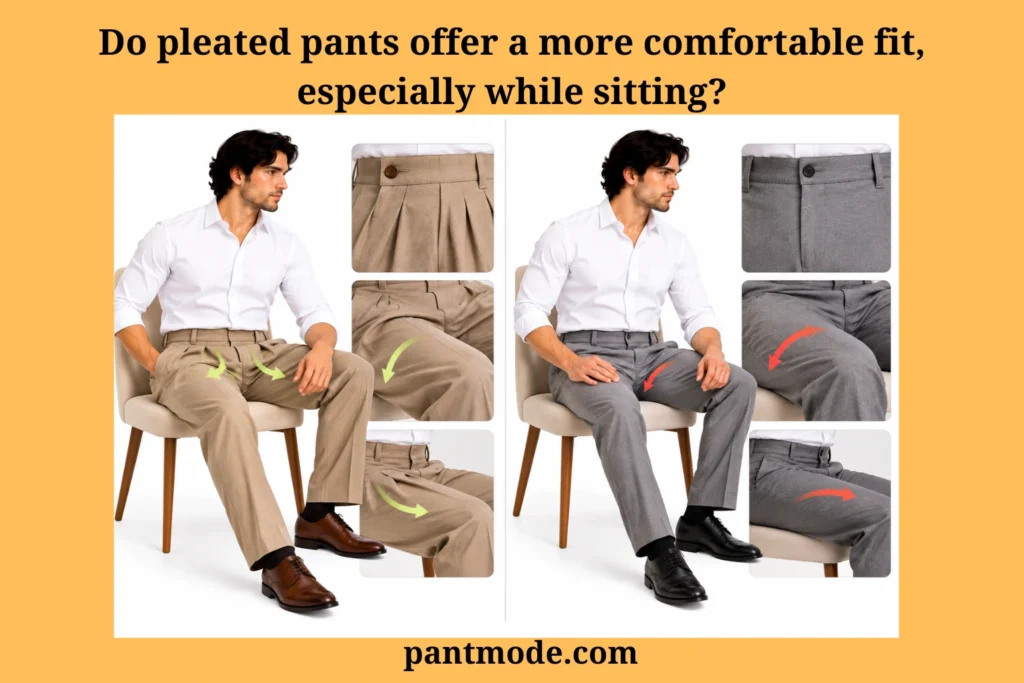
Do Pleated Pants Offer a More Comfortable Fit, Especially While Sitting?
Pleated pants can offer a more comfortable fit while sitting when their folded front construction leaves usable fabric reserve available and the underlying trouser fit is already adequate.
The presence of pleats alone does not guarantee comfort. Waistband circumference, rise and crotch length, hip and seat ease, thigh room, overall size, cut, and fabric response remain independent fit variables.
This conditional relationship belongs within the broader construction of pleated pants.
Quick Answer
Pleated pants can provide additional seated comfort when usable folded fabric remains available as sitting increases demand around the upper-front trouser. The advantage disappears when the main restriction comes from an incorrect waistband, rise, seat, thigh, size, or another base-fit problem.
Definition
Seated fit comfort: adequate garment space during normal sitting without excessive pressure, pulling, restriction, or persistent distortion caused by insufficient fit allowance.
Pleat-generated accommodation: localized additional fabric availability created by usable folded pleat construction.
Base fit: the underlying waist, rise, hip/seat, thigh, size, and cut relationships that must be evaluated before attributing a comfort benefit to pleats.
When Do Pleated Pants Provide More Comfort While Sitting?
Pleated pants can provide useful seated accommodation when the base trouser already fits correctly and the pleat reserve has not been consumed by standing tension.
| Condition | Expected Pleat Role |
|---|---|
| Adequate base fit | Reserve may remain available |
| Real pleat intake | Localized accommodation is possible |
| Pleat already strained while standing | Little usable reserve may remain |
| Tight waistband | Pleat cannot solve the restriction |
| Incorrect rise | Pleat cannot correct the primary issue |
| Insufficient rear-seat room | Front pleat cannot replace rear fit |
Key Takeaway
Pleats can supplement a correct fit; they cannot substitute for one.
Why Does Sitting Change Trouser Fit Demand?
Sitting changes the way trousers must accommodate the waist, rise, hips, seat, and thighs. A pair that feels acceptable while standing can therefore reveal restriction only after the wearer sits.
Threads recommends a direct sit test for pants fit and discusses waistband behavior, crotch length, and wearing ease through the abdomen, hip, and thigh as relevant fitting signals.
This evidence supports the importance of testing standing and seated fit separately. It does not prove that pleats themselves automatically create comfort.
How Do Pleats Provide Localized Accommodation?
A functional front pleat contains folded material that can become more available when demand increases through the upper-front trouser.
The function of trouser pleats is based on a construction sequence: pleat intake creates folded reserve, that reserve remains controlled near the top, and a release zone can contribute localized fullness.
This pleat-specific mechanism is PantMode’s construction synthesis. No fixed comfort percentage should be inferred from the presence of a pleat.
Where Can Pleat Accommodation Act?
Front pleat accommodation primarily acts through the upper-front trouser, including the front hip and upper-thigh region.
The location matters because pleat-generated space is not distributed equally across the whole garment.
| Fit Zone | Pleat Contribution | Boundary |
|---|---|---|
| Upper front | Potentially meaningful | Depends on usable reserve |
| Front hip | Potential localized room | Placement matters |
| Upper thigh | Possible supplemental room | Cannot solve severe restriction alone |
| Waistband | No direct circumference increase | Waist fit is separate |
| Rear seat | Not a substitute | Rear pattern geometry is separate |
Which Conditions Allow the Pleat Benefit to Remain Usable?
Pleat reserve remains useful only when the surrounding trouser system does not consume it before sitting begins.
| Variable | Desired Condition | Why It Matters |
|---|---|---|
| Overall size | Appropriate | Prevents pleat from compensating for undersizing |
| Waistband | Comfortable independently | Pleat does not enlarge waistband |
| Rise / crotch length | Appropriate | Controls upper-trouser geometry |
| Hip / seat | Adequate | Rear fit remains independent |
| Thigh | Adequate | Severe restriction cannot be solved by front pleats alone |
| Pleat reserve | Not consumed at rest | Leaves accommodation available for sitting |
Which Other Fit Variables Control Sitting Comfort?
Pleat allowance is only one part of seated trouser comfort. Waistband fit, crotch length, hip and seat width, thigh width, and material response remain independent controls.
Seamwork’s systematic pants fitting adjustments treat width, rise/crotch length, front fit, thigh width, and rear fit as separate fitting problems rather than one generic trouser issue.
| Variable | Independent Role | Pleat Boundary |
|---|---|---|
| Waistband | Controls waist pressure | Pleat cannot enlarge it |
| Rise / crotch length | Controls upper-trouser geometry | Must be corrected separately |
| Hip / seat | Controls rear accommodation | Front pleat is not a substitute |
| Thigh | Controls leg flexion space | Needs adequate width |
| Fabric stretch | Adds extensibility | Different mechanism |
| Pleat depth | Influences potential folded reserve | Useful only if reserve remains available |
Are Pleated Pants More Comfortable Than Comparable Flat-Front Pants?
Pleated construction has a potential seated advantage only when it contributes usable localized fabric beyond an otherwise comparable base fit.
A fair comparison should keep waist, rise, hip/seat, thigh, size, cut, fabric, and stretch as similar as reasonably possible, then compare the pleated front with the flat front.
| Comparison Variable | Pleated Trouser | Flat-Front Trouser |
|---|---|---|
| Base waist fit | Must be correct | Must be correct |
| Rise / crotch length | Must be correct | Must be correct |
| Hip / seat room | Must be adequate | Must be adequate |
| Thigh room | Must be adequate | Must be adequate |
| Extra front reserve | May exist in pleat | No pleat-generated reserve |
| Comfort verdict | Conditional | Conditional |
A correctly fitted flat-front trouser can therefore be more comfortable than a poorly fitted pleated trouser.
Do Pleat Count, Direction, or Fabric Stretch Automatically Increase Comfort?
No single secondary variable guarantees sitting comfort.
Single and double pleats differ in configuration, but more pleats do not automatically mean more usable accommodation.
Likewise, forward and reverse pleats differ in orientation; direction alone does not determine the amount of folded reserve.
Fabric stretch and fit can provide extensibility, but that mechanism is separate from pleat-generated accommodation.
| Feature | What It Can Change | What It Does Not Guarantee |
|---|---|---|
| More pleats | Configuration | Greater comfort |
| Deeper pleat | Potential reserve | Usable seated accommodation |
| Pleat orientation | Fold presentation | Greater capacity |
| Stretch fabric | Extensibility | Correct base fit |
What Fit Problems Can Pleats Not Solve?
| Problem | Pleat Capability |
|---|---|
| Tight waistband | Cannot solve |
| Incorrect rise / crotch length | Cannot fully solve |
| Insufficient rear-seat room | Cannot solve |
| Severe thigh restriction | Limited help |
| Wrong overall size | Cannot reliably compensate |
| Mild localized upper-front demand | May help |
Which Symptoms Suggest the Pleat Is Not Providing the Intended Benefit?
| Symptom | Likely Area to Check |
|---|---|
| Pleat pulled open while standing | Baseline front tension |
| Strong waistband pressure while seated | Waist fit |
| Waistband pulls or gaps while seated | Rise / crotch-length relationship |
| Front-rise pulling | Rise and front fit |
| Strong thigh restriction | Thigh width |
| Rear pulling | Seat / rear fit |
| Pleat fails to recover after standing | Persistent tension or construction |
Which Features Should Be Prioritized for Sitting Comfort?
Base fit should be checked before pleat configuration because pleats cannot compensate reliably for missing room elsewhere in the garment.
How Should Pleated Trousers Be Tested While Sitting?
The most reliable verdict comes from observing the garment in standing, seated, and recovery states rather than judging the pleat while standing alone.
What Checklist Confirms the Final Sitting-Comfort Verdict?
Base Fit
Pleat Reserve
Mechanism Control
Verification
Frequently Asked Questions About Pleats and Sitting Comfort
They can, when real pleat reserve remains available and the underlying trouser fit is already adequate.
Sitting changes fit demand across the waist, crotch and rise, hips, seat, and thighs, which is why fit should be tested in both standing and seated positions.
Usable folded fabric can contribute localized room through the upper-front trouser when demand increases.
Primarily around the upper-front, front hip, and upper-thigh region.
No. Waistband circumference is a separate fit variable.
What Final Rule Should Guide Pleated-Pants Comfort Decisions?
Fit the waistband, rise, seat, and thighs first; then judge whether the pleat adds useful accommodation when the trousers are actually worn while sitting. Pleat presence alone is not enough evidence of greater comfort.
Pleated pants can improve sitting comfort when usable front pleat reserve remains available and the underlying trouser fit already provides adequate waistband, rise, hip, seat, and thigh space.
The pleat contribution is localized rather than universal. It can supplement upper-front accommodation, but it cannot enlarge a tight waistband, correct an incorrect rise, replace rear-seat ease, or reliably compensate for severe thigh restriction or incorrect sizing.
A fair pleated-versus-flat-front comparison therefore controls the base fit first and validates the result through an actual sitting test.