
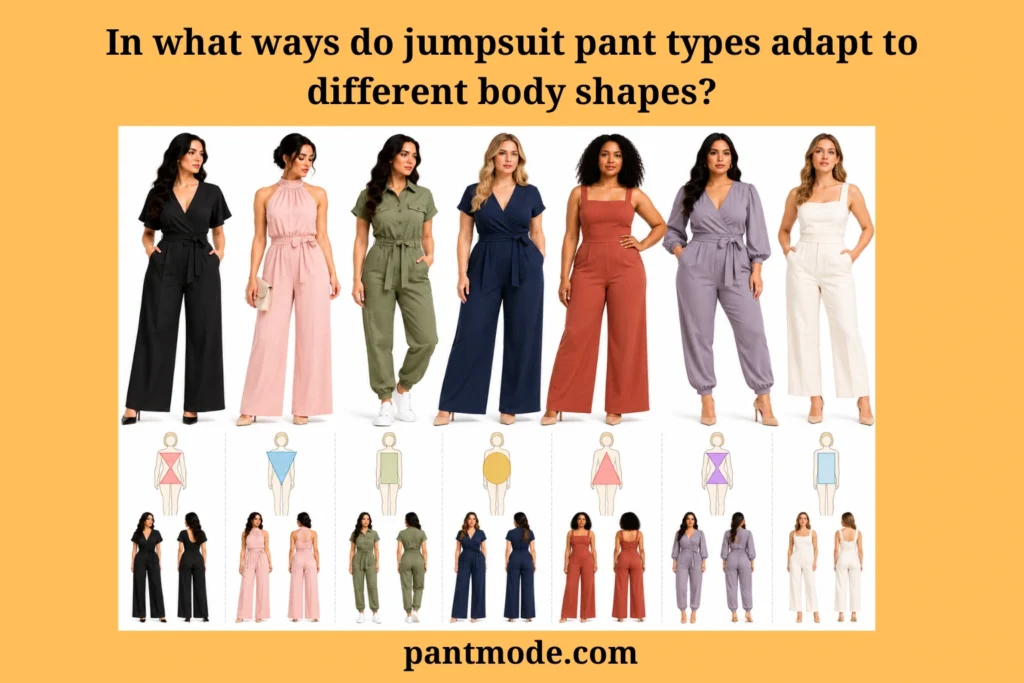
In What Ways Do Jumpsuit Pant Types Adapt to Different Body Shapes?
Jumpsuit pant types adapt to different body shapes by using variations in bodice shaping, torso length, waist and hip construction, leg silhouettes, fabric behavior, and adjustable features to accommodate different body proportions.
Because a jumpsuit connects the upper and lower garment into one system, successful fit depends on coordinated horizontal and vertical dimensions. Bust, shoulders, full girth, front and back waist length, waist, hips, rise, thighs, lower legs, and inseam can all affect the result.
Ease, fabric stretch, recovery, adjustable details, and proportion-specific sizing can expand the range of accommodation, but none replaces measurement-based verification. The broader one-piece jumpsuit construction remains the structural foundation for this fit relationship.
Quick Answer
Jumpsuits adapt to different body proportions through pattern differences in bodice shaping, full-girth length, waist and hip dimensions, crotch rise, trouser width, ease, stretch, adjustable details, and size or proportion systems. A garment is suitable only when those features match the wearer’s actual dimensions and movement requirements.
Definition
Jumpsuit Body-Proportion Adaptation: The use of garment dimensions, pattern shaping, ease, material behavior, and functional adjustment features to accommodate individual differences in body proportions.
Key Takeaway
Measurements identify the fit requirement; garment construction determines whether the jumpsuit can meet it.
How Do Jumpsuit Pant Types Adapt to Different Body Shapes?
Jumpsuit pant types adapt to different body proportions when their bodice, torso, waist, hip, crotch, and trouser construction provide the dimensions and ease required by the individual wearer.
Upper-body accommodation may come from darts, shaped seams, shoulder geometry, or bodice ease. Vertical accommodation depends on bodice length and full girth. Waist and hip accommodation depends on local shaping and ease. Crotch and leg fit depend on rise, seat room, thigh width, lower-leg dimensions, and opening size.
Stretch and adjustable features may modify selected relationships, but every feature should be judged by the specific measurement it can actually change.
| Requirement | Construction Feature | Potential Effect | Verification |
|---|---|---|---|
| More bust room | Darts, seams, or ease | Upper accommodation | Measure and move |
| Different shoulders | Shoulder and armhole shaping | Improved alignment | Inspect and reach |
| Different torso length | Full-girth or bodice adjustment | Vertical accommodation | Sit and reach |
| Different waist-to-hip relationship | Shaping plus hip ease | Better circumference distribution | Compare dimensions |
| Different thigh or lower-leg dimensions | Leg width and opening | Clearance | Walk and flex |
| Variable waist | Functional adjustment | Limited circumference change | Test actual range |
Which Body Measurements Determine the Fit Requirements of One-Piece Jumpsuit Garments?
The fit requirements of one-piece jumpsuit garments are determined by a combination of circumference and vertical measurements rather than any single body dimension.
Threads identifies jumpsuit full-girth and vertical fit variables including full girth, crotch length or half girth, crotch depth, front and back waist lengths, bust, waist, hip, inseam, and related pattern measurements.
The relevant measurements should be compared with actual pattern or finished-garment dimensions. Threads’ numerical fitting examples belong to that fitting method and should not be converted into universal PantMode standards.
For additional garment-level context, women’s jumpsuit fit and styles can help separate design categories from the measurements required for an individual fit.
| Body Dimension | Garment Reference | Possible Fit Problem | Verification |
|---|---|---|---|
| Bust | Bodice circumference and shaping | Pulling or gaping | Compare dimensions |
| Shoulders | Shoulder and armhole | Displacement or restriction | Inspect and reach |
| Full girth | Pattern or garment girth | Vertical pulling | Sit and reach |
| Front / back waist length | Bodice length | Waist displacement | Compare intended waist level |
| Waist | Garment waist | Pressure or excess | Inspect |
| Hip / seat | Finished hip and seat | Restriction or pooling | Sit and walk |
| Crotch depth / rise | Pattern rise | Pulling or excess | Sit and bend |
| Thigh | Garment thigh | Restriction | Walk and flex |
| Inseam | Finished inseam | Hem mismatch | Compare length |
| Calf / ankle | Lower leg and opening | Clearance problem | Move |
How Do Jumpsuit Bodice Designs Accommodate Different Upper-Body Proportions?
Jumpsuit bodice designs accommodate different upper-body proportions through darts, shaping seams, panels, shoulder construction, armhole geometry, and bodice-length adjustments.
Bust darts provide localized shaping. Princess seams and shaped panels distribute contouring across a longer seam line. Shoulder geometry affects placement and arm movement, while armhole shape influences upper mobility.
Bodice length also affects where the waist falls and how the upper garment connects with the crotch and trouser section. This relationship should be understood within the underlying jumpsuit garment structure.
| Feature | Fit Role | Measurement | Boundary |
|---|---|---|---|
| Bust dart | Shapes bust region | Bust location and circumference | Local shaping |
| Princess seam | Distributes shaping | Bodice dimensions | Pattern-specific |
| Shoulder shaping | Positions upper garment | Width, slope, and position | Movement must be tested |
| Armhole | Supports arm mobility | Upper dimensions | Can restrict |
| Bodice length | Controls vertical positioning | Waist length and full girth | Must coordinate with rise |
| Adjustable strap | Changes upper position | Strap length | Limited correction |
How Does Jumpsuit Waist and Hip Construction Accommodate Different Body Proportions?
Jumpsuit waist and hip construction accommodates different proportions by distributing garment circumference and shaping between the waist, hips, and seat.
Darts, shaped seams, and panels can distribute circumference between adjacent areas. Elastic and drawstrings can provide limited waist adjustment. Hip and seat ease must still be sufficient for standing, walking, sitting, and bending.
| Requirement | Construction Response | Possible Benefit | Verification |
|---|---|---|---|
| Smaller waist relative to hip | Darts or shaping seams | Improved distribution | Check both waist and hip |
| Variable waist | Elastic or drawstring | Local adjustment | Test range |
| More seat room | Pattern shaping and ease | Sitting room | Sit and bend |
| Hip difference | Hip shaping | Improved circumference fit | Measure garment |
| Defined waist | Panels or seams | Structural shaping | Check ease |
| Rise mismatch | Rise adjustment | Correct vertical fit | A belt is not a substitute |
How Do Jumpsuit Leg Silhouettes Accommodate Different Lower-Body Proportions?
Jumpsuit leg silhouettes accommodate different lower-body dimensions by distributing garment width differently through the thigh, knee, calf, and ankle.
A wide leg provides more lower-leg width. A straight leg maintains a relatively consistent lower outline. A tapered leg narrows toward the hem and therefore requires specific calf and ankle clearance.
Lower-leg width should not be confused with hip or seat accommodation. A very wide hem does not prove that the garment provides sufficient room at the hips, seat, crotch, or thighs.
| Silhouette | Width Distribution | Potential Accommodation | Boundary |
|---|---|---|---|
| Wide | Broad lower leg | More lower-leg room | Hip and rise remain separate |
| Straight | Relatively consistent | Predictable lower width | Actual dimensions still required |
| Tapered | Narrows downward | Controlled lower opening | Check calf and ankle |
| Other shaped cuts | Pattern-specific | Specific local room | Inspect actual garment |
How Do Stretch Jumpsuit Fabrics and Garment Ease Affect Body-Shape Accommodation?
Stretch fabrics and garment ease affect jumpsuit fit by changing how much the garment can extend, recover, and provide space during standing and movement.
Mechanical stretch can come from textile structure, while elastic fibers can increase extension and recovery. Positive ease means a relevant garment dimension is larger than the corresponding body dimension. Designed negative ease means a relevant stretch-zone garment dimension is smaller and relies on suitable material behavior.
These principles connect with how fabric stretch affects fit, but stretch does not substitute for correct jumpsuit pattern geometry.
| Feature | Mechanism | Fit Implication | Boundary |
|---|---|---|---|
| Mechanical stretch | Textile structure extends | Can support movement | Fabric-specific |
| Elastic-fiber stretch | Fiber extension and recovery | Closer fit may be possible | Recovery varies |
| Positive ease | Garment is larger than body at measured area | Provides additional room | More is not automatically better |
| Negative ease | Garment is smaller in designed stretch area | Can support close fit | Requires intended stretch |
| Good recovery | Returns toward original dimension | Supports shape retention | Must be tested |
| Poor recovery | Remains extended | Fit can change during wear | Not automatically a sizing problem |
Which Adjustable Jumpsuit Designs Accommodate Changes in Body Proportions?
Adjustable jumpsuit designs accommodate selected dimensional differences through functional waist systems, straps, closures, and wrap constructions that alter fit within limited ranges.
An elastic waist changes local waist circumference. A drawstring controls a specific circumference range. Adjustable straps can change upper placement, while functional wraps can alter overlap around selected bodice or waist areas.
Each feature remains local. An adjustable strap does not automatically correct crotch rise, and a drawstring cannot correct insufficient full girth.
| Feature | Mechanism | Main Area | Limitation |
|---|---|---|---|
| Elastic waist | Extends and contracts | Waist | Does not fix rise |
| Drawstring | Changes circumference | Waist | Hip and torso remain separate |
| Adjustable strap | Changes strap length | Upper position | Limited torso correction |
| Functional wrap | Changes overlap | Bust or waist | Pattern-dependent |
| Fixed wrap-effect | Visual crossover | Appearance | Not adjustable |
| Adjustable closure | Changes local position | Closure zone | Limited scope |
How Do Proportion-Sized Jumpsuits Accommodate Petite, Tall, and Extended-Size Requirements?
Proportion-sized jumpsuits may accommodate petite, tall, and extended-size requirements through different vertical dimensions, circumferences, shaping, ease, and grading.
Petite and tall labels can involve changes to bodice length, rise, waist placement, inseam, or other vertical relationships, but those changes vary by brand or pattern. Extended-size grading may require coordinated changes to circumference, shaping, ease, and pattern geometry rather than simply increasing every dimension equally.
Seamwork’s Mercer pattern provides a concrete example of jumpsuit proportion and fit adjustments. Its examples include grading between different bust and hip sizes and making separate shoulder, bust, waist, bodice-length, rise, and inseam alterations for individual wearers.
Mercer is an illustrative commercial pattern example. It does not establish universal petite, tall, or extended-size standards.
| Range | Possible Adjustments | Main Requirement | Boundary |
|---|---|---|---|
| Petite | Torso, waist level, rise, inseam | Different vertical proportions where needed | Brand-specific |
| Tall | Bodice, rise, inseam | Additional vertical length where needed | Label does not guarantee fit |
| Extended-size | Bust, waist, hip, seat, shaping | Appropriately graded dimensions | Not simple enlargement |
| Standard | Base drafted proportions | Compare actual measurements | No universal fit guarantee |
| Between sizes | Region-specific grading | Multi-point comparison | One size may not match every region |
Which Fit Problems Show That Jumpsuit Pant Types Do Not Accommodate Body Proportions Correctly?
Fit problems indicate incompatible jumpsuit proportions when garment dimensions or construction cause pulling, gaping, displacement, restricted movement, or unintended excess fabric.
A visible symptom should be treated as diagnostic evidence only after the responsible variable is investigated. Crotch pulling, for example, may relate to full girth, rise, seat ease, or a combination rather than one universal cause.
Broader pant fit and construction details can help separate local leg and rise symptoms from other one-piece jumpsuit problems.
| Symptom | Possible Cause | Confirmation | Correction Direction |
|---|---|---|---|
| Bust pulling | Insufficient bust accommodation | Measure | Bodice adjustment or different size |
| Upper-back restriction | Shoulder or back mismatch | Reach | Upper adjustment |
| Gaping | Excess or misplaced shaping | Inspect | Review darts or seams |
| Waist displacement | Bodice or full-girth mismatch | Check intended level | Vertical adjustment |
| Crotch pulling | Girth or rise mismatch | Sit and bend | Diagnose vertical fit |
| Sitting restriction | Insufficient ease or length | Sit | Review girth and seat |
| Tight hips | Insufficient hip ease | Measure | Size or pattern change |
| Tight thighs | Insufficient local ease | Walk | Increase local width |
| Pooling | Excess ease or length | Inspect folds | Isolate the dimension |
| Incorrect hem | Inseam mismatch | Check endpoint | Adjust length |
How Can Jumpsuit Fit Be Measured and Tested Across Different Body Proportions?
Jumpsuit fit can be measured and tested by comparing relevant body dimensions with pattern or finished-garment measurements and then confirming the result through movement.
| Stage | Test | Evidence |
|---|---|---|
| Body | Record dimensions | Individual requirement |
| Garment | Review finished dimensions | Construction requirement |
| Ease | Compare dimensions | Designed allowance |
| Bodice | Bust and shoulders | Upper fit |
| Torso | Sit and reach | Full-girth fit |
| Waist / hip | Position and clearance | Circumference fit |
| Crotch | Sit and bend | Rise fit |
| Legs | Walk and flex | Clearance |
| Fabric | Stretch and recovery | Material response |
| Adjustment | Test functional range | Local adaptability |
| Final | Combined static and movement evaluation | Pass / Adjust / Reject |
Which Jumpsuit Pant Styles Best Accommodate Different Body-Proportion Requirements?
Jumpsuit pant styles best accommodate different body proportions when their actual bodice, torso, waist, hip, rise, leg, and material dimensions correspond to the wearer’s measured requirements.
Selection should therefore begin with the problem that actually needs accommodation. More bust room requires appropriate bodice dimensions and shaping. More torso length requires sufficient vertical accommodation. More hip room requires hip or seat dimensions rather than simply a wider hem.
| Requirement | Feature to Consider | Verification | Limitation |
|---|---|---|---|
| More bust room | Shaped bodice or appropriate ease | Measure bodice | Torso length also matters |
| Different shoulders | Suitable shoulder and armhole | Reach and inspect | Bust is independent |
| More torso length | Longer full girth or bodice | Sit and bend | A belt cannot fix it |
| Waist adjustment | Functional waist system | Test range | Local only |
| More hip or seat room | Lower-body shaping and ease | Sit and measure | Wide hem is irrelevant |
| More thigh room | Local leg ease | Walk | Design-specific |
| More calf or ankle room | Straight or wider opening | Flex and walk | Hip fit remains independent |
| Stretch requirement | Suitable material and pattern | Move and test recovery | Not a geometry correction |
| Different vertical proportions | Petite or tall options where suitable | Compare girth, rise, and inseam | Brand-specific |
What Checklist Confirms That Jumpsuit Pant Types Accommodate Individual Body Shapes?
A checklist confirms jumpsuit compatibility by verifying that the garment’s dimensions, shaping, ease, material response, and adjustment features support the wearer’s actual measurements and movement needs.
Measurement Evidence
Waist, Hip & Crotch
Leg & Material Fit
Movement & Final Decision
Yes. Different jumpsuit patterns can accommodate different individual proportions through changes in bodice shaping, torso length, waist and hip dimensions, rise, leg width, ease, material behavior, and adjustable features.
No. Body-shape labels are broad descriptions of proportions, not precise fitting measurements. Actual body and garment dimensions provide stronger fit evidence.
Because the bodice and trousers are physically connected, insufficient or excessive vertical length can affect waist placement, crotch position, pulling, and movement throughout the garment.
No. Stretch can provide material extension and support movement, but it does not correct incompatible full-girth, shoulder, waist, rise, or other pattern geometry.
Start with fit-critical body measurements, compare them with pattern or finished-garment dimensions, evaluate intended ease and material behavior, then test standing, walking, sitting, bending, and reaching before accepting, adjusting, or rejecting the fit.
Jumpsuit pant types accommodate different body proportions when their integrated bodice, full-girth length, waist, hip, crotch, leg, ease, and material characteristics correspond to the wearer’s actual measurements and movement requirements.
Darts, shaping seams, different leg cuts, stretch fabrics, functional waist systems, adjustable straps, wraps, and proportion-specific pattern ranges can expand accommodation, but each mechanism has defined limits. A feature that adjusts one region should not be treated as a correction for unrelated dimensions.
The most reliable process is measurement-led: record the relevant body dimensions, compare them with actual garment or pattern measurements, assess intended ease and material behavior, diagnose any specific mismatch, test the garment in motion, and then decide whether to pass, adjust, or reject the fit.
No body-shape label can replace that process. The garment should be selected according to measurable fit requirements and movement compatibility rather than generalized rules about which silhouette a named body shape is supposed to wear.