
How Did Khaki Trousers Become Associated With British Colonial Military Apparel?
Khaki trousers became associated with British colonial military apparel in 19th-century India because dust-colored field clothing reduced visibility, tolerated dirt, and performed better in hot colonial campaign environments than bright parade-style uniforms.
This guide explains the origin of British colonial khaki trousers, the tactical shift from bright uniforms to subdued field clothing, campaign variation, vintage authentication, myth correction, and a timeline recap. Khaki history involves environmental need, local textile influence, military adaptation, and later standardization, not only khaki color or garment structure.
Quick Answer: How Did Khaki Trousers Become Associated With British Colonial Military Apparel?
Khaki trousers became associated with British colonial military apparel in 19th-century India, where dusty terrain, heat, and field visibility concerns made bright uniforms less practical. Dust-colored khaki trousers offered camouflage, tolerated dirt, and helped shift military clothing toward subdued field uniforms.
Definition: British Colonial Khaki Trousers
British colonial khaki trousers are dust-colored military trousers associated with British imperial service, especially in India and other colonial campaign environments. They are linked to practical field needs, muted camouflage, cotton drill or twill cloth, utility construction, and the broader movement away from bright combat uniforms.
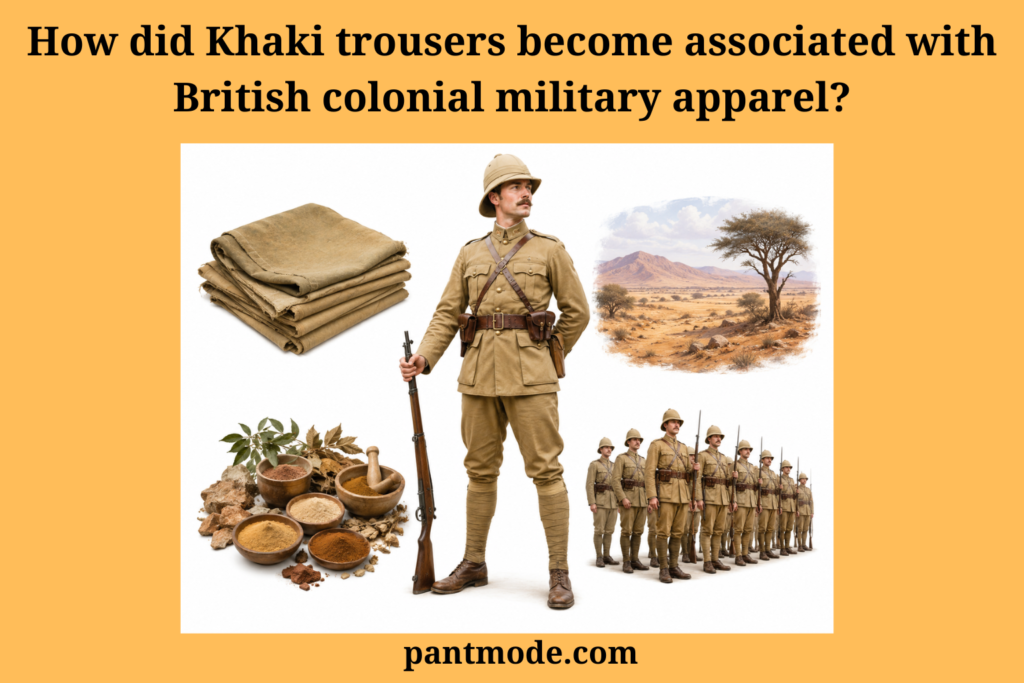
Figure: British colonial khaki trousers developed through British India, dusty terrain, field utility, campaign variation, and modern heritage interpretation.
How Did British India Shape the Origin of British Colonial Khaki Trousers?
British India shaped the origin of British colonial khaki trousers by connecting dust-colored clothing, hot-climate field use, and reduced-visibility military needs in the 19th century.
British India became the key geographic setting because soldiers needed clothing that blended better with dusty, arid terrain than bright white or red garments.
Frontier military conditions made khaki trousers practical because soldiers needed garments that tolerated dirt, heat, movement, and repeated field wear.
Local textile and dyeing practices influenced the broader khaki story before British forces adapted and standardized khaki within colonial military apparel.
Boundary note: British India shaped colonial military use of khaki, but dust-colored textile practices and local dyeing traditions were not invented from nothing by British forces.
British India Khaki Origin Timeline
| Origin Point / Era | Military Need | Historical Result |
|---|---|---|
| 19th-century British India | Troops needed uniforms that blended with dusty, arid terrain | Dust-colored khaki trousers became associated with colonial military practicality |
| Frontier military conditions | Soldiers required garments that reduced visibility and tolerated dirt, heat, and field wear | Khaki trousers became a functional alternative to parade-ground uniform colors |
| Local textile and dyeing influence | Practical dust-toned cloth already had environmental logic | British forces adapted and standardized khaki within military apparel |
| Later colonial campaigns | Field uniforms needed wider practical application | Khaki became more closely tied to active-service clothing |
Why Did British Colonial Forces Replace Bright Uniforms With Khaki Military Trousers?
British colonial forces replaced bright uniforms with khaki military trousers because subdued dust-colored clothing reduced visual contrast and performed better in active field conditions.
Bright red or white uniforms made soldiers highly visible in dusty colonial landscapes, especially when parade-ground visibility conflicted with field practicality.
Khaki military apparel reduced visual contrast against dry terrain and helped move combat dress away from bright identity-based uniform systems.
Subdued colors and practical cloth made campaign trousers more useful in heat, dust, and movement-heavy service conditions, especially when paired with cotton twill.
Boundary note: Khaki improved field practicality in relevant terrain, but it was not a universal camouflage solution for every environment or campaign.
Redcoat vs. Khaki Tactical Shift Table
| Uniform Approach | Field Problem | Tactical Shift | Result |
|---|---|---|---|
| Bright red or white uniforms | High visibility in dusty terrain | Move toward muted khaki shades | Lower visual contrast in field conditions |
| Parade-ground clothing | Designed for identity and visibility | Active-service clothing prioritized practicality | Field uniforms became more functional |
| Heavy or formal uniform systems | Poor suitability for heat, dust, and movement | Lighter and earth-toned garments gained use | Khaki trousers became practical campaign apparel |
| Traditional combat visibility | Became less suitable as warfare changed | Concealment and utility became more important | Khaki helped mark the decline of bright combat dress |
Which Colonial-Era Khaki Trouser Variations Appeared Across Different Military Campaigns?
Colonial-era khaki trouser variations appeared across different campaigns because climate, terrain, supply, fabric availability, and military function changed from region to region.
Indian frontier service favored lightweight cotton khaki trousers because heat, dust, and marching conditions required breathable field clothing.
South African campaigns could involve heavier khaki cloth or serge-influenced field trousers because durability and structure mattered in different terrain and supply conditions.
Middle Eastern and desert conditions encouraged lighter earth-toned khaki field trousers because reduced heat burden and lower visual contrast mattered together.
Gurkha and frontier-influenced uniforms sometimes used high-waisted or adjustable military trouser forms to support marching comfort and fit flexibility.
The classification of colonial khaki garments depends on fabric, color, tailoring, and context, which connects to the wider tailoring test.
Boundary note: Campaign details require source verification because surviving garments and documentation vary by unit, date, supply chain, and military need.
19th-Century Colonial Uniform Comparison Matrix
| Campaign Context | Trouser Variation | Practical Purpose |
|---|---|---|
| Indian frontier service | Lightweight cotton khaki trousers | Improved comfort in heat and dusty terrain |
| South African campaigns | Heavier khaki cloth or serge-influenced field trousers | Greater structure and durability |
| Middle Eastern and desert conditions | Lighter earth-toned khaki field trousers | Reduced heat burden and visual contrast |
| Gurkha and frontier-influenced uniforms | High-waisted or adjustable military trouser forms | Better marching comfort and fit flexibility |
| Later imperial field use | More standardized khaki field garments | Wider military recognition of khaki utility |
Figure: vintage colonial khaki authentication requires fabric, hardware, stitching, cut, labels, and historical consistency together.
How Can Collectors Authenticate Vintage British Colonial Khaki Trousers?
Collectors can authenticate vintage British colonial khaki trousers by evaluating fabric, weave, buttons, hardware, stitching, thread, cut, waistband, labels, markings, and historical consistency together.
Fabric and weave provide the first plausibility check because cotton drill, cotton twill, or serge-like military cloth can support historical consistency.
Buttons and hardware provide era clues when metal, horn, zinc, brass, or early military button types match the garment’s claimed period.
Stitching and thread support dating when natural-fiber thread, period-consistent seams, and the absence of obvious modern synthetic construction align.
Cut and waistband details can support early military identification when high waist, suspender buttons, fishtail back, or military tailoring details appear together.
Labels and markings provide stronger evidence when military issue marks, stamps, dates, unit markings, or contract details match the garment’s story.
Boundary note: Authenticity cannot be confirmed through one feature alone; images, labels, provenance, and expert verification may be needed.
Strong Colonial Khaki Authentication Checklist
☐ Check period fabric: Cotton drill, cotton twill, or serge-like military cloth should match the claimed era and campaign context.
☐ Check khaki shade: The color should look dust-toned, muted, and field-practical, not bright beige or modern fashion tan.
☐ Check buttons and hardware: Metal, horn, zinc, brass, or military button types should fit the claimed period.
☐ Check stitching and thread: Period-consistent seams and thread should not look obviously modern or synthetic.
☐ Check waistband details: High waist, suspender buttons, fishtail back, or military tailoring details should match the garment story.
☐ Check labels and stamps: Issue marks, dates, unit markings, or contract details provide stronger evidence than style alone.
☐ Check campaign logic: Fabric weight, shade, and cut should make sense for the climate and military setting claimed.
☐ Check provenance: Seller history, photos, labels, and documentation should support the item before calling it authentic.
What Myths About British Colonial Khaki Trousers Need Historical Correction?
The biggest myths about British colonial khaki trousers usually come from treating khaki as a single British invention rather than a military adaptation shaped by local textile practices, environment, and later standardization.
The British did not invent the entire idea of dust-colored clothing. Local textile and dyeing practices existed before British military standardization.
Khaki was not only a British military invention. British forces adopted, adapted, and standardized a practical color system influenced by local environments and traditions.
All khaki military trousers were not identical. Fabric, cut, weight, and tailoring changed across regions, campaigns, and eras.
Broader construction differences also explain why khaki trousers must be assessed beyond color through fabric construction.
Boundary note: Exact details of early dyeing, adoption, and standardization should be source-verified because colonial textile history is complex.
Myth vs. Historical Correction Table
| Myth | Historical Correction | Why It Matters |
|---|---|---|
| The British invented the idea of dust-colored clothing | Local textile and dyeing practices existed before British military standardization | Prevents oversimplifying colonial textile history |
| Khaki was only a British military invention | British forces adopted, adapted, and standardized a practical color system influenced by local environments and traditions | Gives a more accurate view of colonial-era clothing development |
| All khaki military trousers are identical | Fabric, cut, weight, and tailoring changed across regions, campaigns, and eras | Helps readers classify garments more accurately |
| One person invented all khaki military apparel | Khaki developed through multiple practical adaptations and later standardization | Avoids turning a complex clothing history into a single-origin myth |
How Do We Summarize the Timeline of British Colonial Khaki Trousers?
The timeline of British colonial khaki trousers begins with local and military adaptation in India, moves through wider field-uniform adoption, and ends with khaki becoming a defining military apparel color.
Early colonial adaptation established the functional logic of dust-colored military clothing because climate and terrain made bright uniforms less practical.
Later 19th-century military adoption shifted active-service clothing toward concealment, heat management, and field practicality.
Boer War and wider imperial use strengthened khaki’s association with British field uniforms and helped cement khaki as a defining military apparel color.
Modern heritage interpretation keeps khaki trousers linked to military utility, historical meaning, and vintage collecting, while related chino history shows how cotton-twill military trousers entered civilian menswear.
Boundary note: Timeline details should be source-verified by campaign, region, garment type, and surviving documentation.
British Colonial Khaki Timeline Recap
| Era | Development | Significance |
|---|---|---|
| Early colonial adaptation | Dust-colored garments emerged as a practical response to climate and terrain | Established the functional logic of khaki military clothing |
| Later 19th-century military adoption | Khaki became more closely associated with active-service uniforms | Shifted combat clothing toward practicality and concealment |
| Boer War and wider imperial use | Khaki became strongly identified with British field uniforms | Cemented khaki as a defining military apparel color |
| Modern heritage interpretation | Khaki trousers remain associated with military utility and colonial uniform history | The garment’s historical meaning continues in menswear and vintage collecting |
Key Takeaway
British colonial khaki trousers developed through environment, military practicality, local textile influence, and later standardization. They were not simply a fashion color or a single invented garment. Authentic study requires checking origin, campaign context, fabric, cut, markings, and historical correction together.
Frequently Asked Questions
Khaki trousers became associated with British colonial military apparel in 19th-century India, where dusty terrain, heat, and field visibility concerns made bright uniforms less practical.
Yes. British India shaped the colonial khaki trouser story by connecting dust-colored clothing, hot-climate field use, reduced visibility, and military standardization.
No. Colonial khaki trousers varied by campaign, climate, fabric availability, military function, cut, weight, and supply chain.
Collectors should evaluate fabric, weave, buttons, hardware, stitching, thread, cut, waistband, labels, markings, provenance, and historical consistency together.
No. Khaki trouser history includes local textile practices, environmental logic, British military adaptation, later standardization, and regional variation.
Conclusion
British colonial khaki trousers became associated with military apparel because they solved practical field problems: visibility, dust, heat, movement, and durability.
British India shaped the early origin context by connecting dusty terrain, hot-climate field use, local textile influence, and military practicality.
The tactical shift from bright uniforms to khaki field clothing reflected changing military needs around visibility, movement, and active-service function.
Colonial-era khaki trouser variations changed across campaigns because climate, fabric supply, cut, and regional military needs were not identical.
Authentic vintage khaki assessment requires fabric, hardware, stitching, cut, markings, provenance, and historical consistency together.
British colonial khaki trousers should be treated as historical military garments interpreted through era, region, fabric, construction, and evidence.