
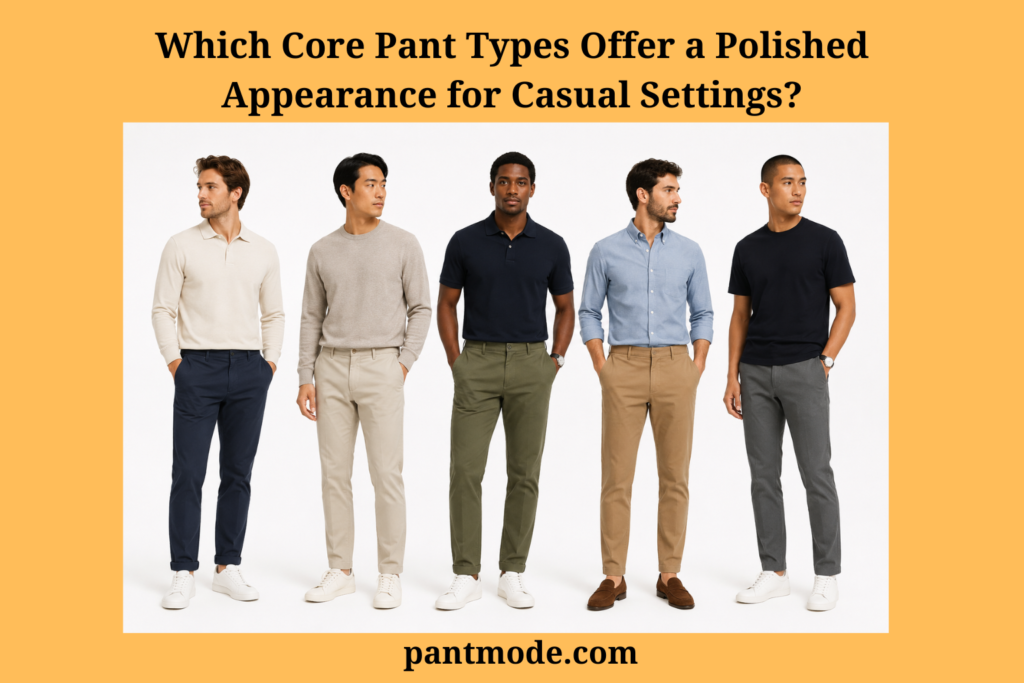
Which Core Pant Types Offer a Polished Appearance for Casual Settings?
Core pant types that offer a polished appearance for casual settings usually include classic chinos, tailored drawstring trousers, five-pocket stretch twill pants, and lightweight wool or wool-blend trousers when their fabric, fit, and styling look clean.
This guide explains the design features, pant style comparisons, outfit styling rules, troubleshooting cues, and capsule wardrobe discipline that help casual pants look refined without becoming formal.
Quick Answer
Core pant types that can offer a polished casual appearance include classic chinos, tailored drawstring trousers, five-pocket stretch twill pants, and lightweight wool or wool-blend trousers. The polished effect usually comes from matte fabric, controlled drape, clean leg shape, discreet comfort features, and balanced styling.
Figure: polished casual pant system supports polished-casual pant evaluation.
What design features separate polished casual pants from ordinary casual trousers?
Design features separate polished casual pants from ordinary casual trousers when fabric finish, drape, leg shape, and comfort details create structure without visible clutter.
The rule is to judge polish by the full design language instead of one isolated detail.
Matte fabrics often look more refined because they reduce visual glare, but texture, garment condition, and fit still matter.
Controlled drape helps refined casual trousers fall cleanly from waist to hem, but weak drape can look limp or sloppy.
Clean taper and balanced straight-leg silhouettes can structure the leg line, but excessive taper may look restrictive rather than relaxed.
Hidden comfort features can improve wearability without visual clutter, but poor waistband structure or weak fabric recovery can still make the pant look casual.
A pant can look casual or polished depending on whether casual cues.
Definition
Polished casual pants are casual trousers that look refined because their fabric, fit, leg shape, waistband design, and styling details create structure without making the outfit fully formal.
Polished casual choices become clearer after readers understand how core types.
Polished Appearance Criteria Table
| Feature | What It Improves | Good Signal | Risk Signal |
|---|---|---|---|
| Matte fabric finish | Visual refinement | Low-shine surface with clean condition | Rugged, worn, shiny, or overly textured surface |
| Controlled drape | Clean fall and silhouette | Fabric falls smoothly without collapse | Limp, stiff, twisted, or messy drape |
| Clean taper / balanced straight leg | Leg-line structure | Shape looks intentional and easy | Overly tight taper or shapeless volume |
| Hidden comfort features | Comfort without visual clutter | Comfort details stay discreet | Visible drawcords, rolling waist, or weak structure |
| Slight or clean break | Footwear visibility and polish | Hem meets footwear cleanly | Pooling, dragging, or awkward lift |
Which polished casual pant styles deserve a place in a versatile wardrobe?
Polished casual pant styles deserve a place in a versatile wardrobe when they combine comfort, structure, and enough refinement for office-casual, travel, social, and weekend settings.
Classic chinos often work well because they balance casual comfort with a cleaner woven structure.
Chinos become easier to evaluate when readers understand how chino construction.
Tailored drawstring trousers can look modern and relaxed when the waistband is discreet, but visible drawcords can reduce refinement.
Five-pocket stretch twill pants can feel familiar and casual while looking cleaner than rugged denim, but patch-pocket construction can still read informal.
Lightweight wool or wool-blend trousers may elevate casual outfits through smoother drape, but they should not be treated as automatically formal or automatically comfortable.
Figure: polished casual style roles supports polished-casual pant evaluation.
Pant Type Decision Matrix
| Pant Style | Best Environment | Key Advantage | Risk / Limitation |
|---|---|---|---|
| Classic chinos | Office-casual, social, weekend rotation | Versatile structure with approachable ease | Fading, wrinkles, or poor fit can reduce polish |
| Tailored drawstring trousers | Travel, relaxed office, modern casual settings | Comfort with cleaner tailoring language | Visible drawcords can look too casual |
| Five-pocket stretch twill pants | Smart-casual weekends and relaxed work settings | Familiar casual cut with cleaner fabric options | Five-pocket construction still reads casual |
| Lightweight wool or wool-blend trousers | Elevated casual dinners, office-casual, seasonal refinement | Controlled drape and smoother texture | Fabric, care needs, and cut must match real use |
How should you style polished casual trousers for maximum versatility?
Polished casual trousers become more versatile when shoe formality, top texture, waist definition, and silhouette balance match the pant’s structure.
Match shoe formality to the trouser’s structure because casual pants look cleaner when footwear supports the same level of refinement.
Minimal sneakers can work with clean chinos or stretch twill, but bulky athletic shoes can weaken the polished line.
Loafers, refined casual boots, or clean leather shoes can elevate smart-casual pants, but overly formal shoes may make relaxed trousers look mismatched.
Use texture contrast strategically by pairing smooth trousers with knitwear, soft shirts, or casual jackets.
Define the waistline when possible, but avoid forced tucking if the waistband or rise does not support it.
Smart-casual outfits work better when refined casual pants borrow restraint from formal features without becoming formal trousers.
Figure: top and footwear pairing system supports polished-casual pant evaluation.
Top & Footwear Pairing Matrix
| Pant Style | Best Top Pairing | Best Footwear Pairing | Styling Risk |
|---|---|---|---|
| Classic chinos | Knit polo, oxford shirt, soft overshirt | Loafers, minimal sneakers, refined casual boots | Too rugged a top can reduce polish |
| Tailored drawstring trousers | Clean knit, relaxed shirt, structured lightweight layer | Minimal sneakers, loafers, clean sandals where appropriate | Visible drawstring may make the outfit too relaxed |
| Five-pocket stretch twill pants | Casual shirt, knitwear, simple jacket | Minimal sneakers, suede shoes, casual boots | Heavy stitching or patch pockets can fight polished styling |
| Lightweight wool or wool-blend trousers | Fine knit, clean shirt, relaxed blazer | Loafers, clean leather shoes, refined boots | Overly formal styling can shift the outfit away from casual |
What common mistakes reduce the impact of polished casual pants, and how can you fix them?
Common mistakes reduce the impact of polished casual pants when length, hip fit, fabric recovery, or styling choices weaken the clean casual line.
Excess fabric pooling at the ankle usually reduces refinement because the hem hides the leg line and footwear relationship.
Pocket flare at the hips often signals fit tension, but a different base cut may work better than forcing tailoring.
Loss of shape through the day may come from weak fabric recovery, but exact recovery claims should come from garment labels, manufacturer data, or textile references.
Overly visible comfort details can make elevated casual pants look like lounge pants.
Footwear mismatch can disrupt the outfit when the shoe looks much more formal or much more athletic than the trouser.
Hidden comfort matters because long-wear comfort depends on fit, fabric, and movement allowance.
Polished casual pants still need context because function and occasion use.
Figure: polished casual troubleshooting system supports polished-casual pant evaluation.
Fit Troubleshooting Table
| Problem | Likely Cause | Possible Fix | Result | Limitation |
|---|---|---|---|---|
| Excess pooling at the ankle | Inseam too long, weak break control, or shoe mismatch | Hem the pant or choose a cleaner break | Sharper leg line and better footwear visibility | Not every pant cut supports every break |
| Pocket flare at the hips | Hip tension, pocket placement, or too narrow a cut | Choose more hip room or a cleaner pocket design | Smoother side profile | Tailoring may not add enough room |
| Loss of shape throughout the day | Weak recovery or poor fabric structure | Choose better fabric behavior and test after sitting | Cleaner long-day appearance | Exact performance depends on garment data |
| Overly visible comfort details | Drawcord, elastic, or waistband detail dominates | Choose hidden or discreet comfort features | More refined casual look | Some comfort-first pants will remain casual |
| Footwear mismatch | Shoe formality clashes with trouser structure | Match shoe weight and finish to the pant | More coherent smart-casual balance | Dress code or context still controls suitability |
How can you build a capsule wardrobe around polished casual pants?
You can build a capsule wardrobe around polished casual pants by choosing versatile colors, seasonal fabric options, and a disciplined rotation of high-performing trousers.
Start with neutral colors because they often coordinate easily, but do not assume neutral color alone creates refinement.
Include multiple fabric options for different seasons without inventing exact fabric-weight thresholds.
Keep the rotation disciplined by replacing lower-performing trousers when a stronger option covers the same role better.
A capsule should cover office-casual, travel, social, and weekend needs without turning into a shopping list.
Figure: polished casual capsule system supports polished-casual pant evaluation.
Capsule Wardrobe Starter Checklist
| Wardrobe Role | Recommended Pant Style | Color Direction | Rotation Purpose | Risk Check |
|---|---|---|---|---|
| Office-casual base | Classic chinos | Navy, stone, khaki, olive, or charcoal | Clean daily structure | Avoid fading, tightness, or heavy wrinkling |
| Travel comfort | Tailored drawstring trousers | Black, navy, grey, or olive | Comfort with cleaner presentation | Avoid visible lounge cues |
| Social refinement | Lightweight wool or wool-blend trousers | Charcoal, taupe, navy, or muted brown | Elevated casual polish | Avoid overly formal styling |
| Weekend polish | Five-pocket stretch twill pants | Dark neutral or muted earth tone | Casual familiarity with cleaner surface | Avoid rugged wash, heavy stitching, or poor recovery |
Key Takeaway
If casual pants look sloppy, the issue is usually uncontrolled fabric, poor break, weak shape recovery, visible comfort details, or styling that clashes with the pant’s structure.
Frequently Asked Questions
Classic chinos, five-pocket stretch twill pants, tailored drawstring trousers, and lightweight wool-blend trousers can look polished while staying casual when the fit, fabric, and styling are clean.
Chinos are often strong polished casual pants because they balance structure and versatility, but wool blends, stretch twill, and tailored drawstring trousers can also work depending on setting and fit.
Drawstring trousers can look polished when the waistband is tailored, the drawstring is discreet, and the fabric has controlled drape.
Minimal sneakers, loafers, clean leather shoes, and refined casual boots can work depending on pant structure and outfit formality.
Excess pooling, poor fabric recovery, pocket flare, overly visible comfort details, weak drape, and mismatched footwear often make casual pants look sloppy.
Conclusion
Polished casual pants work best when fabric, fit, drape, styling, and wardrobe discipline support the same refined casual goal.
The strongest choices keep casual comfort while using cleaner fabric finish, controlled leg shape, discreet comfort details, and balanced styling to avoid a sloppy casual appearance.