
Which Core Pant Types Prioritize Long-Wear Comfort?
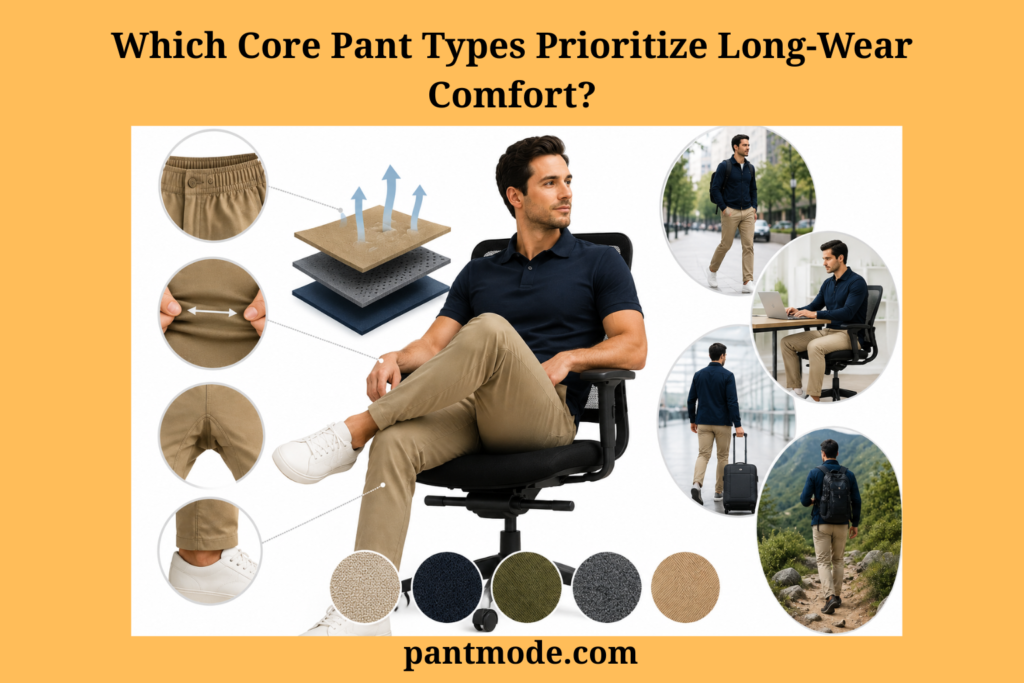
Core pant types that prioritize long-wear comfort usually combine stable stretch, breathable fabric, smooth seams, flexible waist construction, and enough room for sitting and movement.
This guide explains fabric performance, comfort-focused construction, daily style comparison, sizing logic, comfort-failure troubleshooting, and a buying checklist.
Quick Answer
Core pant types that often prioritize long-wear comfort include performance chinos, elevated technical joggers, high-stretch denim, and modern travel trousers. The most comfortable option depends on fabric recovery, breathability, waistband comfort, seam smoothness, movement range, and the environment where the pants will be worn.
Figure: long-wear comfort system shows how comfort features work together rather than acting alone.
Why is fabric performance the foundation of long-wear comfortable pants?
Fabric performance is the foundation of long-wear comfortable pants because stretch, recovery, breathability, and moisture behavior determine how pants feel after hours of sitting, walking, and movement.
The rule is to prioritize balanced fabric behavior rather than one comfort feature alone.
Moderate stretch can support mobility, but too much stretch may reduce structure and lead to bagging when recovery is weak.
Breathable fibers can reduce heat buildup, but airflow still depends on weave, weight, lining, fit, and the environment.
Fabric recovery matters because a pant that feels comfortable at first can lose shape at the knee or seat after repeated movement.
Comfort choices become clearer after readers understand how core types are defined by use, fabric, and fit.
Definition
Long-wear comfortable pants are core pant types designed or selected to reduce pressure, heat buildup, friction, shape loss, and movement restriction during extended daily wear.
Evidence note: Use Textile School, Cotton Incorporated, The Woolmark Company, or manufacturer fabric data when making technical claims about stretch recovery, breathability, moisture behavior, wool, cotton blends, or Tencel blends.
Fabric Performance Comparison Table
| Fabric / Blend | Comfort Benefit | Recovery Signal | Breathability Signal | Risk |
|---|---|---|---|---|
| Cotton-elastane blend | Supports moderate movement | Returns to shape when recovery is balanced | Depends on weave and weight | Too much stretch can reduce structure |
| Wool or wool blend | Can support drape and temperature balance | May hold shape when constructed properly | Often works well in dress contexts | Care and weave still matter |
| Tencel blend | Soft hand and drape | Depends on blend and construction | Can feel airy in suitable weaves | May wrinkle or collapse if too soft |
| Technical fabric | Mobility and travel performance | Often designed for recovery | Moisture behavior depends on fabric data | Claims need manufacturer support |
| High-stretch denim | Familiar look with mobility | Recovery controls bagging | Usually less airy than lighter fabrics | Can cling or lose shape if recovery fails |
What comfort-focused construction features make all-day comfort pants more wearable?
Comfort-focused construction features make all-day comfort pants more wearable by reducing pressure points, friction, stiffness, and movement restriction.
A hidden gusset can improve range of motion, but it will not help if the base fit is too tight through the seat or thigh.
Articulated knees can support bending and sitting, but they may look too technical for formal settings.
A flexible waistband can improve seated comfort, but weak structure can roll, fold, or lose polish.
Flat interior seams can reduce rubbing, but fabric texture and thigh fit still affect long-wear comfort.
Evidence note: Garment construction references or manufacturer technical sheets should support detailed claims about gussets, articulated knees, waistband systems, and seam construction.
Figure: comfort construction features supports long-wear comfort evaluation.
Comfort Feature Matrix
| Feature | Benefit | Daily Impact | Limitation |
|---|---|---|---|
| Hidden gusset | Improves movement range | Helps walking, climbing stairs, and sitting | Not useful if the pant is too tight |
| Articulated knees | Supports bending | Reduces strain during seated or active movement | May look technical in refined outfits |
| Flexible waistband | Reduces seated pressure | Improves comfort during long sitting periods | Weak structure can roll or fold |
| Flat interior seams | Reduces seam bulk | Can reduce rubbing during movement | Fabric texture still matters |
| Room-balanced thigh fit | Prevents restriction | Supports walking and sitting | Too much room can feel sloppy or baggy |
Which comfort-focused pant styles perform best in different daily environments?
Comfort-focused pant styles perform best when the fabric, waistband, leg shape, and construction match the wearer’s daily environment.
Performance chinos often work well for office or smart-casual days because they can balance polish and movement.
Elevated technical joggers can support travel or casual mobility, but visible performance details may read too casual for dressier settings.
High-stretch denim can support casual long wear, but poor recovery can create knee or seat bagging.
Modern travel trousers can support commuting and movement, but wrinkle resistance and moisture behavior should be verified through garment data.
Long-wear comfort still depends on context because function use influences how core pant types should be selected.
Comfort-focused pants can still look refined when casual cues stay controlled rather than overly technical.
More formal contexts may require cleaner construction, so compare comfort features against formal design standards before using technical pants in dressier settings.
Figure: long-wear pant decision logic supports long-wear comfort evaluation.
Long-Wear Pant Decision Matrix
| Pant Style | Best Environment | Comfort Advantage | Risk / Limitation |
|---|---|---|---|
| Performance chinos | Office and smart-casual days | Balanced polish, stretch, and movement | Too much stretch can reduce shape retention |
| Elevated technical joggers | Travel and casual mobility | Flexible waist and range of motion | May look too casual for formal settings |
| High-stretch denim | Casual long days | Familiar look with added movement | Can bag or cling if recovery fails |
| Modern travel trousers | Commuting and movement-heavy days | Wrinkle resistance and mobility potential | Fabric claims need garment-level support |
| Soft structured trousers | Long sitting and polished casual use | Drape with reduced pressure | Too soft can lose shape |
How should you size extended-wear trousers to maintain comfort throughout the day?
Extended-wear trousers should be sized for seated comfort, walking room, waistband stability, and fabric recovery rather than standing fit alone.
If the fabric has high stretch, check whether it returns to shape after sitting and bending.
If the day involves walking or commuting, choose enough thigh and seat room to prevent restriction.
If the day involves long sitting periods, check waistband pressure before trusting the standing mirror fit.
If comfort is the priority, select the closest base cut first instead of relying on stretch to solve every fit problem.
Men’s long-wear fit may need proportion checks because men’s proportions influence pant fit.
Women’s long-wear comfort may also depend on silhouette because women’s silhouette fit affects wearability.
Boundary note: These sizing checks are fit heuristics, not universal sizing rules or a measurement calculator.
Why do fatigue-resistant pants sometimes lose comfort, shape, or mobility?
Fatigue-resistant pants can lose comfort, shape, or mobility when fabric recovery, seam smoothness, waistband structure, breathability, or laundering care fails.
Knee or seat bagging usually points to poor recovery, overstretching, or fabric that does not return cleanly after movement.
Inner-thigh rubbing can come from rough seams, fabric texture, tight thigh fit, or long-duration friction, but persistent skin problems require appropriate professional guidance.
Waistband rolling often comes from weak waistband structure, poor rise match, or too much compression during sitting.
Heat buildup often comes from low airflow, dense fabric, or a poor environment match.
Mobility restriction often means the base cut lacks enough room before stretch or gusset features can help.
Evidence note: Use manufacturer care labels, manufacturer fabric data, or textile-care guidance before making laundering or heat-exposure claims about recovery loss.
Figure: comfort failure diagnosis turns comfort screening into a repeatable check.
Comfort Failure Troubleshooting Table
| Problem | Likely Cause | Possible Fix | Prevention Rule |
|---|---|---|---|
| Knee or seat bagging | Poor recovery or overstretching | Choose better recovery or more structured fabric | Test sitting and bending before buying |
| Inner-thigh rubbing | Rough seams, tight fit, or fabric friction | Check seam smoothness and thigh room | Avoid relying on tight stretch as a comfort solution |
| Waistband pressure | Rise mismatch or waistband compression | Try a different rise or flexible structure | Test seated comfort, not standing fit alone |
| Waistband rolling | Weak waistband or poor size balance | Choose stronger waistband construction | Avoid waistbands that fold while sitting |
| Heat buildup | Low breathability or dense fabric | Match fabric to climate and activity | Avoid dense fabrics for hot long-wear settings |
| Mobility restriction | Base cut too narrow | Choose a roomier cut or gusseted construction | Fit seat and thigh before judging stretch |
What checklist should you use before buying long-wear comfortable pants?
The best checklist for buying long-wear comfortable pants tests fabric composition, breathability, waistband comfort, seam smoothness, movement range, recovery, and daily-use match.
Check fabric composition without assuming one fiber or blend guarantees comfort.
Evaluate breathability by matching fabric weight, weave, and lining to the climate and setting.
Test waistband comfort while sitting because standing fit can hide pressure points.
Inspect seam smoothness and movement range before trusting stretch claims.
Check recovery after bending so the pant does not lose shape quickly.
This page stays narrower than the full pant taxonomy because it focuses only on long-wear comfort, fabric behavior, and buying checks.
Figure: long-wear buying checklist turns comfort screening into a repeatable check.
Long-Wear Comfort Buying Checklist
| Check | Evaluate | Decision | Risk Check |
|---|---|---|---|
| Fabric composition | Fiber, blend, and structure | Choose balanced stretch and recovery | Do not assume percentages guarantee comfort |
| Breathability | Climate, weave, and lining | Match fabric to environment | Low airflow can feel sticky |
| Waistband comfort | Sitting and bending pressure | Keep if stable without digging | Weak waistbands may roll |
| Seam smoothness | Interior seam profile | Choose low-profile seams for long movement | Fabric texture still matters |
| Movement range | Walk, sit, bend, and climb | Keep if the pant moves with the body | Stretch cannot fix a bad base cut |
| Recovery | Shape after movement | Choose fabric that returns visually | Poor recovery causes bagging |
| Daily-use match | Work, travel, casual, or commute | Choose the pant for the real environment | Wrong context reduces comfort and polish |
Key Takeaway
If pants feel comfortable at first but lose shape, trap heat, rub the thighs, or pressure the waist after hours of wear, the issue is usually fabric recovery, seam construction, waistband structure, or sizing balance.
Frequently Asked Questions
Performance chinos, elevated technical joggers, high-stretch denim, and travel trousers can often work well, but the best choice depends on fabric recovery, waistband comfort, movement needs, and setting.
No. Stretch can improve mobility, but poor recovery can cause bagging, cling, or shape loss after hours of wear.
Common causes include waistband pressure, short rise, tight thighs, rough seams, poor fabric recovery, or low breathability.
Moderate stretch, recovery, breathability, softness, and moisture behavior usually matter most for extended daily wear.
Sit, walk, bend, check waistband pressure, inspect seam smoothness, and see whether the fabric returns to shape after movement.
Conclusion
Long-wear comfortable pants work best when fabric performance, construction details, fit balance, and daily environment align.
Use stretch, recovery, breathability, waistband behavior, seam comfort, movement range, and daily-use match together before treating any core pant type as comfortable for extended wear.