
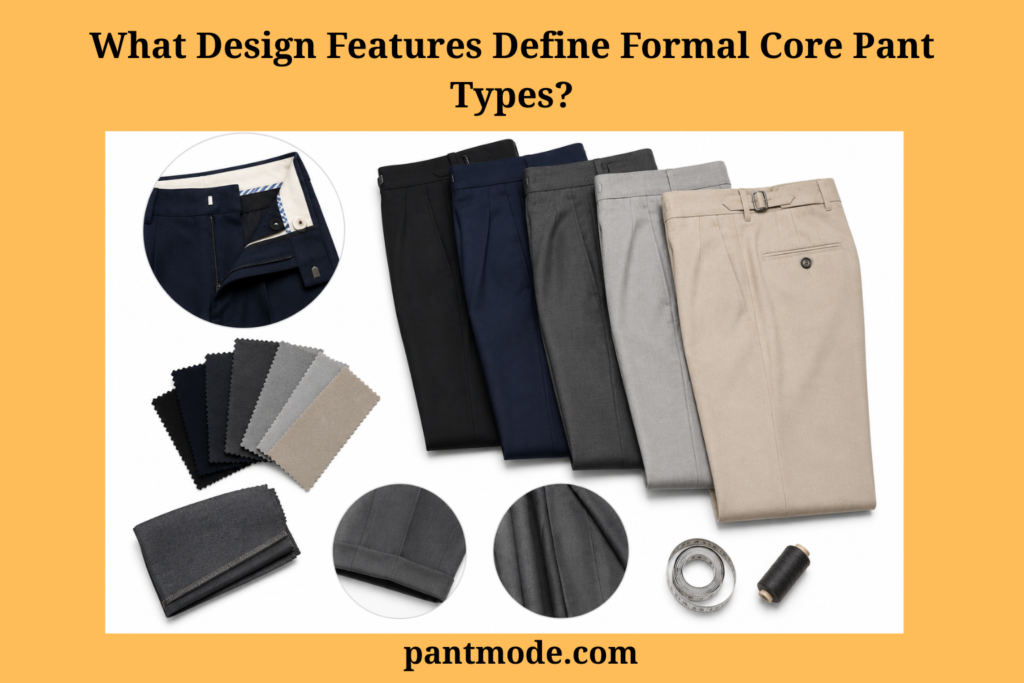
What Design Features Define Formal Core Pant Types? A Sartorial Guide
Formal core pant types are defined by construction, drape, refined fabric, clean waist structure, discreet pockets, and polished finishing rather than color alone.
This sartorial guide explains formal trouser anatomy, fabric selection, finishing details, rise, seat, break, common mistakes, and purchase evaluation.
Quick Answer
Formal core pant types are usually defined by clean construction, refined fabric, a stable waistband, a visible center crease, discreet pocket design, controlled drape, polished hem finishing, and a break that works with the shoe. No single feature guarantees formality; the details must work together.
Figure: formal trouser design system supports formal-trouser evaluation without turning the article into a product guide.
Why do the design features of formal core pant types determine whether trousers appear truly formal?
Formal trouser design determines formality because construction, drape, and finishing communicate polish more reliably than color alone.
The rule is that formal trousers are defined primarily by construction and drape rather than color alone.
A dark garment can still look casual if its construction resembles jeans, utility pants, or stretch chinos.
A black five-pocket cotton pant remains casual in many contexts, while a pressed worsted-wool dress trouser can signal formality when the fit and finishing support it.
No single feature automatically guarantees formality, because fabric, cut, context, and finishing must work together.
The parent framework for core types explains how use, fabric, and fit interact before this page narrows the lens to formal design.
Definition
Formal core pant types are refined trousers whose construction, fabric behavior, crease, waistband, pocket profile, drape, and hem finishing create a polished sartorial line.
What structural elements define the anatomy of formal core pant types?
The anatomy of formal core pant types is defined by the center crease, pocket construction, waistband structure, seat balance, and clean leg line.
The center crease structures the vertical line and often signals dress-trouser polish, but a crease still needs suitable fabric and correct pressing to look refined.
Pocket construction controls the side profile, so discreet slanted, jetted, or clean pocket shapes typically look more formal than bulky utility pockets.
Waistband construction stabilizes the trouser and may support alteration, but a strong waistband cannot rescue poor rise or seat balance.
Seat construction preserves smoothness across the back of the trouser, while a clean leg line helps the fabric fall from waist to hem without casual collapse.
Figure: formal trouser anatomy supports formal-trouser evaluation without turning the article into a product guide.
Formal Trouser Anatomy Table
| Feature | Purpose | Formal Standard | Casual Warning Sign |
|---|---|---|---|
| Center crease | Creates a vertical line and polished signal | Sharp, continuous, and aligned | Broken, absent, or distorted crease |
| Pocket construction | Controls side profile | Discreet, flat, and clean | Bulging, patch-like, or utility-shaped pocket |
| Waistband construction | Stabilizes the trouser | Structured waistband with clean closure | Weak waistband or overly casual belt treatment |
| Seat construction | Supports smooth back drape | Clean seat without major pulling or sagging | Wrinkles, collapse, or tight strain |
| Clean leg line | Preserves refined fall | Smooth drape from thigh to hem | Clinging, twisting, or heavy stacking |
How do fabric choices influence the drape and classification of formal core pant types?
Fabric choices influence formal core pant types by controlling drape, crease retention, seasonal comfort, texture, and visual refinement.
For business-formal or ceremonial settings, high-twist worsted wool often supports sharp drape, but garment quality and fit still need verification.
For cold-weather formality, worsted flannel or wool serge may add warmth and structure, but bulky collapse can weaken refinement.
For warm-weather formality, wool-mohair or refined linen-wool blends may offer airflow with polish, but overly slubby linen texture can read more casual.
For year-round use, mid-weight worsted wool often provides versatility, but weave, cut, and tailoring still matter.
Fabric behavior belongs inside the broader pant taxonomy, but this page keeps the focus on formal trouser construction and drape.
Figure: fabric formality signals supports formal-trouser evaluation without turning the article into a product guide.
Fabric Formality Matrix
| Fabric | Formality Signal | Typical Use | Drape Character | Seasonal Use | Caution |
|---|---|---|---|---|---|
| High-twist worsted wool | Sharp and refined | Business formal or ceremonial wear | Clean and crisp | Year-round or temperate | Quality, cut, and fit still matter |
| Worsted flannel | Soft but formal | Cold-weather dress trousers | Structured with warmth | Cool seasons | Avoid bulky collapse |
| Wool serge | Dense and traditional | Formal or uniform-adjacent trousers | Firm and controlled | Cool or transitional weather | Can look heavy if poorly cut |
| Wool-mohair | Crisp and breathable | Warm-weather formal settings | Dry and polished | Warm weather | May feel sharper than soft fabrics |
| Refined linen-wool blend | Seasonal polish | Summer formal or dress-casual | Airy with texture | Warm weather | Avoid overly casual linen slub |
Which finishing details separate premium formal trousers from standard dress trousers?
Premium formal trousers are separated from standard dress trousers by finishing details that refine the waistline, hem, closure, pocket profile, and visual continuity.
Side adjusters often create a cleaner waistline than belt loops, but belt loops may still work depending on dress code and styling context.
Plain hems typically look sleeker, while turn-ups can add visual substance in some tailoring traditions.
Blind hems refine the finishing because visible hem stitching can look less formal, but hem quality still depends on execution.
Extended waist closures and discreet pocket finishing can elevate the trouser line, but no single detail alone makes trousers premium.
Figure: formal finishing details supports formal-trouser evaluation without turning the article into a product guide.
Formal Trouser Finishing Comparison Table
| Detail | Visual Effect | Formality Verdict | Best Use | Caution |
|---|---|---|---|---|
| Side adjusters | Cleaner waistband without belt interruption | Often more formal | Tailored trousers and suiting | Not required for every dress code |
| Belt loops | Practical waist support | Can still be acceptable | Business dress trousers | Belt choice can reduce refinement |
| Plain hems | Sleek lower line | Typically cleaner | Formal and business trousers | Can look too light in some fabrics |
| Turn-ups | Adds weight and substance | Context-dependent | Classic tailoring traditions | Can look bulky or casual if mismatched |
| Blind hems | Discreet finishing | Refined | Formal trouser hems | Execution quality still matters |
| Extended closure | Smooth front continuity | Elevated when well made | Tailored dress trousers | Poor closure can pull or distort |
How should properly fitted formal core pant types sit and drape on the body?
Properly fitted formal core pant types should sit securely at the waist, drape cleanly through the seat, and break proportionally over the shoe.
The rise should support the natural waist or high-hip area, but the right placement depends on the trouser cut and wearer’s proportions; men’s proportions explains proportion logic outside this formal-design lens.
The seat should drape cleanly without pulling, sagging, or excess collapse.
The break should remain clean and proportional, because too much pooling can weaken the formal line.
The hem opening should match shoe shape and fabric drape so the lower leg looks intentional.
Because break and movement matter during long wear, long-wear comfort helps explain why standing fit alone is not enough.
Figure: rise seat and break control supports formal-trouser evaluation without turning the article into a product guide.
Hem & Break Decision Matrix
| Break Type | Visual Effect | Best Formal Use | Shoe Pairing | Risk |
|---|---|---|---|---|
| No break | Very clean and modern | Slim or tapered dress trousers | Sleek formal shoes | Can look short if hem is too high |
| Slight break | Balanced and refined | Most formal trouser contexts | Oxford, loafer, derby, dress boot | Depends on leg width and drape |
| Half break | Classic with more fabric presence | Wider or traditional trousers | Substantial dress shoes | Can become heavy if fabric collapses |
| Full break | More traditional and covered | Rare formal use with specific cuts | Heavier shoes | Often risks pooling and visual heaviness |
What common mistakes reduce the elegance of formal core pant types, and how can you fix them?
Common mistakes reduce the elegance of formal core pant types when fit, finishing, fabric, or hem control disrupts the clean formal line.
Pocket flare often comes from hip tension or pocket construction, and a cleaner cut or better seat room may restore the side profile.
Visible hem stitching can reduce refinement, so a discreet blind hem may improve the finish when the fabric allows it.
Excess pooling often comes from incorrect length, weak drape, or mismatched shoe shape, and a cleaner break may restore proportion.
Seat wrinkling often signals poor seat balance, but complex seat corrections may require professional tailoring.
A broken crease or overly casual pocket shape can weaken the formal line, and sometimes the better fix is choosing a more formal base trouser.
Casual pant language should stay separate because casual cues differ from formal-trouser signals; the softer boundary belongs closer to polished casual styling than strict formality.
Figure: formal fit troubleshooting supports formal-trouser evaluation without turning the article into a product guide.
Formal Fit Troubleshooting Table
| Mistake | Likely Cause | Possible Fix | Result | Limitation |
|---|---|---|---|---|
| Pocket flare | Hip tension or pocket construction | Choose more room or a cleaner pocket profile | Cleaner side line | Tailoring may not add enough room |
| Visible hem stitching | Less refined finishing | Use a discreet hem finish when suitable | More polished lower edge | Depends on fabric and execution |
| Excess pooling | Length, drape, or shoe mismatch | Adjust hem or break | Cleaner shoe balance | Not every cut supports every break |
| Seat wrinkling | Seat balance or fit issue | Refine fit with tailor if possible | Smoother back drape | Complex corrections are not universal |
| Broken crease | Pressing, fabric, or fit problem | Press correctly or choose better fabric/cut | Sharper vertical line | Weak fabric may not hold it well |
| Overly casual pocket shape | Casual construction language | Choose more discreet pockets | More formal profile | Pocket design may be structural |
How can you evaluate formal core pant types before making a purchase?
You can evaluate formal core pant types before purchase by checking crease sharpness, fabric refinement, pocket design, waistband construction, seat balance, hem finish, and tailoring allowance.
Check the center crease to confirm that it aligns cleanly and supports the vertical line.
Verify fabric refinement by looking for smooth drape, appropriate texture, and a clean fall from waist to hem.
Examine pocket construction because bulky or distorted pockets reduce formal polish.
Confirm hem finish and break because the trouser must relate cleanly to the shoe.
Assess rise and seat balance before relying on alterations.
Evaluate waistband construction and tailoring allowance where possible, but do not treat tailoring as a universal rescue.
Occasion fit still matters because function use affects how formal trousers should be selected.
Sartorial Quality Evaluation Checklist
| Evaluation Point | What to Check | Pass Signal | Risk Signal |
|---|---|---|---|
| Center crease | Alignment and continuity | Sharp vertical line | Broken or wandering crease |
| Fabric refinement | Texture, drape, and surface | Smooth and controlled fall | Collapse, shine, or rough casual texture |
| Pocket design | Side profile and bulk | Discreet and flat | Bulging or utility-like pocket |
| Waistband construction | Stability and closure | Clean waistline | Weak or distorted waistband |
| Seat balance | Back drape | Smooth without major strain | Pulling, sagging, or heavy wrinkles |
| Hem finish | Stitching and edge quality | Discreet and refined | Visible rough stitching |
| Break and drape | Shoe interaction | Clean proportional break | Pooling or awkward lift |
| Tailoring allowance | Practical alteration room | Refinable fit issue | Structural mismatch |
Key Takeaway
Formal core pant types look genuinely formal when construction, fabric, crease, pocket profile, waistband, drape, and hem control work together. If the fabric, seat, rise, or pocket construction fails, choose a better base trouser before relying on tailoring.
Frequently Asked Questions
No. Black pants are not automatically formal because construction, fabric, drape, pocket shape, crease, and finishing determine formality more reliably than color alone.
Worsted wool often works well for formal trousers because it can support a clean crease and refined drape, but weave, cut, fit, and garment quality still matter.
Side adjusters are not required for every formal trouser. They can create a cleaner waistband, but belt loops may still work depending on dress code and styling context.
A clean no-break or slight-break trouser often looks refined, but the best break depends on leg width, shoe shape, fabric drape, and personal context.
No. Tailoring can refine many issues, but it cannot reliably fix every structural problem, especially if the rise, seat, pocket construction, or fabric choice is wrong from the start.
Conclusion
Formal core pant types are defined by construction, fabric behavior, drape, finishing, fit, and hem control rather than dark color alone.
Use the crease, fabric, waistband, pockets, seat, break, and finishing details together as a repeatable sartorial checklist before judging whether a trouser is genuinely formal.