
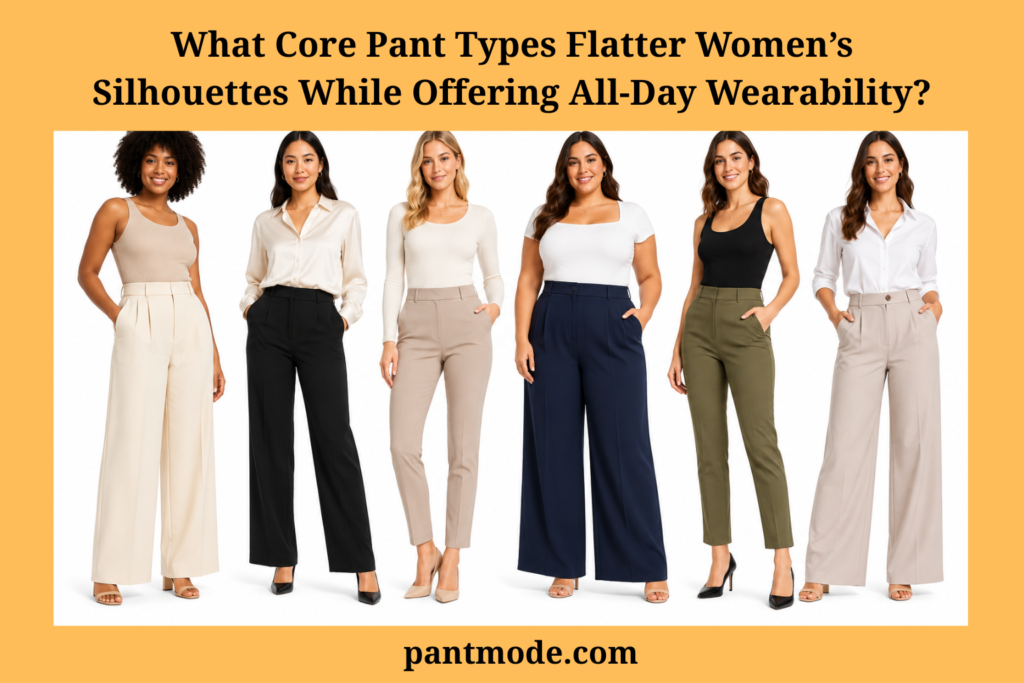
What Core Pant Types Flatter Women’s Silhouettes While Offering All-Day Wearability?
The best core pant types for women may balance flattering silhouette, reliable structure, and daily comfort when the rise, fabric, and leg shape match the wearer’s movement needs.
This guide focuses on core women’s pant styles that work across real-life movement, long sitting periods, professional outfits, and casual wardrobe rotation.
Quick Answer
The best core pant types for women may balance flattering silhouette, reliable structure, and daily comfort. Wide-leg trousers can often add flow, straight-leg ankle pants may create a clean line, bootcut styles can balance curves, tapered pleat pants may add hip and thigh room, and structured pull-on trousers can support long-day wear.
Figure: comfort and silhouette fit system supports practical fit and styling decisions.
Why do women’s core pant styles often struggle to balance a flattering silhouette with all-day comfort?
Women’s core pant styles often struggle to balance a flattering silhouette with all-day comfort because structure and stretch solve different fit problems.
A flattering pant needs structure, but all-day comfort needs controlled stretch.
Rigid fabrics can hold shape, but they may dig, wrinkle, or restrict movement when the rise, hip block, or thigh room does not match the wearer.
Overly stretchy fabrics may feel easy, but they can cling, sag, or lose polish when the fabric lacks enough structure.
Rise placement controls both comfort and silhouette because the waistband must stay stable while the body sits, bends, and walks.
The fit logic becomes clearer after readers understand how use, fabric, and fit define core types.
Fabric Composition & Stretch Guide
| Feature | What It Controls | Good Sign | Risk Sign |
|---|---|---|---|
| Structure | Polish and shape | Clean line | Restriction |
| Stretch | Movement | Comfort with recovery | Sagging or cling |
| Rise | Waist stability | Supportive fit | Digging or dragging |
| Drape | Silhouette flow | Smooth fall | Pooling or collapse |
Definition
Core pant types for women’s silhouettes are foundational trouser cuts chosen by how they balance rise, fabric behavior, hip room, thigh movement, leg shape, and all-day wearability.
What are the women’s core pant styles that consistently flatter the body without restricting movement?
Women’s core pant styles can flatter the body without restricting movement when the cut pairs shape control with enough room for sitting, walking, and daily wear.
Wide-leg trousers can add flow and visual length when fabric drapes cleanly and the hem does not pool.
Straight-leg ankle pants may create a clean vertical line for everyday wear when the rise and hip block feel stable.
Kick-flare or bootcut pants can balance curves when the knee, hem, and footwear line coordinate.
Tapered pleat or carrot pants may add hip and thigh room while keeping the lower leg more structured.
Structured pull-on trousers can support long workdays when the waistband feels secure without rolling or digging.
Professional outfits need structure because formal features rely on cleaner construction and controlled drape.
Figure: women’s core pant style roles supports practical fit and styling decisions.
Women’s Core Pant Style Comparison Table
| Pant Style | Possible Benefit | Common Use Case | Fit Risk |
|---|---|---|---|
| Wide-Leg Trouser | Fluid movement and visual length | Office, travel, dress-casual | Pooling if hem or drape fails |
| Straight-Leg Ankle Pant | Clean vertical line | Everyday and smart-casual outfits | Can pull if hip block is too narrow |
| Kick-Flare / Bootcut Pant | Curve balance and longer leg line | Professional and elevated casual use | Hem can clash with footwear |
| Tapered Pleat / Carrot Pant | Hip and thigh room | Seated comfort and relaxed tailoring | Pocket flare if cut is wrong |
| Structured Pull-On Trouser | Waistband comfort with polish | Long workdays and travel | Waistband may roll or dig |
Which women’s core pant styles best complement your body proportions and shape?
Women’s core pant styles may complement body proportions when the rise, waistband, hip room, leg shape, and drape create balance without restricting movement.
For pear-shaped proportions, wide-leg trousers may create vertical flow and balance hip width when the fabric hangs cleanly.
For apple-shaped proportions, straight-leg ankle pants may create a cleaner line when the waistband stays stable and the rise feels comfortable.
For hourglass proportions, kick-flare or bootcut pants can support waist definition while balancing the lower leg.
For rectangle-shaped proportions, tapered pleat or relaxed structured styles may add shape and dimension without forcing volume.
For athletic proportions, tapered pleat pants or structured pull-on trousers may support hip and thigh room while maintaining polish.
Proportion logic differs by audience, so this article keeps women’s silhouette-fit decisions separate from men’s pant-fit guidance.
Figure: pant shape to body silhouette matrix supports practical fit and styling decisions.
Pant Shape to Body Silhouette Matrix
| Body Shape Heuristic | Possible Pant Shape | Likely Result | Avoid When |
|---|---|---|---|
| Pear | Wide-leg trouser | May balance hip width and create flow | Fabric collapses or hem drags |
| Apple | Straight-leg ankle pant | May create a cleaner vertical line | Waistband digs or rolls |
| Hourglass | Kick-flare or bootcut pant | Can balance waist and lower leg | Hip block feels restrictive |
| Rectangle | Tapered pleat or relaxed structured pant | May add shape and dimension | Pleats pull or pockets flare |
| Athletic | Tapered pleat or structured pull-on trouser | May support thigh room and polish | Knee or calf area clings |
Body shape categories are broad styling shortcuts. Individual proportions, fabric behavior, and personal comfort can override the matrix.
How can you style core women’s trouser cuts for desk-to-dinner wearability?
Core women’s trouser cuts can work for desk-to-dinner wearability when the top, footwear, and layer balance the pant’s volume, rise, and leg shape.
If wearing wide-leg trousers, pair them with a defined top and stable footwear so the volume stays intentional.
If wearing straight-leg ankle pants, pair them with a clean knit, blouse, or blazer so the line works across office and evening settings.
If wearing kick-flare or bootcut pants, pair them with footwear that supports the hem so the leg line remains controlled.
If wearing tapered pleat pants, pair them with a fitted or tucked top so the hip room reads as relaxed tailoring.
If wearing structured pull-on trousers, add a polished layer so comfort does not look too casual.
A silhouette-friendly pant still needs context because core pant types are also classified by function use.
Figure: desk-to-dinner styling formula supports practical fit and styling decisions.
Desk-to-Dinner Styling Formula Table
| Pant Style | Day Pairing | Evening Adjustment | Possible Result |
|---|---|---|---|
| Wide-Leg Trouser | Defined knit or tucked blouse | Sharper shoe or structured layer | Flow with polish |
| Straight-Leg Ankle Pant | Blouse, knit, or blazer | Swap to cleaner footwear or jewelry | Clean day-to-evening line |
| Kick-Flare / Bootcut Pant | Fitted top or soft blouse | Add elevated shoe and jacket | Balanced curve-friendly shape |
| Tapered Pleat / Carrot Pant | Tucked top or cropped layer | Add sleeker shoe | Relaxed tailoring |
| Structured Pull-On Trouser | Soft top and polished layer | Add refined outer layer | Comfort with structure |
What common fit mistakes ruin women’s core pant styles, and how do you fix them?
Common fit mistakes can ruin women’s core pant styles when the waist, rise, hip block, thigh room, fabric recovery, or pocket placement conflicts with the body’s movement.
Waist gap often comes from a hip-to-waist mismatch, so fit the hips first and refine the waist only if the base cut works.
Crotch drag often comes from rise mismatch, so test the rise while sitting and walking before buying.
Knee bagging often comes from fabric recovery or cut collapse, so choose more structure if the fabric distorts quickly.
Thigh restriction often comes from insufficient upper-leg room, so use a roomier base cut before expecting tailoring to solve it.
Pocket flare often comes from hip block tension or pocket placement, so choose a better-proportioned pant alternative.
Casual rotation works better when casual cues differ from formal-trouser signals.
Figure: women’s pant fit troubleshooting supports practical fit and styling decisions.
Fit Troubleshooting Table
| Problem | Likely Cause | Possible Fix | Better Pant Alternative |
|---|---|---|---|
| Waist gap | Hip-to-waist mismatch | Fit hips first, then refine waist | Contoured-waist straight-leg or wide-leg trouser |
| Crotch drag | Rise mismatch | Test sitting and walking before buying | Higher-rise or better hip-block cut |
| Knee bagging | Poor recovery or fabric collapse | Choose more structure | Ponte, structured twill, or better-cut straight leg |
| Thigh restriction | Insufficient thigh room | Start with a roomier base cut | Tapered pleat, carrot, or relaxed trouser |
| Pocket flare | Hip block tension or pocket placement | Try a different cut or pocket design | Structured trouser with better hip room |
How do you evaluate the perfect pair of women’s core pant styles before buying?
You can evaluate a pair of women’s core pant styles before buying by using fitting-room tests as screening heuristics for waistband stability, rise comfort, pocket behavior, thigh movement, and fabric recovery.
The sit test checks whether the waistband digs, rolls, slides, or creates crotch drag.
The bend test checks whether the rise, seat, and thigh area allow movement without pulling.
The pocket check identifies pocket flare, gaping, or tension across the hip block.
The thigh movement test checks whether walking and sitting feel restricted.
The fabric recovery test checks whether the pant returns visually after sitting or bending.
Long days require comfort checks because some core pant types prioritize long-wear comfort.
Figure: five-point fitting room screen supports practical fit and styling decisions.
5-Point Fitting Room Checklist
| Screening Test | What to Check | Pass Condition | What Failure May Suggest |
|---|---|---|---|
| The Sit Test | Waistband, rise, and crotch area | Pant stays stable without digging or drag | Rise mismatch or waistband issue |
| The Bend Test | Seat, thigh, and back rise | Movement feels supported | Thigh or seat restriction |
| The Pocket Check | Pocket flare and hip tension | Pocket lies cleanly | Hip block or pocket placement issue |
| The Thigh Movement Test | Walking and sitting comfort | Thigh moves without strain | Cut is too narrow |
| The Fabric Recovery Test | Shape after sitting or bending | Fabric returns visually enough for intended use | Recovery or structure issue |
These fitting-room tests are screening heuristics, not universal fit rules.
Key Takeaway
If a pant fails at the rise, hips, thighs, or fabric recovery, choose a different base cut before relying on alterations. Tailoring can refine fit, but it cannot reliably fix a restrictive or poorly matched pant type.
This page stays narrower than the full taxonomy where fit, styling, use, and structure define the five main pant types.
Frequently Asked Questions
The most comfortable core pant type depends on rise, waistband stability, fabric recovery, and thigh room. Structured pull-on trousers, wide-leg trousers, and tapered pleat pants can often work well when they match the wearer’s proportions.
Wide-leg trousers can flatter some women when the fabric drapes cleanly, the rise supports the waist, and the hem length creates vertical flow without pooling.
Contoured-waist straight-leg pants, curvy-fit trousers, or wide-leg styles with better hip-to-waist shaping may reduce waist gap when the hips fit but the waistband stands away.
Knee bagging often comes from fabric with poor recovery, excessive stretch, or a cut that collapses after sitting and bending.
Women should evaluate both silhouette and comfort. A pant that flatters while standing but restricts sitting, walking, or long wear is not a successful all-day fit.
Conclusion
Core pant types can flatter women’s silhouettes and support all-day wearability when rise, fabric behavior, leg shape, and fit stability work together.
Choose the base cut by testing structure, stretch, rise, waistband stability, hip room, thigh movement, drape, and fitting-room screening results before treating tailoring as the final refinement.