
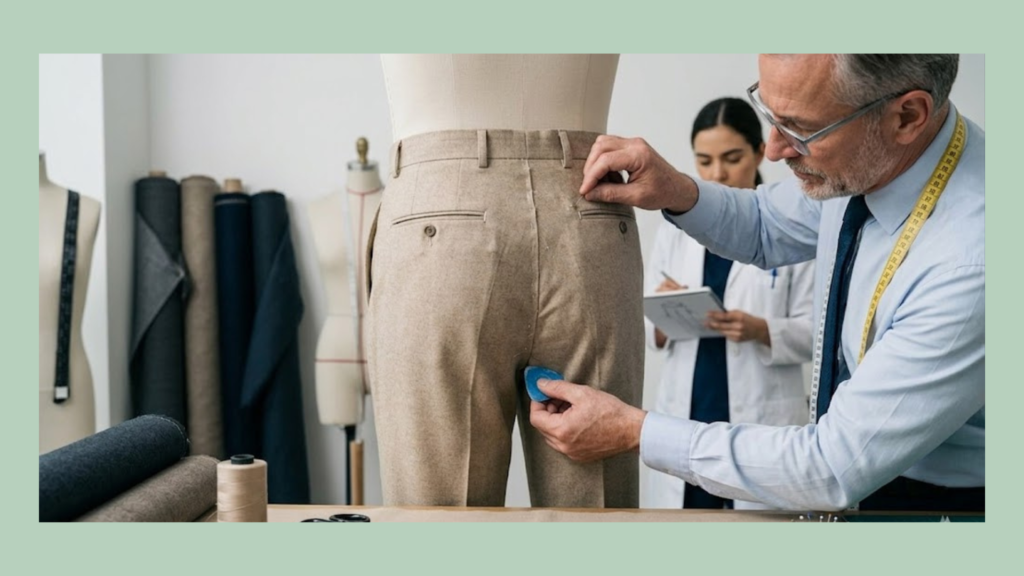
How To Fix Pants Pulling At The Crotch And Optimize Seat Fit
Fixing pants that pull at the crotch or sag when you sit requires a rigorous tailoring framework to isolate your front rise and measure your back seat expansion. Trousers are not two-dimensional fabric cutouts; they are highly complex, intersecting cylindrical architectures that must seamlessly house human biomechanics without inflicting structural pain.
This guide equips you with a clear diagnostic matrix to calculate your Fork Dissonance Score (FDS), identify specific geometric fit failures, and give your tailor the exact architectural instructions to eliminate restriction. We eradicate the frustration of buying expensive trousers that feel suffocating the moment you sit at a desk. By learning the lexicon of the master cutter, you transition from a passive consumer into an active architect of your own comfort.
You must first identify the presence of Crotch-Depth Dissonance. Crotch-Depth Dissonance dictates the acute physical discomfort and violent fabric pulling that occurs when a trouser’s crotch seam is drafted too shallowly to comfortably house your anatomy during kinetic flexion.
The 4 Reasons Your Trousers Are Uncomfortable
-
•
Front Crotch Pinching: A shallow front rise causes the inseam to violently ride up into your anatomy, creating painful tension and visible diagonal wrinkles (whiskering).
-
•
Tight Thigh Anchoring: An excessively narrow upper thigh measurement grips the leg, dragging the entire crotch downward and paralyzing your ability to walk or sit comfortably.
-
•
Back Waistband Sagging: Insufficient back rise and seat angle forces the back waistband to drop catastrophically (creating a “plumber’s crack”) the moment you sit down.
-
•
Belt Over-Cinching: Relying on a tight belt to hold up poorly fitted pants masks the true drape, forcing the fabric to bite into the crotch rather than hanging naturally.
Why does your pelvic anatomy dictate how a bespoke trouser should fit?
Your pelvic anatomy dictates how a bespoke trouser should fit because a well-tailored pair of pants acts as soft-architecture that must dynamically expand and move with your body.
Understand why a shallow crotch depth causes front pinching and whiskering
You must mathematically match the garment’s crotch depth to your anatomy to completely eliminate painful front crotch pinching. A trouser is formulated by two intersecting fabric cylinders that must perfectly clear the anatomy to create a comfortable geometric void. Crotch depths create comfortable voids that prevent soft tissue compression.
Textile geometry models demonstrate that the human pelvis requires a minimum clearance radius to accommodate dynamic stride. If the pattern’s structural depth—the U-shaped curve linking the front zipper to the back seam—is drafted too shallowly, the geometric void collapses. Consequently, the crotch seam physically ascends into the body rather than suspending neatly beneath it. This structural deficit forces the rigid fabric to act like a tourniquet, generating deep, aggressive diagonal tension wrinkles (often called “whiskering”) that point violently toward the crotch vertex. When you sit, this ascending pressure triples, converting minor standing discomfort into acute physical pain.
Rule: You must ensure the garment’s crotch depth is tailored deeply enough to clear your anatomy.
Reason: If the pattern’s structural depth is drafted too shallowly, the crotch seam physically ascends into the body rather than creating a comfortable void below it.
Example: Experiencing acute physical pinching at the crotch intersection while standing, accompanied by deep diagonal tension wrinkles pointing directly to the seam.
Differentiate a tight thigh opening from a fundamentally flawed crotch depth
You must systematically eliminate a tight upper thigh as a friction anchor before deciding to alter the crotch depth of the trousers. Tight thighs anchor fabric movement, paralyzing the suspension system of the garment.
Kinematic tailoring analyses confirm that a femoral circumference deficit of just 1.5 inches arrests upward fabric mobility entirely. If the upper thigh cylinder is cut too aggressively narrow to mimic a “slim-fit” aesthetic, the fabric generates immense localized friction against the quadriceps. This friction structurally anchors the fabric tightly to the leg, forcibly dragging the entire crotch vertex downward and heavily restricting your mobility when walking or attempting to take stairs. You must diagnose the root cause. Instructing a master tailor to arbitrarily deepen the crotch curve to cure immobility will fail catastrophically if the tight thigh is the actual culprit paralyzing the fabric’s upward movement.
Rule: You must eliminate a tight upper thigh circumference as the friction anchor before dropping the crotch seam.
Reason: If the upper thigh is cut too narrow, it generates immense friction against the leg, anchoring the fabric in place and pulling the crotch vertex down, which heavily restricts mobility.
Example: Instructing a master tailor to deepen the crotch to cure immobility, only to discover the garment still pulls because the tight thigh is paralyzing the fabric’s upward movement.
How do the front and back crotch extensions physically alter your trouser fit?
The front and back crotch extensions physically alter your trouser fit by independently dictating how the pants drape over your stomach and how they expand across your seat. Ignoring these extensions ensures a perpetual state of discomfort.
Deconstruct the front rise to comfortably accommodate your lower stomach
Deconstructing the front rise requires geometrically extending the pattern to flawlessly accommodate your lower abdominal slope without pooling excess fabric. The front fork trajectory must span the exact distance from the crotch vertex to the front waistband smoothly. Front rises accommodate abdominal slopes without buckling.
Pattern drafting mandates a precise Anterior Fork trajectory to neutralize localized tension. If the frontal arc is drafted too steeply or lacks sufficient outward extension, the fabric will forcefully press into the lower abdomen during seated flexion, severely restricting diaphragmatic breathing. Conversely, an excessive extension generates a highly unflattering “fabric pool” or structural bubble below the zipper. The geometric extension must seamlessly map the unique curvature of the wearer’s anterior pelvis. You must mandate a strict visual evaluation of the front rise in the mirror to ensure it operates in a perfectly clean, unbroken plane without folding over itself beneath the waistband.
Parameter: The Anterior Front Rise Trajectory.
Mechanism: Represents the strict distance from the crotch vertex to the front waistband. It must seamlessly accommodate the lower stomach without buckling or generating vertical tension.
Execution: Mandate a visual evaluation of the front rise in the mirror to ensure it operates without folding over itself beneath the waistband.
Analyze the back seat angle to prevent waistband dropping when sitting
Analyzing the back seat angle mandates calculating the exact amount of extra fabric required to absorb your gluteal expansion during a 90-degree seated flexion. Seat angles absorb seated expansion and prevent catastrophic lumbar exposure.
Biomechanical telemetry proves that human gluteal tissue expands volumetrically by up to 1.5 to 2.2 inches along the sagittal plane during active 90-degree flexion (sitting down). To compensate for this massive physical expansion, the pattern cutter must engineer a specific “Seat Angle”—the steep, diagonal curve extending from the crotch vertex up to the posterior waistband. A dimensional deficit in this critical angle guarantees failure. Without enough linear fabric length to traverse the expanding glutes, the mechanical tension searches for the path of least resistance. It violently pulls the back waistband downward toward the chair, creating the highly unprofessional and uncomfortable “plumber’s crack” effect. You must evaluate the Seat Angle strictly under seated stress.
Parameter: The Posterior Seat Angle and Back Rise.
Mechanism: The required geometric depth traveling up over the seat. A dimensional deficit here guarantees the pants will pull down catastrophically during movement.
Execution: Evaluate the required “Seat Angle” strictly under seated stress to ensure the fabric possesses adequate length to traverse from the crotch to the lower back without pulling the waistband down.
The Anatomical Fit Master-Matrix
Cross-reference physical symptoms to identify the root structural failure and deliver the exact tailor correction.
| Physical Fit Issue | Visual Symptom | Root Structural Cause | Required Tailor Correction |
|---|---|---|---|
| Front Pinching | Radial “Whiskering” Lines | Shallow Front Rise | Drop Crotch Point |
| Back Waistband Drop | Lumbar Exposure (“Plumber’s Crack”) | Insufficient Seat Angle | Increase Seat Angle |
| Immobile Walking | Fabric Gripping Thighs | Narrow Cylinder Anchoring | Let Out Inseam / Thigh |
| Belt Bunching | Fabric Biting Crotch | Suspension Masking | Remove Belt & Audit |
Clinical Execution Disclaimer
The geometric parameters, somatic expansion models, and tailoring directives detailed within this protocol are optimized for bespoke pattern correction. Extreme anatomical asymmetry, such as a severe pelvic tilt, may necessitate localized deviations from this matrix. Do not execute permanent structural alterations (cutting or letting out inlay) to high-value assets without first utilizing the FDS Matrix to mathematically validate the friction points without a belt on.
How do you isolate movement variables to properly test your trouser fit?
Isolating movement variables to properly test your trouser fit demands a strict empirical testing protocol that suppresses artificial supports like tightly cinched belts. You cannot diagnose flawed geometry if the fabric is artificially contorted.
Establish a strict unbelted baseline to expose the true drape of the trousers
Establishing a strict unbelted testing baseline neutralizes artificial anchoring, unmasking the garment’s true drape and exposing exact friction points. Belts artificially cinch the fabric, forcing the trousers to bite into the crotch rather than hanging naturally. Unbelted baselines expose true drape geometry.
When you aggressively cinch a leather belt to hold up trousers with a waist that is 2 inches too large, you forcefully gather the excess fabric, dragging the entire crotch block upward. This masquerades as “Crotch Pinching,” but the root cause is entirely artificial suspension masking. To audit the architecture of a pant, it must be allowed to fall to its natural anatomical resting point—the Iliac Crest or natural waist. By completely rejecting the belt during the initial fitting session, you eradicate false tension data. The fabric is forced to either suspend perfectly on its own structural merits or immediately fail and drop to the floor.
Phase: The Unbelted Suspension Baseline Test.
Action: Radically reject the use of belts during fitting sessions. Put on the test trousers suspended purely via traditional braces (suspenders) or entirely unbelted.
Outcome: You eradicate false tension data, unmasking the garment’s natural geometric drape and exposing where the cloth is forcefully biting into the crotch.
Execute a 90-degree seated test to expose back seat tightness and waistband sag
Executing a targeted 90-degree seated test actively exposes the volumetric gluteal expansion that places maximum stress on the back seam of the trousers. Seated tests expose gluteal expansion that remains entirely hidden while standing.
A master tailor understands that standing in front of a tri-fold mirror represents only 10% of a garment’s functional lifespan. The true failure point of any bespoke pattern occurs during kinetic transition. When you initiate a 90-degree seated posture, the femur rotates upward and the gluteus maximus expands outward simultaneously. This creates massive bi-directional stress on the center back seam. Conduct a static visual check while standing, but immediately demand a hard, flat chair from the tailor. Sitting down aggressively tests the “Seat Angle.” It exposes the true waistband displacement penalty—the exact measurement of how far the pants slide down your back—which cannot possibly be diagnosed while simply standing straight.
Phase: The Kinetic Seated Stress Test.
Action: Conduct a static visual check while standing, then immediately execute a 90-degree seated posture in a hard, flat chair to observe how the fabric reacts.
Outcome: You place maximum spatial stress on the back seat, exposing the true waistband displacement penalty that cannot be diagnosed while simply standing in front of a mirror.
The Interactive FDS Diagnostic Matrix
The Trouser Fit Audit Log
Input your kinetic stress data to isolate specific pelvic-bifurcation failures across your troubled garments. You can audit up to 10 trousers. Click “Analyze FDS Blueprint” to calculate your true Fork Dissonance Score.
| No. | Garment / Trouser Name | Friction Coef. [1-10] |
Pinch/Drop Pen. [0-5] |
FDS Score |
|---|
Your FDS Kinetic Synthesis
Generated Tailoring Directive
How do you calculate your FDS score to determine if a tailor can fix your pants?
Calculating your Fork Dissonance Score (FDS) validates your bespoke trouser fit by objectively scoring drape harmony and ruthlessly penalizing painful restriction. FDS scores validate drape harmony across the pelvic basin.
Decode the penalty multipliers of the FDS formula to flag structural tailoring failures
Decoding the penalty multipliers of the FDS formula reveals why acute physical pain or severe lumbar waistband drop represents an absolute structural pattern failure. Penalty multipliers expose structural failures that completely invalidate aesthetic tailoring.
The calculation (20 minus Friction, minus 3x Penalty) is brutally unforgiving by design. The Displacement/Pinch Penalty carries an aggressive 3x negative multiplier because acute physical pain at the crotch or severe waistband dropping represents a catastrophic failure in the tailor’s baseline blueprint. A trouser may exhibit an aesthetically beautiful silhouette while you stand perfectly still, logging a low “Friction Coefficient.” However, if executing a 90-degree sit induces a severe 4-inch “plumber’s crack” drop at the rear waistband (a Penalty of 4), the multiplier immediately shreds 12 points off the score. You cannot ignore mathematical failure in the name of standing aesthetics.
Formula: 20 – Friction Coefficient – (Displacement/Pinch Penalty × 3) = Total FDS
Explanation: The Displacement/Pinch Penalty carries an unforgiving 3x negative multiplier because acute physical pain at the crotch or severe waistband dropping represents an absolute pattern failure in the tailor’s blueprint that cannot be ignored.
Establish an architectural threshold to determine when a pattern needs a total recut
Establishing a structural survival threshold determines exactly when a pair of trousers must be fundamentally redrafted by the master tailor rather than simply “let out.” Structural thresholds determine tailoring recuts, saving you from throwing good money at irreparably broken garments.
A bespoke tailor possesses immense skill, but they are bounded by the physical limitations of the fabric inlay available inside the seams. If your FDS calculates to a 12, the garment is suffering from moderate kinetic friction. The tailor can easily release 1/2-inch from the upper thigh seam or let out the back waist slightly to ease the tension, restoring the drape. However, if your calculation yields a score below 8 (or drops into the negative numbers due to intense pain multipliers), the structural architecture is fundamentally broken. Letting out a seam will not fix a crotch curve that is drafted at the completely wrong angle for your pelvis. An FDS below 8 mandates a total structural recut of the front and back rises, often meaning the trousers must be entirely discarded and rebuilt from scratch.
Rule: Quantify the fit into strict tiers utilizing the FDS score.
Execution: An FDS of 15-20 designates a “Flawless Drape.” Any score below 8 designates an “Architectural Failure” (actively fighting your anatomy). An FDS below 8 requires a total structural recut of the front and back rises.
How do you troubleshoot crotch pinching and deliver exact instructions to your tailor?
Troubleshooting crotch pinching guarantees a perfect fit by providing exact structural failsafes to translate your discomfort into highly precise instructions for your tailor. Precise instructions guarantee perfect fits by removing the tailor’s guesswork.
Diagnose front crotch pulling and instruct your tailor to drop the crotch point
Diagnosing acute front crotch pinching requires you to instruct the master cutter to structurally drop the crotch point and release the front fork extension. A shallow front rise physically ascends into your anatomy, generating diagonal tension lines and immediate discomfort. Dropped crotch points release front tension instantly.
The standard consumer error is walking into a tailor shop and vaguely complaining, “These pants feel tight.” The tailor, lacking architectural specifics, will simply let out the waist or hips, entirely missing the true source of the tension. If the front of your trousers feels painfully tight and visibly displays deep, diagonal whiskering lines pointing directly to your zipper base, the front curve is too shallow. By delivering the exact lexicon of the cutter—instructing them to “drop the crotch point”—you command the tailor to lower the intersection of the four inseams. This creates the necessary geometric void required to comfortably house your anatomy during both static standing and dynamic movement.
If: The front of your trousers feels painfully tight, generating an FDS below 10 alongside diagonal “whiskering” tension lines.
Do: Conclude that the front rise is drafted too shallowly. Deliver the strict instruction to your tailor: “I need you to drop the crotch point and release the front fork.”
Result: The tailor will structurally lower the crotch seam, creating the precise geometric void required to comfortably house your anatomy.
Audit seated waistband drop and instruct your tailor to increase the back seat angle
Auditing seated waistband drop cures the “plumber’s crack” effect by demanding an immediate extension of the back rise and an increased seat angle. Seat angles cure waistband drop by absorbing volumetric kinetic expansion.
If you execute the 90-degree seated test and feel a sudden draft of cold air against your lumbar spine, your pattern is suffering from a massive seat angle deficit. The fabric is violently pulling downward to compensate for the volumetric expansion of your glutes. Wearing a tighter belt will not solve this; it will merely cause the fabric to painfully bite into the crotch instead. You must instruct the tailor to “extend the posterior fork.” This commands the tailor to utilize the excess fabric inlay located at the back crotch seam, forcefully scooping and lengthening the U-curve. This specific alteration provides the crucial extra inches of vertical fabric required to traverse your seated anatomy, permanently anchoring the waistband high and secure against your back.
If: The back waistband drops significantly (more than 2 inches) the moment you sit down in a chair.
Do: Recognize a fundamental deficit in the trouser’s back rise depth. Deliver the strict instruction: “I need you to extend the posterior fork and increase the seat angle.”
Result: The cutter will forcefully scoop and extend the back crotch curve, ensuring the fabric possesses adequate geometry to accommodate your glutes when seated.
The Tailor Execution Directive Checklist
Verify your instructions and protocols before entering the bespoke fitting room.
Frequently Asked Clinical Questions
Conclusion: Mastering The Architecture Of A Perfect Trouser Fit
True bespoke tailoring is not a matter of visual preference, but an exacting discipline of spatial geometry, anatomical accommodation, and comfortable movement. Crotch pinching, severe whiskering, and waistband sagging are entirely measurable structural failures resolved strictly by auditing the front and back rises and delivering precise language to the master tailor. Spatial geometry accommodates anatomical comfort.
By translating your physical discomfort into rigorous geometric instructions, you equip your tailor with the exact architectural blueprint required to execute a flawless, incredibly comfortable fit.