
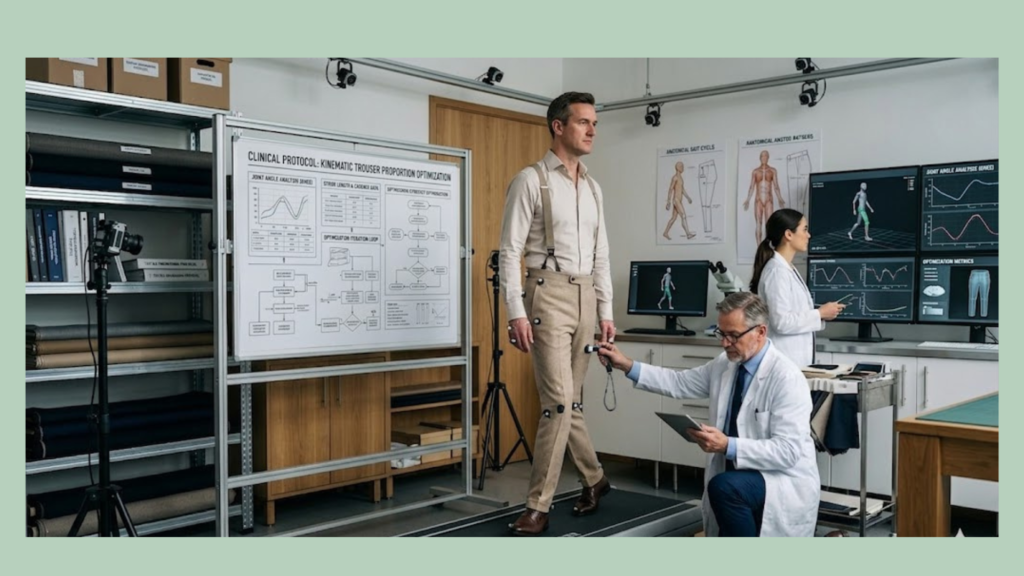
How To Execute A Strict Clinical Protocol For Kinematic Trouser Proportion Optimization
Executing a strict clinical protocol for kinematic trouser proportion optimization requires a rigorous biomechanical framework to isolate the Vamp-Break Intersect and establish Top-Half Neutrality. Trousers are the architectural foundation of human styling. Their structural “Rise” dictates your torso-to-leg ratio, their fabric drape dictates your kinematic freedom, and their terminal hem intersection dictates your footwear viability.
This guide equips analytical consumers with a mathematical decision matrix to calculate their Wardrobe Utility Coefficient (WUC), diagnose proportional failure points, and execute a permanent 3-Pillar Golden Ratio acquisition strategy. We must permanently transition away from acquiring trousers based solely on waist size and arbitrary color palettes, analyzing them instead as functional geometric tools that manipulate visual height, kinematic mobility, and physical thermodynamics.
You must first identify the presence of Wardrobe Dissonance. Wardrobe Dissonance is defined as the psychological and physical fatigue caused by maintaining a bloated inventory of trousers that artificially shorten the legs, restrict sagittal plane movement, or thermodynamically overheat the wearer.
The 4 Failure Points of Lower-Body Geometry
-
•
Low-Rise Leg-Shortening: Deploying trousers that terminate at the hips, creating an optical illusion that artificially compresses the legs and disproportionately elongates the torso.
-
•
Kinematic Binding: Utilizing high-GSM, rigid textiles in active environments, resulting in severe viscoelastic resistance that actively paralyzes 90-degree seated flexion.
-
•
The Vamp-Break Clash: Failing to synchronize the trouser hem width with the volumetric mass of the shoe, destroying the vertical line of the leg via catastrophic ankle bunching.
-
•
Thermal Trapping: Deploying heavyweight fabrics in high-ambient temperatures, triggering an immediate thermodynamic overload that renders the garment physically unwearable regardless of geometric perfection.
Why do spatial geometry and textile GSM dictate baseline kinematic trouser proportion optimization?
Spatial geometry and textile GSM dictate baseline kinematic trouser proportion optimization by transforming garments from arbitrary aesthetic choices into highly functional architectural tools that manipulate optical height.
Understand the geometric laws of the golden ratio torso-to-leg bisection
You must mathematically match the garment’s structural Rise to your natural pelvic equator to engineer the Golden Ratio. The architectural ‘Rise’ serves as the primary visual bisection point, mathematically dictating your perceived torso-to-leg ratio. Structural rises dictate torso-to-leg ratios with absolute authority.
The golden ratio (approximately 1:1.618) provides a universal aesthetic ideal for the human silhouette. Yet, empirical stereoradiography data proves only 40.5% of the male population naturally aligns with these proportions. The majority of men possess a structurally longer torso relative to their femur length. Therefore, the trouser rise must function as a mathematical corrective tool to physically shift the visual navel point upward. A high-rise mathematically elongates the lower hemisphere and compresses the torso into the optimal 1/3 upper, 2/3 lower ratio. Conversely, a low-rise elongates the torso, frequently resulting in a disproportionate, stubby kinematic silhouette that ruins structural authority.
Rule: You must mathematically match the garment’s structural Rise to your natural pelvic equator to engineer the Golden Ratio.
Reason: A high-rise mathematically elongates the lower hemisphere and compresses the torso, whereas a low-rise elongates the torso, frequently resulting in a disproportionate, stubby kinematic silhouette.
Example: Donning a low-rise trouser that terminates at the hips, creating an optical illusion where the wearer’s torso appears unusually long while their legs look artificially compressed and heavy.
Differentiate structural textile density from dynamic kinematic mobility constraints
You must geometrically balance the Grams per Square Meter (GSM) of a textile against its required kinematic flexibility. Textile density restricts kinematic flexibility by exerting viscoelastic resistance against sagittal plane movement.
Clinical data from the CDC establishes that undersized or highly rigid garments reduce mean Range of Motion (ROM) by up to 24% specifically during hip flexion. When you utilize heavy, high-GSM fabrics like 16oz raw denim or 400g military twill, the garment induces substantial kinematic loss. This causes a physiological “hobbling effect” that requires extra metabolic work output just to overcome the fabric’s mechanical resistance during basic ambulation. Heavy fabrics possess phenomenal architectural structure—they hold a sharp, unbroken vertical crease that commands authority—but they severely paralyze 90-degree seated flexion. Conversely, hyper-fluid textiles (like a 220g tropical wool) maximize mobility but risk collapsing under spatial stress, appearing wrinkled and unanchored. You must calculate the exact GSM required for the daily operational context to prevent kinematic binding.
Rule: You must geometrically balance the Grams per Square Meter (GSM) of a textile against its required kinematic flexibility.
Reason: Heavy, rigid fabrics possess phenomenal architectural structure (holding a sharp vertical crease) but severely restrict active kinematics (sitting/bending), whereas hyper-fluid textiles maximize mobility but risk collapsing under spatial stress.
Example: Attempting to execute a deep 90-degree seated flexion in 14oz raw denim, resulting in severe kinematic restriction and physical binding at the crotch vertex and posterior seat.
How do geometric vamp-breaks physically alter your kinematic trouser proportion optimization?
Geometric vamp-breaks physically alter your kinematic trouser proportion optimization by establishing a critical visual terminus that dictates the absolute harmony of the lower hemisphere. The intersection point is non-negotiable.
Deconstruct the visual mass of the terminal footwear intersection
Deconstructing the visual mass of the terminal footwear intersection prevents the catastrophic structural clash that ruins the vertical line of the leg. The terminal hem must execute a flawless spatial handshake with the anterior vamp of the footwear. Terminal hems execute spatial handshakes.
A flat leg opening width of 17 to 19 cm is mathematically recommended to create a clean seat on modern, low-profile loafers. If you engineer a leg opening narrower than 16 cm on an adult male calf, the fabric structurally binds to the gastrocnemius muscle during movement, physically sticking to the leg rather than draping vertically. Conversely, widths exceeding 21 cm paired with a slim loafer invite catastrophic puddling over the vamp. The terminal hem must possess a precise spatial relationship with the “Vamp” (the upper anterior surface) of the footwear. A volumetric mismatch creates an immediate structural clash that ruins the vertical line of the leg via ankle bunching.
Parameter: The Vamp-Break Geometric Handshake.
Mechanism: The terminal hem must possess a precise spatial relationship with the “Vamp” (the upper anterior surface) of the footwear. A volumetric mismatch creates an immediate structural clash that ruins the vertical line of the leg.
Execution: Mandate that wide-leg bifurcations are anchored exclusively by volumetric footwear to prevent “swallowing” the foot, while sharp tapers must terminate cleanly without buckling over chunky boots.
Analyze the thermodynamic bottleneck of heavy rigid textile profiles
Analyzing the thermodynamic bottleneck of heavy rigid textile profiles prevents the immediate physiological overload that renders structurally perfect garments unwearable. High-GSM textiles trigger thermodynamic overload when deployed outside their mathematical temperature window.
The thermal insulation (Clo value) of a garment reduces by 20% in a sitting position and by up to 50% during active movement due to forced convection. However, high-heat environments drastically reverse this equation, rapidly trapping metabolic heat within the heavy denim microclimate. The Perceptual Strain Index (PeSI) correctly or conservatively overestimates physiological strain 94.7% of the time in high-GSM barriers. This means that a perfectly tailored 16oz raw denim trouser deployed in 80°F weather immediately triggers a severe thermal penalty vector. The wearer physically overheats, rendering the geometric perfection of the garment entirely irrelevant as physiological panic sets in.
Parameter: The Thermal Penalty Vector.
Mechanism: High-GSM textiles (heavy corduroy, heavyweight denim) trap metabolic heat within the lower-body microclimate. If deployed in the wrong ambient temperature, they trigger an immediate Thermal Penalty, rendering the garment unwearable regardless of its geometric perfection.
Execution: Mathematically restrict all textiles exceeding 12oz GSM strictly to environments operating below 65°F to prevent thermodynamic overload.
Clinical Execution Disclaimer
The kinematic parameters, somatic proportioning algorithms, and thermodynamic limits detailed within this protocol are optimized for baseline anatomical statistical averages. Extreme kinematic variance, severe physiological asymmetry, or localized microclimates may necessitate deviations from this matrix. Do not execute permanent structural alterations (tailoring) to high-value assets without first utilizing the WUC Diagnostic Engine to mathematically validate your hem and ratio baselines.
How do you isolate biomechanical variables to test your kinematic trouser proportion optimization?
Isolating biomechanical variables to test your kinematic trouser proportion optimization requires strict tracking protocols to neutralize exogenous styling variables and collect uncorrupted spatial data.
Establish strict footwear baselines to neutralize intersection dissonance
Establishing strict footwear baselines neutralizes intersection dissonance by mathematically locking the terminal anchor point during the architectural audit. You must pair the test trouser exclusively with the primary shoe silhouette intended for long-term deployment. Footwear baselines neutralize intersection dissonance.
The fit of a trouser over a shoe is highly complicated by the deformation of the human foot at varying heel heights. Empirical studies demonstrate that the mean error between foot deformed models (FDM) and scanned models ranges from 2.61 mm for 40 mm heels to 3.42 mm for 70 mm heels. This spatial deformation mandates a completely locked footwear baseline during trouser evaluation. If you test a 19cm hem trouser with a low-profile loafer on Tuesday, and a chunky commando-sole boot on Wednesday, your visual data regarding the “trouser break” is fundamentally corrupted by the shifting volume beneath it.
Phase: The Footwear Baseline Control Protocol.
Action: Lock your footwear variable by pairing the test trouser exclusively with the primary shoe silhouette you intend to deploy it with long-term.
Outcome: You mathematically eradicate corrupted “Vamp-Break” data caused by testing a wide trouser with a slim loafer on Tuesday, and a chunky boot on Wednesday.
Execute the top-half neutrality protocol to expose absolute geometric rise
Executing the top-half neutrality protocol structurally prevents untucked shirting from obscuring the pelvic equator, exposing the absolute geometric rise. Top-half neutrality exposes geometric rise to accurate visual measurement.
Master pattern making relies on apportioning scales where the upper part of the human body equals exactly 1/2 of total kinematic height (a 1:1 bisection). However, precision in subjective rise calculation must incorporate normative pelvic parameters, such as the Anatomical Pelvic Tilt (aPT), which averages 13.2° but fluctuates dynamically with body weight and posture. To accurately evaluate if a trouser rise is successfully engineering the 1:3 Golden Ratio, the waistline must be fully visible. An untucked, oversized sweater completely obscures this critical intersection, rendering any analysis of torso-to-leg proportions structurally void.
Phase: The Golden Ratio Visibility Protocol.
Action: Strictly deploy a tucked-in, anatomically fitted upper-hemisphere garment during all testing phases to ensure the trouser waistband is entirely visible.
Outcome: You structurally prevent untucked shirting from obscuring the pelvic equator, allowing you to accurately audit the resulting torso-to-leg optical bisection.
The Interactive WUC Diagnostic Matrix
The 14-Day Architectural Audit Log
Input your daily metrics to isolate geometric and kinematic failures across your inventory. You have complete freedom to define your profile in the text box. Leave un-worn days blank. Click “Analyze Blueprint” to calculate your true retention strategy.
| Day | Geometric Profile | Prop. Conf [1-10] |
Kinematic [1-10] |
Vamp Pen [0-5] |
Therm Pen [0-5] |
WUC |
|---|
Your Architectural Synthesis
Generated Acquisition Hypothesis
How do you calculate your WUC score to validate kinematic trouser proportion optimization?
Calculating your Wardrobe Utility Coefficient (WUC) validates kinematic trouser proportion optimization by objectively scoring architectural utility and ruthlessly penalizing physical discomfort. WUC scores validate architectural utility.
Decode the temporal and penalty multipliers of the WUC formula
Decoding the temporal and penalty multipliers of the WUC formula reveals why manipulating visual height carries exponential weight compared to minor aesthetic flaws. Penalty multipliers expose structural failures by aggressively destroying the overall utility score of a garment.
Interface pressure on a limb area is positively correlated with fabric tension and negatively correlated with the radius of curvature, as defined by Laplace’s Law. A trouser rise that is perfectly comfortable while standing may exert excessive, localized pressure on the symphysis pubis during 90-degree sitting, where internal pelvic floor pressures are significantly elevated. This creates a severe Kinematic Penalty. The formula weights Proportional Confidence with a 1.5x multiplier because manipulating visual height is the primary architectural function of the garment. The penalties (Vamp-Break and Thermal) carry severe 2x negative multipliers because physical pain or severe optical clashing renders the garment a total failure, negating all visual benefits.
Formula: (Proportional Confidence × 1.5) + Kinematic Freedom – (Vamp-Break Penalty × 2) – (Thermal Penalty × 2) = Total WUC
Explanation: Proportional Confidence carries a 1.5x multiplier because manipulating visual height is the primary architectural function. Penalties carry severe 2x negative multipliers because physical pain (thermal/kinematic) renders the garment a total failure.
Establish structural significance using the mathematical baseline threshold
Establishing structural significance using the mathematical baseline threshold forces a ruthless categorization of your inventory into anchors and orphans. Baseline thresholds categorize inventory tiers to streamline morning cognitive load.
Integrated clothing comfort systems require stable physiological baselines (e.g., maintaining skin temperature at approximately 33°C) to achieve neutral comfort. Garments failing to meet these thermodynamic equilibrium scores or lacking strong affective proportional value must be ruthlessly categorized. A WUC of 20+ designates an “Architectural Anchor”—a flawless execution of geometry and thermodynamics. You must replicate this exact cut immediately in varying textiles. Any score below 10 designates a “Structural Orphan”—a garment actively harming your silhouette and inducing physical dissonance. You must purge structural orphans immediately to maintain a highly optimized rotational matrix.
Rule: Quantify the inventory into strict tiers using the calculated WUC score.
Execution: WUC 20+ designates an “Architectural Anchor” (replicate this cut immediately). Any score below 10 designates a “Structural Orphan” (actively harming your silhouette). Purge Orphans immediately.
How do you troubleshoot wardrobe dissonance to guarantee kinematic trouser proportion optimization?
Troubleshooting wardrobe dissonance guarantees kinematic trouser proportion optimization by providing exact optical and biomechanical failsafes to neutralize severe proportion errors. Biomechanical failsafes neutralize proportion errors before they enter public deployment.
Diagnose and resolve the low-rise leg-shortening optical illusion
Diagnosing and resolving the low-rise leg-shortening optical illusion requires immediate architectural intervention to elevate the pelvic equator. High-rise profiles elongate lower hemispheres by physically pulling the visual navel upward.
If your Proportional Confidence consistently registers below a 6 on all Low-Rise or Mid-Rise trousers, your natural somatic geometry requires a higher anchor. Individuals with a short femur relative to total leg length require higher-rise trousers to physically shift the visual navel point and approximate the 1.618 golden ratio. Furthermore, athletes with significantly lower waist-to-height ratios (e.g., a ratio of 0.428) require a much more aggressive waist-to-hip curvature in the pattern block. Failing to accommodate this requires low-rise belts that force excess fabric into the groin, violently interfering with hip extension kinematics. Cease the acquisition of fast-fashion low-rise cuts.
If: The Proportional Confidence score consistently registers below a 6 on all Low-Rise or Mid-Rise trousers within the audit matrix.
Do: Conclude that your natural somatic geometry possesses a longer torso and shorter legs, requiring immediate architectural intervention to manipulate the Golden Ratio.
Result: Cease the acquisition of all low-rise fast fashion. Permanently adopt a High-Rise, Straight-Cut profile to elevate the pelvic equator and artificially elongate the lower hemisphere.
Audit the vamp-break penalty to cure severe geometric footwear misalignment
Auditing the vamp-break penalty cures severe geometric footwear misalignment by executing an immediate tailor intervention to establish a flawless No-Break interface. Tailor interventions cure geometric misalignment by removing destructive fabric pooling.
The degree of “break” (the fold of fabric over the shoe) is mathematically influenced by the taper of the leg opening. Narrower openings constrict the fabric circumference, causing it to grab the calf and break much higher up the leg. A standard half-break displaces the hem exactly 1/2″ to 3/4″ downward into the shoe vamp. Aggressive tapers (e.g., 16 cm) on large waists (>33 inches) catastrophically throw off the visual balance of the entire silhouette, creating a “carrot” effect. If a high Vamp-Break Penalty (3+) is logged, you must recognize a fundamental mathematical failure in your standard inseam length.
If: A high Vamp-Break Penalty (3+) is consistently logged across multiple trousers, resulting in severe ankle bunching or structural clashing over the shoe.
Do: Recognize a fundamental mathematical failure in your standard inseam length or a complete volumetric mismatch between your preferred shoe and your trouser leg opening.
Result: Initiate an immediate tailor intervention. Execute a geometric hem crop to establish a “No-Break” interface, ensuring the trouser terminates with mathematical precision just above the footwear vamp.
The 3-Pillar Golden Ratio Deployment Checklist
Verify your final WUC analysis to execute a permanent 3-pillar acquisition strategy.
Frequently Asked Clinical Questions
Conclusion: Mastering the Spatial Architecture of the Lower Hemisphere
True kinematic optimization is not a function of arbitrary sizing, but a mastered discipline of spatial geometry and thermodynamic management. Leg-shortening illusions and thermodynamic overload are entirely preventable mathematical errors resolved strictly by auditing the Vamp-Break Intersect, establishing Top-Half Neutrality, and calculating the Wardrobe Utility Coefficient. Spatial geometry defines kinematic optimization.
By treating your trousers as functional architectural tools rather than subjective garments, you permanently eradicate wardrobe dissonance and guarantee a flawlessly proportioned, mathematically validated lower hemisphere.